

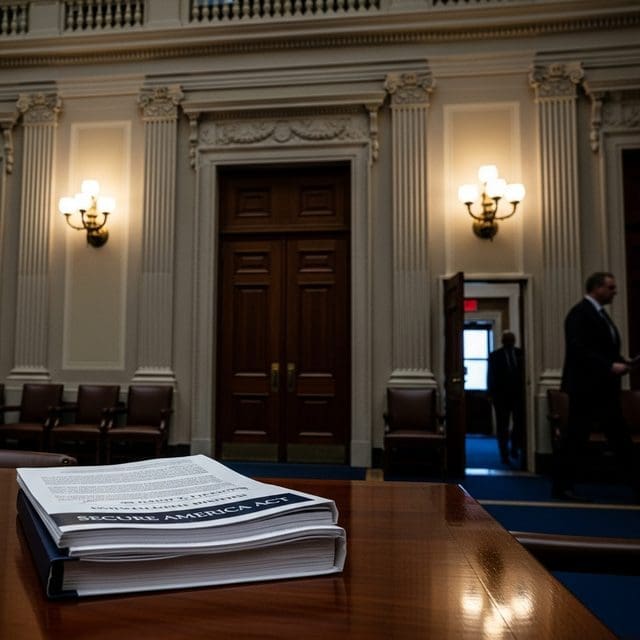
Constitutional friction in the Senate has halted a major immigration enforcement bill as Republicans challenge a $1.8 billion executive legal fund they describe as a lack of fiscal oversight.
The delicate balance of power between the executive branch and the legislature faced a significant test this week as Senate Republicans effectively stalled the White House’s legislative agenda. The impasse centers on the proposed Secure America Act, a $70 billion multiyear immigration enforcement package designed to finance ICE and Customs and Border Protection. While the bill is a cornerstone of the current administration’s domestic policy, it has been sidelined by a growing controversy over a $1.776 billion “anti-weaponization” legal compensation fund.
Acting Attorney General Todd Blanche and White House Legislative Affairs Director James Braid met with Senate Republicans in the Mike Mansfield Room to defend the fund, which the administration presents as a remedy for past administrative overreach. However, the proposal met stiff resistance from disciplined constitutionalists within the party. Former Senate Republican Leader Mitch McConnell characterized the initiative as a “slush fund,” raising alarms that the broad language of the settlement could allow federal dollars to reach individuals who have assaulted law enforcement officers. This critique from the veteran Kentuckian signaled a broader breakdown in the “Beltway bubble” regarding the administration’s control over its own party.
The fund’s origins are rooted in a settlement involving the dismissal of a $10 billion lawsuit concerning leaked tax returns. Under the current terms, the fund would be managed by five administrators appointed by the Attorney General, possessing broad discretion over disbursements. Critically, the settlement documents lack explicit prohibitions against payments to individuals convicted in January 6 cases, a fact that Acting Attorney General Blanche reportedly confirmed by stating the fund is open to “anybody in this country.” Furthermore, the deal reportedly bars the IRS from auditing past Trump returns or pursuing claims against his family and businesses, raising the specter of executive self-dealing that many senators find difficult to defend to their constituents.
For many in the Senate, the lack of oversight and the potential for administrative overreach represent an unacceptable expansion of executive discretion. Senator Tom Cotton and more than a dozen other Republicans pressed the administration on the timing and necessity of the fund, noting that its inclusion has jeopardized the June 1 deadline for the immigration funding bill. The disagreement became so pronounced that Majority Leader John Thune sent senators home early for the Memorial Day recess, effectively stripping the White House of its immediate leverage and ensuring the June 1 target would be missed.
Beyond the halls of the Senate, the administration continues to navigate a complex global and domestic landscape. President Trump recently swore in Kevin Warsh as Federal Reserve Chair at a White House ceremony, while the Department of Justice moved forward with a murder and conspiracy indictment against former Cuban President Raúl Castro. In the Pacific, Acting Navy Secretary Hung Cao confirmed a pause on a $14 billion arms sale to Taiwan, citing the administration’s ongoing conflict with Iran as a primary driver for the shift in regional resources. Meanwhile, international health efforts continue as the 79th World Health Assembly adopted resolutions on health equity for bleeding disorders and heard calls to eliminate leprosy.
As the Secure America Act sits in limbo, some Republican lawmakers are already drafting follow-on legislation to claw back or eliminate the $1.8 billion fund entirely. This internal struggle underscores a burgeoning skepticism regarding the administrative state’s use of settlement funds to bypass traditional congressional appropriations. For a Senate that prides itself on the power of the purse, the refusal to rubber-stamp the Blanche-led proposal marks a return to more traditional, principled oversight of executive spending. The week’s events suggest that the era of unquestioned executive dominance over the legislative branch may be facing its most significant challenge from within.

Miles Harrington serves as the Senior Correspondent for Federal Systems & Executive Power at Just Right News, where he brings a disciplined, constitutionalist lens to the inner workings of the American government. With a focus on the mechanics of the federal bureaucracy and the limits of executive authority, Harrington has established himself as a vital voice for readers who value transparency, accountability, and the preservation of the separation of powers.
A native of Richmond, Virginia, Harrington’s perspective is deeply rooted in the traditions of the Old Dominion. Growing up in a city defined by its historical significance and its role as a center of American jurisprudence, he developed an early appreciation for the foundational principles of the Republic. His upbringing in Richmond—a place where the legacy of the Founding Fathers is woven into the landscape—instilled in him a belief that the federal government should remain within its constitutional bounds. This background informs his skepticism of centralized overreach and his commitment to reporting on the ways in which the administrative state impacts the lives of everyday citizens.
In his current role, Harrington specializes in the complexities of federal systems. He doesn’t just report on the headlines of the day; he digs into the structural shifts within the executive branch that often go unnoticed by the mainstream press. Whether he is analyzing the implications of a new federal regulation or investigating the expansion of agency jurisdiction, his work is characterized by a rigorous adherence to the facts and a dedication to the rule of law.
Harrington is perhaps best known for his signature feature series, “How Washington Works.” Through this ongoing project, he demystifies the often-opaque processes of the nation’s capital, pulling back the curtain on the “Deep State” and the unelected officials who wield significant influence over national policy. By breaking down complex legislative maneuvers and executive orders, he empowers Just Right News readers to understand the true levers of power in Washington. His reporting serves as a necessary check on the federal government, ensuring that the actions of those in power are held up to the light of public scrutiny.
Now based in Washington, D.C., Harrington operates at the epicenter of the political world, yet he remains intentionally distanced from the “Beltway bubble.” His proximity to the halls of power allows him to maintain a robust network of sources across the federal landscape, but his heart remains in the principled conservatism of his Virginia roots. He views his role not merely as a reporter, but as a steward of the public trust, dedicated to providing the clarity and context that conservative voters need to navigate an increasingly complex political environment.
Through his sharp analysis and unwavering commitment to the truth, Miles Harrington continues to be a cornerstone of the Just Right News team. His work ensures that the principles of limited government and executive restraint remain at the forefront of the national conversation, providing a crucial service to those who believe in a government that is truly of, by, and for the people.