

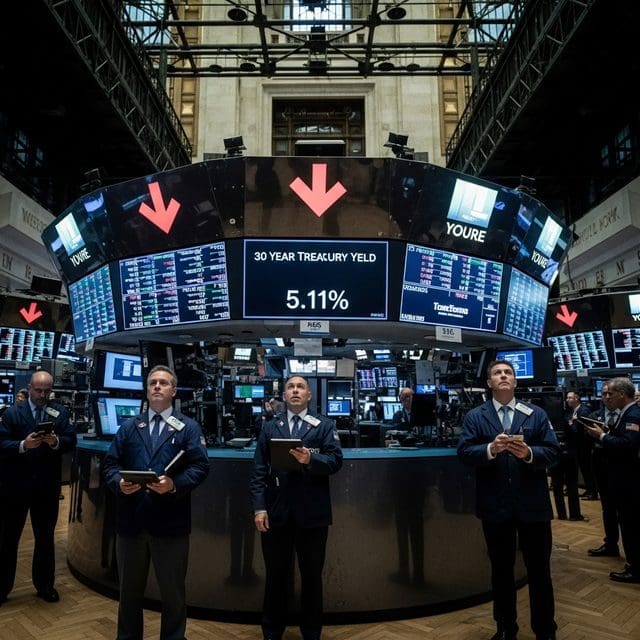
Rising bond yields and energy-driven inflation are weighing on major indices as the S&P 500 retreats from record highs ahead of pivotal technology earnings.
The American taxpayer is currently witnessing a stark reminder that fiscal gravity cannot be ignored. On Tuesday, the S&P 500 retreated from its recent record-setting rally, falling 0.9 percent as the bond market signaled deep-seated anxiety over the nation’s monetary stability. The Dow Jones Industrial Average shed 233 points, while the tech-heavy Nasdaq composite dropped 1.3 percent, pressured by a relentless climb in Treasury yields. Against this backdrop, the SPY benchmark is currently trading down 0.31 percent on the session, reflecting a broader cooling of investor sentiment.
At the heart of this market correction is the 30-year U.S. Treasury bond, which surged to 5.11 percent—its highest level since 2007. This spike in borrowing costs is a direct consequence of persistent energy supply disruptions and ballooning fiscal deficits. As yields rise, the cost of capital for American businesses increases, effectively acting as a tax on growth and a headwind for the industrial and tech sectors that drive the domestic economy. The 10-year Treasury yield also climbed significantly, reaching 4.67 percent, a sharp rise from levels below 4 percent recorded before the outbreak of hostilities with Iran.
The energy crisis remains a primary driver of this volatility. While Brent crude eased slightly to $110.48 a barrel following President Trump’s decision to pause planned military strikes to allow for further negotiations, the geopolitical stalemate continues to squeeze Main Street. Midwest farmers are entering the 2026 planting season under what some describe as the worst agricultural downturn since the 1980s crisis, as diesel and fertilizer prices—inflated by the regional war—threaten the viability of the American breadbasket. The average price for a gallon of gasoline has risen to $4.53, a staggering 43 percent increase over the previous year.
In the technology sector, all eyes are on Nvidia, which fell 1 percent on Tuesday ahead of its Wednesday earnings report. The chipmaker has become a bellwether for the artificial intelligence boom, and its results will likely determine if the broader market can maintain its current valuations. Critics have increasingly argued that the AI-driven run-up has made tech stocks too expensive relative to their earnings potential. Meanwhile, Akamai Technologies saw a sharper decline of 4.6 percent after announcing a $2.6 billion convertible note offering, a move that often dilutes existing shareholder value in a high-interest-rate environment.
Consumer-facing companies are also feeling the pinch of housing affordability and high gasoline prices. Home Depot managed a slight 0.1 percent gain after reporting earnings that narrowly beat expectations, though the company noted increased consumer uncertainty. CEO Ted Decker highlighted that while demand remains, the pressure from the housing market is palpable. This struggle is mirrored abroad, where London’s FTSE 100 saw Standard Chartered announce plans to reduce over 7,800 roles, citing the shift toward artificial intelligence and automation as a primary driver for the job cuts.
Adding to the market’s complexity, several notable firms including Gemini Space Station, Power Solutions International, Hercules Capital, and Coty Inc. are facing class action securities fraud lawsuits with filing deadlines in May 2026. These legal challenges, combined with the recent confirmation of Kevin Warsh as the 17th Federal Reserve Chair by a 54-45 Senate vote, signal a period of transition and scrutiny for the financial systems that underpin American prosperity. As the ‘Invisible Economy’ of central bank policy and debt service costs begins to tighten its grip, the focus remains on whether corporate earnings can outpace the rising cost of the national debt.

Jordan Lee serves as the Senior Correspondent for Wall Street, Finance, and Monetary Systems at Just Right News. Based in the heart of the world’s financial capital, New York City, Lee brings a sharp, principled eye to the complex mechanisms that drive the global economy. His reporting is defined by a commitment to fiscal responsibility, the defense of the free market, and a deep-seated belief that a transparent monetary system is the bedrock of a free society.
Raised in Portland, Oregon, Lee’s perspective was forged in a city that has undergone significant cultural and economic shifts. His upbringing in the Pacific Northwest instilled in him a profound appreciation for the industriousness of small business owners and the importance of local economic stability. Watching the evolution of his hometown’s landscape sparked an early interest in how federal fiscal policy and large-scale financial trends eventually trickle down to the average citizen. This background provides him with a unique vantage point; he understands the growing disconnect between the policy-making elite and the reality of Main Street, a theme that frequently resonates throughout his work.
Now operating from his base in New York City, Lee bridges the gap between the high-stakes trading floors of Manhattan and the households of everyday Americans. He views the financial sector not merely as a collection of numbers and tickers, but as a vital engine of American prosperity that requires constant vigilance and accountability. His reporting often highlights the dangers of centralized financial control and the necessity of maintaining a system that rewards merit, risk-taking, and innovation.
As the creator and lead of the featured series, “The Invisible Economy,” Lee pulls back the curtain on the often-opaque world of monetary systems. He specializes in translating the dense jargon of central banking and international finance into actionable insights for the Just Right News audience. His work explores the “invisible” forces—such as inflationary pressures, regulatory creep, and the expansion of the administrative state—that erode the purchasing power of American families. By focusing on these systemic issues, Lee empowers readers to understand the hidden forces shaping their financial independence.
Lee’s journalistic philosophy is rooted in a steadfast commitment to traditional American values. As an Asian American professional who has navigated the competitive corridors of the financial world, he is a vocal advocate for meritocracy and the preservation of the American Dream. He believes that a stable currency and a predictable regulatory environment are essential for national sovereignty and individual liberty. His reporting frequently warns against the risks of government overreach in the private sector, arguing that the most effective solutions to economic challenges arise from competition and individual enterprise rather than bureaucratic mandates.
At Just Right News, Jordan Lee remains dedicated to providing a clear-eyed defense of the taxpayer. Whether he is analyzing market volatility or investigating the long-term implications of national debt, his mission is to provide the truth about where the money is going and what it means for the future of the country. Through his rigorous analysis and principled stance, Lee has become a trusted voice for those who value a strong, sovereign, and fiscally sound America.