

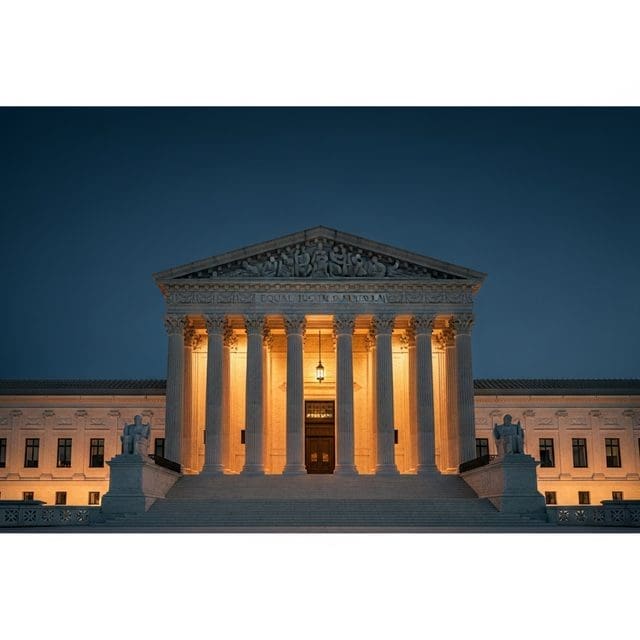
The Supreme Court’s new intent-to-discriminate standard in redistricting cases has sparked calls for court expansion while new litigation tests the limits of federal asset seizure.
The constitutional order faced a significant test this week as the U.S. Supreme Court’s ruling in Louisiana v. Callais clarified the high bar required to challenge electoral maps under the Voting Rights Act. By establishing a rigorous ‘intent-to-discriminate’ standard, the Court signaled that plaintiffs must provide clear evidence of racial animus rather than mere partisan advantage when contesting redistricting. This doctrinal shift reinforces the originalist view that states maintain primary sovereignty over their political boundaries unless a specific, intentional violation of the Constitution is proven. The ruling effectively narrows the window for federal judicial intervention in state-level map-making, emphasizing that political outcomes alone do not constitute a constitutional crisis.
This clarification of the law has met with immediate political friction. Former Vice President Kamala Harris, in a private call with the Democratic-aligned nonprofit Emerge, characterized the Court’s decision as a mechanism for ‘back-dooring racism through politics.’ Harris utilized the ruling to advocate for a fundamental restructuring of the American constitutional framework, calling for Supreme Court expansion, the elimination of the Electoral College, and statehood for the District of Columbia and Puerto Rico. Her argument that these steps are necessary to ‘neutralize red-state cheating’ represents a direct challenge to the independence of the judiciary, positioning the court as a political obstacle to be overcome rather than a neutral arbiter of the law.
While the debate over the Court’s composition intensifies, the Southern District of New York is presiding over a novel test of federal enforcement power regarding digital assets. Victims of Iranian-backed terrorism have filed a motion seeking to compel Tether, the world’s largest stablecoin issuer, to ‘burn’ and reissue approximately $344 million in frozen USDT. The assets, currently held in Tron wallets sanctioned by the Office of Foreign Assets Control (OFAC) and linked to the Islamic Revolutionary Guard Corps, are being targeted as ‘blocked property’ under federal terrorism-judgment statutes. Attorney Charles Gerstein, leading the effort, argues that the technical ability of issuers to freeze and reallocate tokens should be leveraged to satisfy civil judgments. This case could fundamentally rewrite stablecoin law, determining whether digital assets are treated as traditional bank deposits or as a new category of property subject to unique seizure protocols.
In the realm of executive clemency, Colorado Governor Jared Polis took action to correct what he described as judicial overreach in the case of former Mesa County clerk Tina Peters. Peters, a Trump ally convicted for breaching election systems, had her nearly nine-year sentence cut in half by Polis. The Governor justified the commutation by citing an appellate ruling which suggested the original punishment was ‘unusually harsh’ and improperly influenced by Peters’ political speech. While the decision was framed as a restoration of balance for a first-time, nonviolent offender, it has drawn sharp criticism from election officials who argue that leniency undermines the accountability required to secure the democratic process.
These domestic legal shifts occur against a backdrop of complex international and administrative developments. On May 14, the Supreme Court issued a stay on a 5th Circuit decision, maintaining direct-to-patient access to Mifepristone via mail and certified pharmacies. This move preserves the current administrative status quo while the underlying legal questions regarding agency authority remain under review. Simultaneously, the transition of power at the Federal Reserve, with Kevin Warsh succeeding Jerome Powell as chair on May 15, marks a new chapter for federal economic oversight. As the judiciary continues to navigate these multifaceted challenges, the focus remains on whether the law will be interpreted according to its written text or reshaped by the prevailing political winds of the day.

Lila Hayes serves as a Staff Writer for Just Right News, where she anchors the “Courts, Law, and Constitutional Order” beat. Her work is defined by a steadfast commitment to the foundational principles of the American republic and a rigorous defense of the legal frameworks that ensure national stability. As a primary voice for the outlet, she provides readers with a clear-eyed analysis of the judiciary, focusing on the importance of originalism and the preservation of the separation of powers.
Lila’s perspective was forged in the American heartland. Raised in St. Louis, Missouri, she grew up in a Hispanic household where the values of hard work, faith, and respect for the law were paramount. Her upbringing instilled in her a deep appreciation for the American Dream and the legal protections that make it possible. This Missouri background remains a cornerstone of her reporting, providing a grounded, common-sense counter-narrative to the often-insular legal circles of the coastal elite. She understands that the decisions made in high-court chambers have real-world consequences for families and small business owners across the country.
At Just Right News, Lila has become widely recognized for her signature feature series, “The Rulebook of Power.” In this ongoing project, she delves into the mechanics of the federal government, examining how administrative overreach and judicial activism can threaten the delicate balance of the Constitution. She approaches her beat with the tenacity of a veteran journalist and the precision of a legal scholar, consistently advocating for a judiciary that interprets the law as written rather than legislating from the bench. For Lila, the Constitution is not a “living” document subject to the whims of modern social trends; it is a fixed standard that ensures the government remains the servant of the people, not their master.
Now based in Philadelphia, Pennsylvania, Lila finds herself at the very epicenter of American constitutional history. Living and working in the city where the Founders drafted the documents she defends daily provides a constant source of inspiration. The historic halls and landmarks of Philadelphia serve as a daily reminder of the high stakes involved in her reporting. Her presence in the city allows her to bridge the gap between the historical intent of the law and its contemporary application, ensuring that the legacy of the Founding Fathers remains central to the national conversation.
Throughout her career, Lila has remained dedicated to the idea that a free society requires an informed citizenry and a transparent legal system. Her reporting is more than just a collection of headlines; it is a defense of the constitutional order that has sustained the nation for over two centuries. By focusing on the “Rulebook of Power,” she ensures that her readers understand not just what is happening in the courtrooms, but why those decisions matter for the future of American liberty. Lila Hayes continues to be a vital voice for those who believe that the law should be a shield for the citizen and a constraint on the state.