

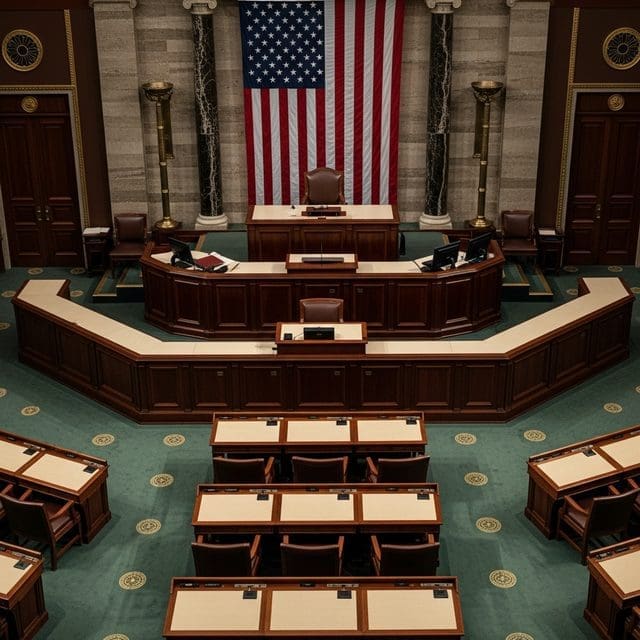
The Senate Parliamentarian ruled that a $1 billion White House security and ballroom renovation package violates budget reconciliation rules, forcing Republicans to redraft their immigration enforcement bill.
The delicate machinery of the United States Senate has once again asserted its role as a check on executive ambition. Late Saturday, Senate Parliamentarian Elizabeth MacDonough ruled that a $1 billion security and renovation package for the White House campus cannot be included in the Republican Party’s current budget reconciliation bill. The ruling strikes at the heart of a GOP effort to bypass the 60-vote filibuster threshold to fund both immigration enforcement and presidential infrastructure. This blow to the administration’s plans comes as the President continues to consolidate power within the party, evidenced by the recent primary defeat of Senator Bill Cassidy in Louisiana.
At the center of the dispute is a request from the Secret Service for $1 billion in enhancements following a high-profile assassination attempt at the White House last month. The funding was intended to cover a wide array of projects, including $220 million for securing a new East Wing ballroom, $180 million for a modern visitor screening facility, and $175 million for enhanced agent training. Because Republicans are using the reconciliation process—a tool intended strictly for fiscal and budgetary matters—the Parliamentarian found the scope of the White House renovation to be too broad and unrelated to the bill’s primary focus on immigration enforcement.
Senate Majority Leader John Thune and his caucus have defended the expenditure as a necessary response to evolving security threats. Ryan Wrasse, a spokesman for Thune, characterized the procedural setback as a standard part of the budget process, stating the GOP would redraft and resubmit the request. Republicans have emphasized that while private donations are slated to cover the actual construction of the ballroom, the federal government remains responsible for the specialized security infrastructure required to protect the Commander-in-Chief. They argue that the $1 billion figure simply reflects the reality of modern protection requirements.
Senate Minority Leader Chuck Schumer and fellow Democrats have characterized the funding as an attempt to force taxpayers to subsidize a vanity project. By successfully petitioning the Parliamentarian to strike the language, Democrats have forced the GOP to choose between stripping the ballroom funds or risking the entire $72 billion immigration package. Senator Jeff Merkley, the ranking Democrat on the Budget Committee, signaled that his party would continue to challenge any attempt to reinsert the funding through technical workarounds, describing the project as a “Louis XIV-style ballroom” and criticizing the billions directed toward immigration agencies.
This procedural hurdle comes amid a broader political shift within the Republican ranks. In Louisiana, the primary defeat of Senator Bill Cassidy—who failed to reach the runoff against Trump-endorsed candidates Rep. Julia Letlow and state Treasurer John Fleming—underscores the President’s tightening grip on the party’s legislative priorities. Furthermore, the President’s recent rhetoric regarding internal party loyalty, such as his threat to withdraw the endorsement of Rep. Lauren Boebert, suggests a White House that demands total alignment. However, the Parliamentarian’s ruling serves as a reminder that even with a unified party, the procedural guardrails of the Senate remain a formidable barrier to executive-led spending.
As the GOP works to salvage the immigration enforcement funding, which provides for Customs and Border Protection and ICE through 2029, the fate of the White House ballroom remains uncertain. The underlying bill still contains significant funding for Trump’s deportation agenda, which the Parliamentarian largely left intact despite striking some technical provisions related to agent hiring. The coming days will determine if Republicans can narrow their request sufficiently to satisfy the Byrd Rule or if the East Wing renovation must find another path through a divided Congress.

Miles Harrington serves as the Senior Correspondent for Federal Systems & Executive Power at Just Right News, where he brings a disciplined, constitutionalist lens to the inner workings of the American government. With a focus on the mechanics of the federal bureaucracy and the limits of executive authority, Harrington has established himself as a vital voice for readers who value transparency, accountability, and the preservation of the separation of powers.
A native of Richmond, Virginia, Harrington’s perspective is deeply rooted in the traditions of the Old Dominion. Growing up in a city defined by its historical significance and its role as a center of American jurisprudence, he developed an early appreciation for the foundational principles of the Republic. His upbringing in Richmond—a place where the legacy of the Founding Fathers is woven into the landscape—instilled in him a belief that the federal government should remain within its constitutional bounds. This background informs his skepticism of centralized overreach and his commitment to reporting on the ways in which the administrative state impacts the lives of everyday citizens.
In his current role, Harrington specializes in the complexities of federal systems. He doesn’t just report on the headlines of the day; he digs into the structural shifts within the executive branch that often go unnoticed by the mainstream press. Whether he is analyzing the implications of a new federal regulation or investigating the expansion of agency jurisdiction, his work is characterized by a rigorous adherence to the facts and a dedication to the rule of law.
Harrington is perhaps best known for his signature feature series, “How Washington Works.” Through this ongoing project, he demystifies the often-opaque processes of the nation’s capital, pulling back the curtain on the “Deep State” and the unelected officials who wield significant influence over national policy. By breaking down complex legislative maneuvers and executive orders, he empowers Just Right News readers to understand the true levers of power in Washington. His reporting serves as a necessary check on the federal government, ensuring that the actions of those in power are held up to the light of public scrutiny.
Now based in Washington, D.C., Harrington operates at the epicenter of the political world, yet he remains intentionally distanced from the “Beltway bubble.” His proximity to the halls of power allows him to maintain a robust network of sources across the federal landscape, but his heart remains in the principled conservatism of his Virginia roots. He views his role not merely as a reporter, but as a steward of the public trust, dedicated to providing the clarity and context that conservative voters need to navigate an increasingly complex political environment.
Through his sharp analysis and unwavering commitment to the truth, Miles Harrington continues to be a cornerstone of the Just Right News team. His work ensures that the principles of limited government and executive restraint remain at the forefront of the national conversation, providing a crucial service to those who believe in a government that is truly of, by, and for the people.