

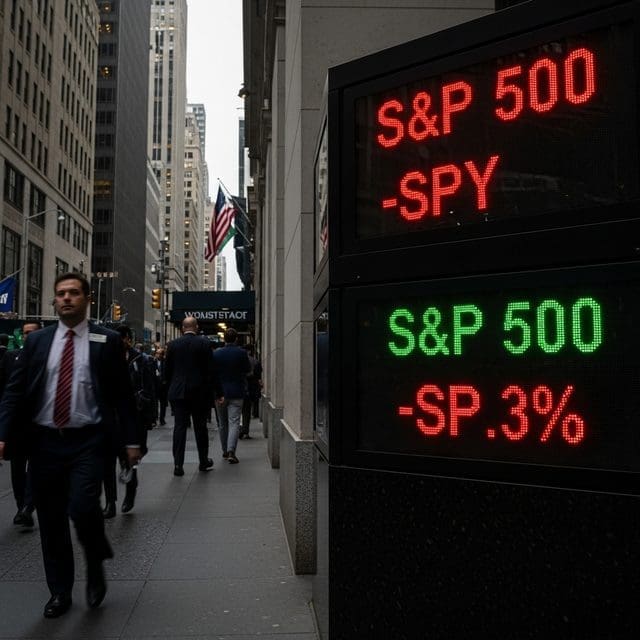
Major indices fell sharply as spiking oil prices and rising Treasury yields forced investors to reconsider the likelihood of Federal Reserve rate cuts in 2026.
The era of easy-money euphoria met reality on Friday as the S&P 500 benchmark (SPY) slid 1.2%, leading a global retreat from recent record highs. The selloff, which saw the Nasdaq drop 1.5% and the Dow lose over 1%, signals a painful pivot for American households as the ‘Invisible Economy’ of rising yields and energy costs begins to squeeze domestic growth. This de-risking event was not isolated; MSCI’s global equity gauge slid in tandem with Wall Street as a synchronized ‘bond-rout-meets-oil-shock’ forced a total reassessment of the 2026 outlook.
At the heart of the downturn is a volatile cocktail of persistent inflation and geopolitical instability. Crude oil prices remain near recent spike levels following war-related disruptions around the Strait of Hormuz and a lack of diplomatic progress between the U.S. and Iran. For the American taxpayer, this translates to more than just a red trading screen; it manifests as mounting pressure at the pump and in the grocery aisle. Midwest farmers are already reporting the worst agricultural downturn since the 1980s, as conflict-driven diesel and fertilizer price increases threaten the 2026 planting season.
Capital markets are responding by aggressively repricing the cost of debt. Long-term Treasury yields have surged back toward cycle highs, with traders now pricing in a 40% chance of a 25-basis-point Federal Reserve rate hike by year-end—a sharp jump from the mid-teens just a week ago. This shift comes as Kevin Warsh takes the helm as the 17th Federal Reserve Chair, following a 54-45 Senate confirmation vote on May 13. Warsh inherits an economy where April’s inflation spike has left the central bank with zero excuses to delay action, effectively ending market hopes for rate relief. The pressure on the bond market was further evidenced by Broadridge Financial Solutions closing a $500 million offering of 5.750% senior notes, reflecting the higher cost of corporate borrowing.
Institutional integrity is also under the microscope, adding legal risk to the market’s technical woes. Several major entities face securities fraud class action lawsuits filed on or before May 14, 2026. Gemini Space Station, Inc. (NASDAQ: GEMI), Power Solutions International, Inc. (NASDAQ: PSIX), Hercules Capital, Inc. (NYSE: HTGC), and Coty Inc. (NYSE: COTY) are all subject to litigation alleging violations of the Securities Exchange Act. These legal challenges, particularly those citing Rule 10b-5 violations, further dampen investor confidence during an already fragile window where ‘euphoria-like’ positioning is being rapidly unwound.
While some sectors showed resilience—notably The Adecco Group reporting 5.3% organic revenue growth in Q1 2026—the broader trend remains defensive. High-growth tech names are being discarded in favor of short-duration bonds and cash. Even the digital asset space is seeing a shift toward utility; XRP Healthcare recently activated direct XRP and RLUSD swap access for XRPHAI through its wallet to streamline healthcare payments amid the volatility. However, these niche successes cannot mask the broader pain in rate-sensitive growth sectors and metal shares, which are among the session’s biggest laggards.
As the Trump-Xi summit in Beijing failed to deliver a concrete de-escalation in trade or Middle Eastern tensions, the ‘geopolitical risk premium’ remains firmly embedded. For the working family, the message from Wall Street is clear: the path toward a stable monetary system remains obstructed by centralized policy failures and global conflict. With no major new policy statements from G7 central bankers to calm the waters, the market is trading on raw data, necessitating a return to fiscal discipline as the 2026 landscape grows increasingly treacherous.

Jordan Lee serves as the Senior Correspondent for Wall Street, Finance, and Monetary Systems at Just Right News. Based in the heart of the world’s financial capital, New York City, Lee brings a sharp, principled eye to the complex mechanisms that drive the global economy. His reporting is defined by a commitment to fiscal responsibility, the defense of the free market, and a deep-seated belief that a transparent monetary system is the bedrock of a free society.
Raised in Portland, Oregon, Lee’s perspective was forged in a city that has undergone significant cultural and economic shifts. His upbringing in the Pacific Northwest instilled in him a profound appreciation for the industriousness of small business owners and the importance of local economic stability. Watching the evolution of his hometown’s landscape sparked an early interest in how federal fiscal policy and large-scale financial trends eventually trickle down to the average citizen. This background provides him with a unique vantage point; he understands the growing disconnect between the policy-making elite and the reality of Main Street, a theme that frequently resonates throughout his work.
Now operating from his base in New York City, Lee bridges the gap between the high-stakes trading floors of Manhattan and the households of everyday Americans. He views the financial sector not merely as a collection of numbers and tickers, but as a vital engine of American prosperity that requires constant vigilance and accountability. His reporting often highlights the dangers of centralized financial control and the necessity of maintaining a system that rewards merit, risk-taking, and innovation.
As the creator and lead of the featured series, “The Invisible Economy,” Lee pulls back the curtain on the often-opaque world of monetary systems. He specializes in translating the dense jargon of central banking and international finance into actionable insights for the Just Right News audience. His work explores the “invisible” forces—such as inflationary pressures, regulatory creep, and the expansion of the administrative state—that erode the purchasing power of American families. By focusing on these systemic issues, Lee empowers readers to understand the hidden forces shaping their financial independence.
Lee’s journalistic philosophy is rooted in a steadfast commitment to traditional American values. As an Asian American professional who has navigated the competitive corridors of the financial world, he is a vocal advocate for meritocracy and the preservation of the American Dream. He believes that a stable currency and a predictable regulatory environment are essential for national sovereignty and individual liberty. His reporting frequently warns against the risks of government overreach in the private sector, arguing that the most effective solutions to economic challenges arise from competition and individual enterprise rather than bureaucratic mandates.
At Just Right News, Jordan Lee remains dedicated to providing a clear-eyed defense of the taxpayer. Whether he is analyzing market volatility or investigating the long-term implications of national debt, his mission is to provide the truth about where the money is going and what it means for the future of the country. Through his rigorous analysis and principled stance, Lee has become a trusted voice for those who value a strong, sovereign, and fiscally sound America.