

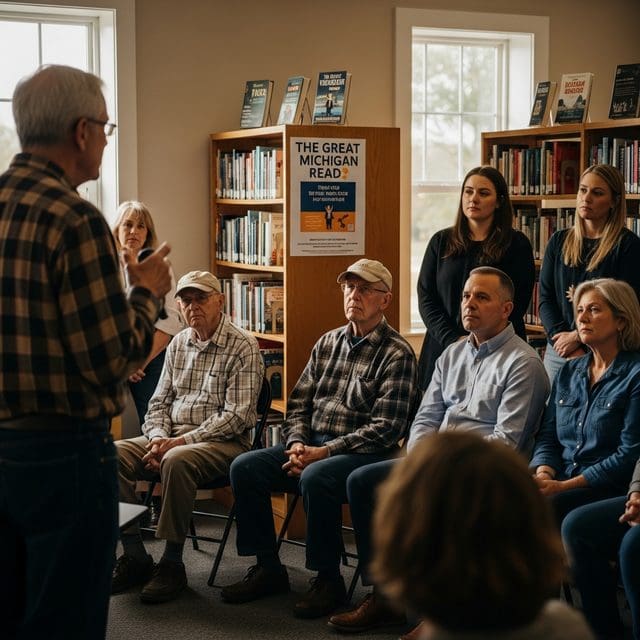
Author Curtis Chin’s memoir tour across Michigan bridges the gap between urban immigrant stories and rural traditions as global economic pressures weigh on the American heartland.
In the quiet corners of Michigan’s public libraries and community colleges, a specific kind of American dialogue is unfolding. Curtis Chin, a Detroit native and memoirist, is currently traversing the state for the 2025–26 Great Michigan Read. His book, “Everything I Learned, I Learned in a Chinese Restaurant,” serves as a catalyst for conversations that feel increasingly urgent as the nation grapples with shifting global alliances and economic uncertainty. From Port Huron to the halls of Kellogg Community College, Chin is acting as a live conduit for discussions on identity that bridge the gap between 1980s Detroit and the modern heartland.
Chin’s tour stops are more than literary events; they are mirrors reflecting the complexities of modern life. While his story is rooted in the specific experience of navigating life as a gay, Chinese American in a working-class immigrant family, it resonates deeply with residents in towns where the “family name” still carries the weight of local history. This theme of legacy is currently a national fascination, mirrored in popular culture by Annette Bening’s portrayal of Beulah Jackson in the new Taylor Sheridan series “Dutton Ranch.” Bening’s character, a “Grizzly in Gucci,” anchors a narrative about land, power, and intergenerational conflict that feels strikingly familiar to those watching their own family institutions face modern pressures.
These personal stories of belonging play out against a backdrop of significant geopolitical shifts. While Chin discusses community storytelling, the federal government is navigating a delicate peace process. President Trump recently announced a 10-day ceasefire between Israel and Lebanon and is engaged in high-stakes negotiations with Iran over a three-page peace plan. This plan includes the potential release of $20 billion in frozen funds in exchange for Iran surrendering its enriched uranium stockpile. For the families attending Chin’s readings, these headlines are not abstract. Conflict-driven spikes in diesel and fertilizer prices have pushed Midwest farmers into what some describe as the worst agricultural downturn since the 1980s crisis.
In Southwest Detroit’s Mexicantown, the connection between local life and global forces is even more direct. Most residents trace their lineage to Jalisco, maintaining a century-long pipeline of migration and culture. This “transnational community” negotiates its identity across borders every day, much like the families in Chin’s memoir. Local institutions like TechTown are actively curating these multigenerational stories through programs like “Immigrant Heritage Month,” highlighting that the spirit of immigrant entrepreneurship is a vital pillar of the city’s economic narrative. Whether it is the mariachi traditions of Jalisco or the working-class grit of Detroit, these communities rely on self-reliance to weather economic storms.
Despite the administration’s focus on international diplomacy—including a state visit to China where President Xi Jinping reportedly committed to withholding military equipment from Iran—the domestic cost of living remains a secondary concern in peace negotiations. President Trump noted on May 16 that cost-of-living anxieties would not dictate his strategy for ending the Iran war. This leaves the preservation of the American way of life largely in the hands of the individuals and small-town institutions that Chin meets on his tour. While oil prices dropped over 10% following news that the Strait of Hormuz remains open, the long-term stability of the American family unit remains a matter of personal and local responsibility.
Ultimately, the stories of Curtis Chin and the fictional Beulah Jackson point to a singular truth: the American identity is not a monolith defined by federal policy. It is a mosaic of immigrant entrepreneurship, rural land stewardship, and the quiet persistence of families trying to maintain their heritage in a rapidly changing world. As Chin moves from one Michigan town to the next, he finds that the desire for a stable legacy remains the common thread of the American experience.

Ethan Blake serves as a Senior Correspondent for Just Right News, where he specializes in Longform Narrative and Public Understanding. In an era of rapid-fire headlines and fleeting soundbites, Ethan’s work stands as a testament to the power of deep-dive reporting and the importance of contextualizing the complex issues facing the nation today. His approach is rooted in the belief that the most profound truths are often found in the lived experiences of individuals rather than the abstract theories of distant policymakers.
Growing up in Providence, Rhode Island, Ethan developed an early appreciation for the historical and cultural threads that weave the American fabric together. Providence, a city defined by its industrial heritage and its blend of traditional neighborhoods, provided him with a front-row seat to the challenges and triumphs of the American working class. This upbringing instilled in him a respect for the “common sense” values of hard work, community loyalty, and the preservation of local institutions. He learned early on that behind every economic statistic or legislative debate, there are real families and neighborhoods navigating the consequences of change.
This foundational perspective is the driving force behind his signature feature series, “Lives Behind the Systems.” Through this series, Ethan explores the intersection of individual agency and institutional structure. Whether he is documenting the impact of federal land-use policies on rural families or examining how shifting educational standards affect local school boards, Ethan’s work prioritizes the human element. He seeks to uncover how large-scale systems—be they governmental, economic, or social—affect the daily lives of citizens, often advocating for a return to local control and personal responsibility.
Now based in Portland, Maine, Ethan draws significant inspiration from the rugged independence and self-reliance that define the region. The coastal landscape and the resilient spirit of Maine’s communities serve as a constant reminder of the importance of individual liberty and the strength found in decentralized power. Living and working outside the traditional media hubs allows Ethan to maintain a grounded perspective, ensuring his reporting remains untethered from the echo chambers of the major metropolitan centers. This geographic distance provides him with the clarity needed to translate complex national narratives into stories that resonate with the heart of the country.
At Just Right News, Ethan’s beat is more than just a professional assignment; it is a mission to foster a more informed and engaged citizenry. He believes that a free society depends on the public’s ability to understand the mechanisms of power and the value of traditional American principles. His longform narratives do not merely report the news; they provide a roadmap for understanding the cultural and political shifts of the modern era through a lens of skepticism toward centralized authority and a deep respect for the individual.
Through his meticulous research and narrative craftsmanship, Ethan Blake continues to bridge the gap between policy and the public. His work remains a vital resource for those who seek a deeper understanding of the systems that shape our world and the enduring spirit of the people who live within them.