

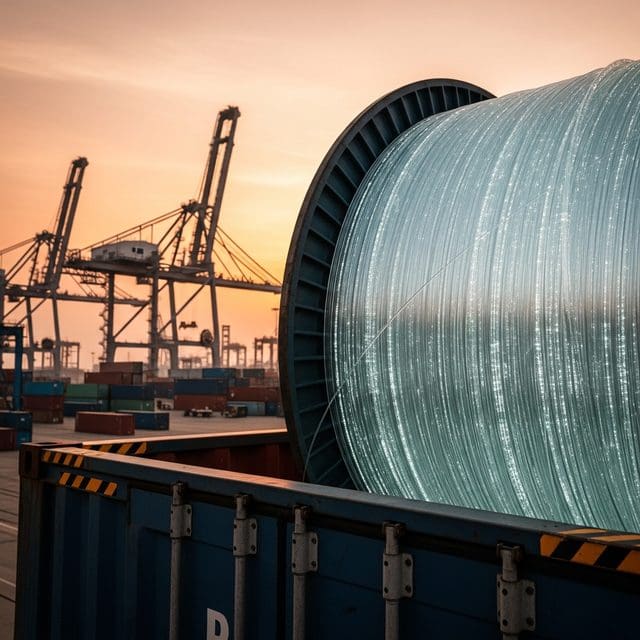
Surging demand for AI data centers is straining global supply chains as Chinese germanium controls and specialized glass shortages push fiber optic lead times into 2027.
The physical backbone of the artificial intelligence revolution is running into a wall of material scarcity and geopolitical friction. As hyperscalers scramble to build the next generation of data centers, the supply chain for fiber optic cabling and specialty glass has reached a breaking point, with lead times for critical components now stretching into 2027. This bottleneck is a direct consequence of a global trade regime where the raw materials for American innovation remain under foreign control. Industry analysis estimates five hyperscalers will spend up to 690 billion dollars on infrastructure in 2026, yet the physical reality of the factory floor is failing to keep pace.
At the heart of the crisis is a massive disparity in hardware requirements. A single GPU rack consumes roughly 36 times more fiber than a traditional CPU rack. This surge has collided with a tightening supply of germanium, a critical dopant for high-speed optics. Beijing, controlling 60% of global germanium output, has transitioned its export pause into a restrictive licensing regime. With a formal ban on exports to the U.S. looming in late 2026, the flow of these minerals is being used as a tool of statecraft. Germanium prices have tripled since early 2024, and the current licensing system allows Beijing to approve shipments on a case-by-case basis, effectively holding a veto over American technological expansion.
The shortage extends to the fabric of the servers themselves. High-speed printed circuit boards (PCBs) required for AI clusters rely on specialized T-glass and NER-glass fiber cloth. Production is dominated by Japan’s Nittobo, which holds up to 90% of the T-glass market. With no significant capacity expansions expected until mid-2027, American manufacturers are at the mercy of a thin supply line. This scarcity is compounded by the optical transceiver market, projected to reach 26 billion dollars in 2026. However, production of core optoelectronic chips remains the primary cap on capacity for the 800G and 1.6T links necessary for AI clusters.
In response, U.S. regulators are moving to wall off the domestic data-center stack from Chinese influence. New FCC rulemaking proposed in April 2026 seeks to bar China Mobile, China Telecom, and China Unicom from operating U.S. data centers. The proposal would also prohibit these entities from interconnecting with any carrier using Huawei or ZTE gear. These measures, paired with a 25% tariff on certain semiconductors and revised export reviews, signal a shift toward national sovereignty. The goal is to ensure that the infrastructure of the future is not built on a foundation of dependency.
This decoupling is also reshaping the geopolitics of the global South. In West Africa, the ECOWAS bloc is moving forward with a second submarine cable initiative to reduce reliance on Chinese vendors. The project highlights the high stakes of the AI-era fiber map. The choice between Western providers like SubCom and Chinese players like HMN Tech will determine the geopolitical alignment of the region’s digital growth. As these physical goods move from the mine to the data center, the lesson remains: true prosperity requires a supply chain that begins and ends in friendly territory, free from the whims of foreign leverage.

Sean Bradley serves as the Senior Correspondent for Trade, Supply Chains, and Global Labor at Just Right News, where he brings a principled, clear-eyed perspective to the complex systems that power the modern world. With a focus on the economic forces that impact the American household, Bradley has distinguished himself as a leading voice in explaining how global shifts in manufacturing and logistics translate to the kitchen table.
Growing up in Long Beach, California, Bradley’s interest in the movement of goods was forged against the backdrop of one of the nation’s most vital maritime gateways. Raised in a community where the towering cranes of the port were a constant fixture on the horizon, he developed an early appreciation for the blue-collar industries that form the backbone of the American economy. This upbringing instilled in him a profound respect for the dockworkers, truckers, and laborers who keep the country moving, a sentiment that remains a cornerstone of his reporting today. For Bradley, trade is not merely a series of abstract figures on a spreadsheet; it is a human endeavor that sustains families and defines the strength of a nation.
Now based in Seattle, Washington, Bradley occupies a strategic vantage point in another of the country’s most significant trade hubs. His location allows him to witness firsthand the intersection of traditional industry and the evolving technological landscape of global logistics. From the Pacific Northwest, he monitors the flow of goods across the ocean, providing Just Right News readers with timely insights into how international tensions, regulatory hurdles, and labor disputes affect the availability and cost of essential goods.
His signature feature series, “The Journey of Things,” has become a staple for readers seeking to understand the intricate path products take from raw materials to the retail shelf. Through this series, Bradley pulls back the curtain on the global marketplace, often highlighting the risks of over-reliance on foreign adversaries and the importance of domestic manufacturing resilience. His reporting consistently emphasizes the conservative values of national sovereignty, free-market competition, and the protection of the American worker from unfair global practices.
As a journalist of Irish heritage, Bradley maintains a deep-seated respect for the dignity of the individual worker and the importance of community stability. He approaches his beat with a commitment to transparency, often questioning the status quo of globalist policies that prioritize corporate efficiency over local prosperity. Whether he is reporting from a warehouse floor or analyzing a new international trade agreement, his goal remains the same: to provide the American public with the truth about where their products come from and what it costs to get them there.
Throughout his tenure at Just Right News, Bradley has remained a steadfast advocate for economic common sense. His work serves as a vital resource for those who believe that a strong nation is built on secure borders, robust trade, and a respected workforce. By combining his local roots in Long Beach with his professional experience in Seattle, Bradley continues to offer a unique and necessary perspective on the forces that shape the American way of life.