

Recent attacks on health infrastructure and security forces in Nigeria highlight the persistent risks to international development projects and pandemic preparedness in the region.
The reliability of global health infrastructure depends heavily on local security, a reality underscored by a series of violent disruptions across Nigeria this week. As international organizations like the World Health Organization (WHO) emphasize the need for robust local health systems to combat future pandemics, the ground reality in West Africa reveals a fragile environment where criminal activity and insurgency directly target essential services.
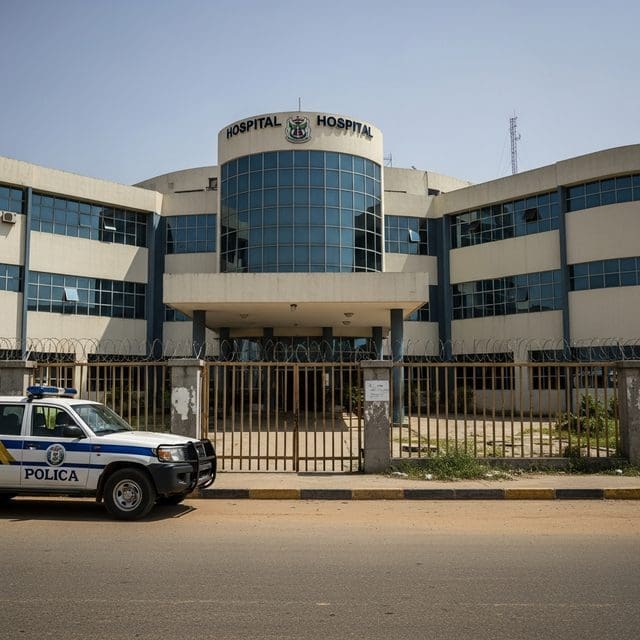
In Ondo State, police recently arrested two suspects, including a security guard, for the vandalism and theft of electrical cables at a general hospital. Such incidents are not merely local crimes; they represent a significant drain on foreign aid and development resources. When hospital infrastructure is stripped for parts, the efficacy of international health investments is neutralized, leaving populations vulnerable and wasting the capital provided by donor nations like the United States.
Security operations in the South-East further illustrate the volatility of the region. The Imo State Police Command recently dismantled a camp used by the Indigenous People of Biafra (IPOB) and its armed wing, the Eastern Security Network (ESN). The raid, led by intelligence from a captured commander, resulted in the recovery of machine guns, thousands of rounds of ammunition, and drones. The presence of advanced surveillance technology among non-state actors raises the stakes for international aid workers and health officials attempting to operate in these zones.
Further south, in Rivers State, a late-night attack on a local vigilante office in Omoku by gunmen in an ash-colored Lexus resulted in injuries to security personnel. While the guards repelled the assault, the persistent threat to local law enforcement creates a vacuum that hinders the distribution of aid and the implementation of climate adaptation strategies. Without a secure environment, the market-driven solutions often championed by development experts remain impossible to execute.
While regional political figures maintain high-level international ties—exemplified by former Vice President Atiku Abubakar’s recent attendance at a high-profile wedding in Morocco alongside former Burkina Faso Prime Minister Lassina Zerbo—the disconnect between elite diplomacy and grassroots security remains stark. For American taxpayers and policy makers, these developments serve as a reminder that global health security is inextricably linked to national sovereignty and the rule of law within partner nations. Without addressing the underlying instability, the billions allocated for global development remain at high risk of being offset by local lawlessness.

Rachel Vaughn serves as a Senior Correspondent for Just Right News, where she leads the network’s coverage of Global Health, Climate, and Development. With a career defined by intellectual rigor and a commitment to principled reporting, Rachel provides a vital conservative perspective on some of the most complex and high-stakes issues facing the world today. Her work is characterized by a refusal to accept bureaucratic narratives at face value, focusing instead on how international policies impact national sovereignty, individual liberty, and the American taxpayer.
Raised in New Haven, Connecticut, Rachel grew up in an environment dominated by elite academic discourse. This upbringing provided her with a front-row seat to the inner workings of the American establishment, but it also instilled in her a healthy skepticism of the “ivory tower” consensus. She learned early on that while academic theories may sound promising in a lecture hall, they often fail to account for the practical realities of the working class. This background drives her to bridge the gap between high-level policy discussions and the common-sense concerns of everyday citizens, ensuring that her reporting remains grounded and accessible.
Now based in Burlington, Vermont, Rachel operates from a unique vantage point within one of the nation’s most progressive political landscapes. Living and working in a region that often serves as a testing ground for radical social and environmental experiments allows her to witness the real-world consequences of these policies firsthand. From her base in the Green Mountain State, she provides Just Right News readers with essential “boots on the ground” reporting, documenting the friction between local mandates and the constitutional freedoms of the individual. Her presence in Burlington ensures that her critiques of globalist agendas are informed by a direct understanding of how those ideologies manifest at the local level.
In her acclaimed feature series, “Planetary Stakes,” Rachel explores the intersection of international development and environmental stewardship. She rejects the alarmism often found in mainstream media, opting instead for a sober analysis of the economic and geopolitical costs of global climate agreements. Her reporting frequently highlights the importance of market-driven innovation and the role of American leadership in fostering global health without ceding authority to unelected international bodies. Through “Planetary Stakes,” she has become a leading voice for those who believe that true conservation and public health are best achieved through transparency, accountability, and the protection of private property rights.
Throughout her tenure at Just Right News, Rachel has distinguished herself as a journalist who is unafraid to ask difficult questions of global institutions. Whether she is investigating the influence of non-governmental organizations on domestic policy or analyzing the fiscal transparency of international health initiatives, her goal remains the same: to provide her audience with the facts necessary to navigate an increasingly interconnected world. Her blend of East Coast intellectual heritage and her current immersion in the political heart of the Northeast makes her an indispensable asset to the newsroom and a trusted source for readers seeking a principled, conservative take on the issues that define our era.