

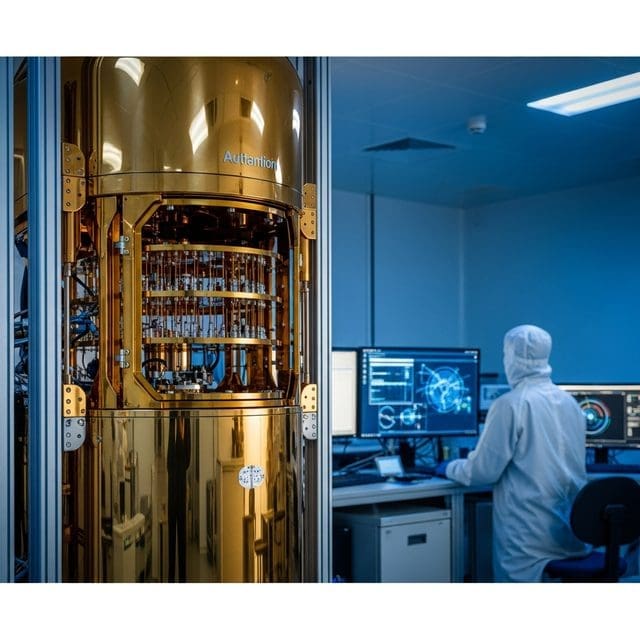
Origin Quantum has unveiled a 180-qubit superconducting computer, signaling a major leap in China’s drive for full-stack technological independence from Western supply chains.
The global race for quantum supremacy has entered a high-stakes new phase as China’s Origin Quantum unveiled the Origin Wukong-180. Launched on May 9, 2026, in Hefei, Anhui province, this fourth-generation superconducting quantum computer represents a significant milestone in Beijing’s pursuit of absolute digital sovereignty. By achieving what the company calls full-industry-chain autonomy, the Wukong-180 demonstrates that the era of relying on Western hardware and software may be closing for the East.
The Wukong-180 is not merely a laboratory curiosity; it is a functional powerhouse featuring 180 computational qubits and an advanced Origin Tianji 4.0 control system. With single-qubit fidelity reaching 99.9%, the machine offers the precision necessary for complex simulations that traditional supercomputers cannot match. This launch follows the success of its 72-qubit predecessor, which recorded over 50 million remote accesses from 160 countries, proving that there is a massive global appetite for non-Western computing alternatives.
For American observers, the most critical aspect of this development is the ‘3+3’ stack independence. Origin Quantum has successfully developed the quantum chip, the measurement and control systems, the cryogenic environment support, and the operating system entirely in-house. This vertical integration ensures that their quantum infrastructure remains immune to foreign sanctions or export controls, a direct challenge to the free-market dominance long enjoyed by Silicon Valley giants.
The implications for national security and economic competitiveness are profound. Quantum computing has the potential to crack modern encryption and revolutionize material science, making it the ultimate frontier in the ‘New Cold War.’ While the U.S. has historically led this field, the Wukong-180’s integration of AI via the Origin Brain model suggests that China is rapidly closing the gap by merging quantum power with artificial intelligence to create a unified, sovereign tech ecosystem.
As of May 7, 2026, Origin Quantum began offering free 60-second trials of this power via its cloud platform, inviting the world to test its capabilities. While the University of Michigan reports that American consumer sentiment has hit record lows amid domestic economic uncertainty and elevated energy prices, China is doubling down on long-term strategic infrastructure. The arrival of the Wukong-180 serves as a stark reminder that digital leadership is not a permanent birthright, but a position that must be defended through relentless innovation and a commitment to technological self-reliance.

Ryan Mitchell serves as a Staff Writer for Just Right News, where he anchors the desk for Cyber, Technology Policy, and Digital Sovereignty. In an era where the digital landscape has become as much a battlefield as any physical territory, Ryan provides a critical conservative lens on the forces shaping the future of American innovation and national security. His work is defined by a commitment to the idea that American leadership in the digital age is not just a matter of economic success, but a necessity for the preservation of global liberty.
Born and raised in Austin, Texas, Ryan’s perspective is deeply rooted in the Lone Star State’s tradition of independence and skepticism of centralized authority. Growing up in a city that transformed from a quiet state capital into a global technology hub, he witnessed firsthand the disruptive power of the tech industry. This upbringing instilled in him a firm belief in free-market principles and the necessity of protecting individual liberties from both government overreach and corporate overstep. His Texan background serves as a foundational compass, guiding his reporting toward stories that emphasize national resilience and the preservation of constitutional values in an increasingly virtual world.
Now based in San Francisco, California, Ryan operates from the epicenter of the very industry he scrutinizes. Living and working in the heart of Silicon Valley allows him to provide “boots on the ground” reporting that few conservative journalists can match. He navigates the cultural and political complexities of the Bay Area to bring Just Right News readers an inside look at the boardrooms and coding labs where the next generation of digital policy is forged. For Ryan, being stationed in San Francisco is a strategic choice; it allows him to challenge the prevailing ideological monoculture of the tech elite from within their own backyard, ensuring that the concerns of middle America are represented in the conversation about our digital future.
His beat—Cyber, Technology Policy, and Digital Sovereignty—covers the high-stakes world of data privacy, artificial intelligence, and the infrastructure of the modern web. Ryan is particularly focused on the concept of digital sovereignty, arguing that for a nation to remain truly free, it must maintain control over its own technological destiny and critical infrastructure. He frequently explores how international regulations and domestic policies impact the ability of American firms to compete without sacrificing the privacy or security of their citizens.
Central to his current body of work is his featured series, “The New Cold War.” Through this project, Ryan examines the escalating technological rivalry between the United States and its global adversaries. He delves into the complexities of state-sponsored hacking, the global race for semiconductor dominance, and the ideological struggle to define the rules of the internet. Ryan views this competition not merely as a commercial race, but as a fundamental defense of Western values against authoritarian digital models. Through his rigorous reporting and principled analysis, Ryan Mitchell ensures that the readers of Just Right News stay informed about the invisible forces defining the 21st century, always advocating for a future where technology serves the cause of freedom.