

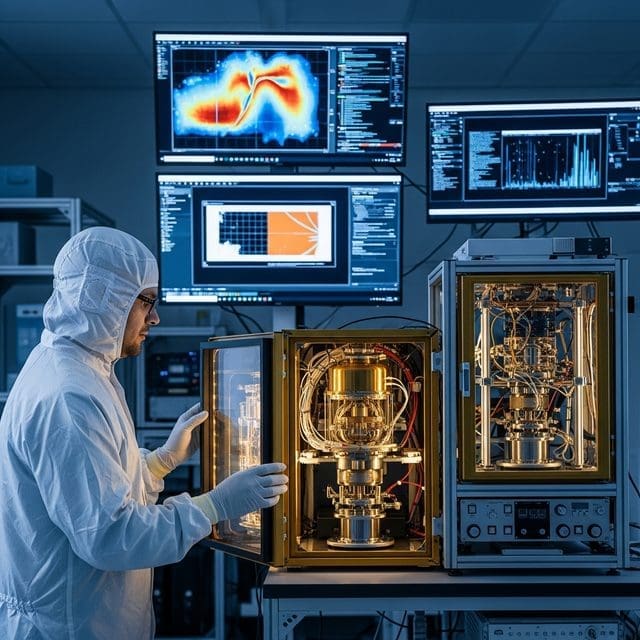
Major international developments in quantum computing, from South Korean security pilots to Chattanooga’s new apprenticeship program, signal a shift from theoretical research to industrial-scale deployment and workforce readiness.
The landscape of emerging technology is shifting rapidly as quantum computing moves out of the laboratory and into the foundations of national infrastructure. Recent developments across the globe indicate a concerted effort by both sovereign states and private enterprises to secure a lead in what is being called the next great industrial revolution. From national security pilots in East Asia to workforce development in the American South, the focus has pivoted toward practical application and long-term sovereignty.
South Korea is leading this charge by expanding its Post-Quantum Cryptography (PQC) pilot program. Originally focused on administrative and medical sectors, the initiative now encompasses telecommunications, finance, transportation, defense, and space. This expansion is a direct response to the “Harvest Now, Decrypt Later” threat, where adversaries collect encrypted data today to crack it once quantum hardware matures. The South Korean government aims for full-cycle PQC self-reliance by 2030, establishing a standardized model to protect critical national assets against AI-driven quantum advancements.
In the United States, the focus is increasingly on the “peopleware” required to sustain this high-tech shift. The Chattanooga Quantum Collaborative, in partnership with BuildWithin, has launched the nation’s first quantum pre-apprenticeship program. Supported by a National Science Foundation grant, the 12-week initiative targets mid-career professionals. By equipping the existing workforce with the skills to lead quantum adoption strategies, Chattanooga is positioning itself as a regional hub for the decentralized innovation that defines the American spirit of ingenuity.
Industrial efficiency is also seeing a quantum boost through strategic partnerships. SiC Systems and ORCA Computing have joined forces to integrate quantum-enhanced AI into chemical and biomanufacturing plant design. By combining quantum processors with AI-driven workflows, the collaboration aims to optimize a $1 trillion industry, potentially saving over 20,000 engineering hours per project. Similarly, Quandela and Safran have launched the AQeFLU project, which utilizes photonic quantum technology to develop fluid dynamics algorithms. This project seeks to reduce fuel consumption in future aircraft by improving aerodynamic simulations, demonstrating how quantum tools can serve traditional manufacturing and environmental stewardship.
Investment continues to pour into the sector, reflecting a maturing market. Qutwo recently raised $29.4 million for its AI-quantum operating system, while Quantum Motion secured $160 million to commercialize silicon spin processors using standard CMOS manufacturing. These milestones suggest that the future of computing will not be centralized in a few bureaucratic hands but distributed through a robust, competitive marketplace that respects national borders and individual liberty.
As these technologies move toward utility, the emphasis remains on maintaining a skeptical counterweight to centralized control. The integration of quantum computing into defense and finance must be balanced with the protection of constitutional rights and individual privacy. Whether through the development of sovereign European technology by firms like Qutwo or the expansion of the “Quantum Prairie” in the American Midwest, the goal is a future where innovation serves the citizen, not the state.

Mason Reed serves as a Staff Writer for Just Right News, where he spearheads the Future Frontiers & Special Projects desk. In an era defined by rapid technological shifts and evolving social landscapes, Mason provides a steady, principled voice, examining the innovations of tomorrow through the lens of traditional American values. His work is most prominently featured in his signature series, “The Next Horizon,” where he explores the intersection of emerging technology, national sovereignty, and the preservation of individual liberty.
A native of San Diego, California, Mason’s worldview was shaped by the unique culture of his hometown. Growing up in a region defined by its strong military presence and its history of maritime industry, he developed a deep-seated respect for the institutions that provide national stability and the entrepreneurial spirit that drives the American economy. This upbringing instilled in him a belief that true progress is not found in discarding the past, but in building upon a foundation of proven principles. His reporting often reflects this San Diego influence, emphasizing the importance of a robust national defense and the necessity of maintaining a competitive edge in the global marketplace.
Now based in San Francisco, Mason operates from the heart of the world’s technological engine. Living and working in the Bay Area provides him with a front-row seat to the advancements—and the ideological challenges—emanating from Silicon Valley. While many in the region embrace a “move fast and break things” mentality, Mason’s reporting serves as a vital counterweight. He offers Just Right News readers a “boots on the ground” perspective, documenting how radical local policies and the concentration of tech power impact the everyday lives of citizens. His proximity to the industry allows him to cut through the marketing jargon of big tech to uncover the real-world implications for privacy, free speech, and the nuclear family.
In his “Future Frontiers” beat, Mason tackles complex subjects ranging from the ethics of artificial intelligence to the burgeoning private space race. He approaches these topics with a healthy skepticism toward centralized bureaucracy, championing instead the decentralized innovations that empower individuals. Through “The Next Horizon,” he highlights the pioneers and thinkers who are working to ensure that the future remains a place where human dignity and constitutional rights are protected. He believes that the rapid pace of change requires more than just technical expertise; it requires a moral compass rooted in the Western tradition.
Throughout his tenure at Just Right News, Mason has remained committed to the idea that the future is something to be shaped, not merely accepted. His writing is characterized by a rigorous defense of American exceptionalism and a belief that the country’s best days lie ahead, provided it remains true to its founding ideals. Whether he is investigating the impact of automation on the American workforce or profiling the next generation of aerospace engineers, Mason Reed ensures that his readers are equipped with the insights they need to navigate a changing world with confidence and clarity.