

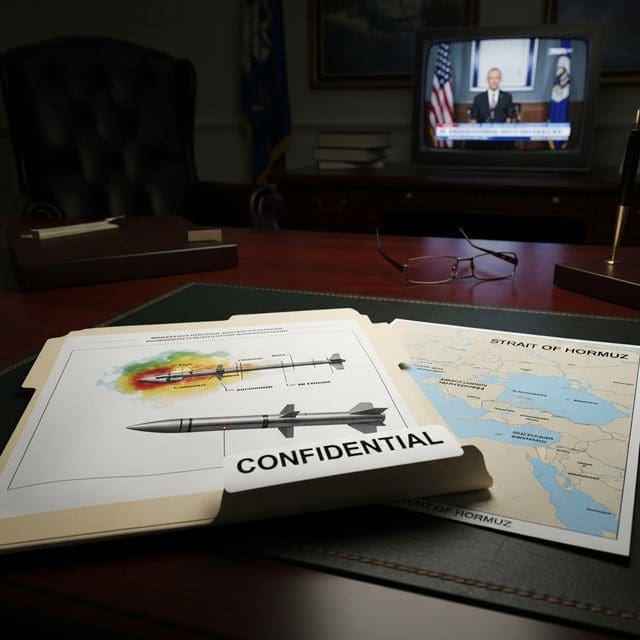
Confidential intelligence records contradict President Trump’s assertions regarding Iran’s military degradation and economic collapse as peace negotiations continue.
A confidential CIA analysis leaked to policymakers this week provides a starkly different assessment of the conflict in Iran than the one currently presented by the White House. While President Donald Trump stated on May 6 that the war has a very good chance of ending and suggested the Iranian economy is crashing, internal intelligence records indicate the regime maintains significant military and logistical resilience.
The leaked dossier, confirmed by three U.S. officials, reveals that Iran retains approximately 70% of its prewar missile stockpile and 75% of its mobile launchers. These figures persist despite sustained U.S. and Israeli bombing campaigns. The records further show that Tehran has successfully repaired underground facilities and continues to assemble new missiles, directly challenging the administration’s public narrative of a decimated Iranian military capability.
On the economic front, the intelligence findings undermine assertions that the Iranian economy is in a state of total collapse. While the administration has pointed to 150% inflation and unpaid soldiers as signs of imminent surrender, the CIA analysis concludes that Iran can survive the current U.S. blockade of the Strait of Hormuz for 90 to 120 days before facing severe hardship. The documents detail how Iran is utilizing empty tankers for oil storage and exploring overland smuggling routes via Central Asia rail networks to bypass maritime restrictions.
These disclosures arrive as the two nations reportedly near an agreement on a one-page memorandum to end the two-month conflict. President Trump has threatened to renew and intensify bombing if a deal—which must include the reopening of the Strait of Hormuz—is not reached. However, an Iranian official characterized the current U.S. proposal on May 7 as a “wish list” rather than a finalized reality.
Domestic pressure regarding the conflict continues to mount. A recent PBS News/NPR/Marist poll indicates that 60% of Americans disapprove of the administration’s handling of Iran, with 63% blaming the President for high gas prices. As the White House maintains its public stance of maximum pressure, these internal records suggest the administrative state’s private assessment is one of a much longer and more resilient stalemate than the public has been led to believe.
This gap between public rhetoric and classified intelligence is becoming a focal point for government watchdogs. While the White House met with Brazilian President Luiz Inácio Lula da Silva on May 7 to discuss unrelated matters like organized crime and tariffs, the shadow of the Iranian conflict remains the dominant factor in both domestic approval and international stability. The leaked CIA analysis serves as a primary source reminder that the administrative state’s internal data often tells a more complicated story than the simplified versions presented at the podium.

Ben Taylor serves as the Senior Correspondent and Investigations Lead for Just Right News, where he anchors the network’s commitment to government transparency and institutional accountability. With a career defined by a relentless pursuit of the facts, Taylor spearheads the acclaimed feature series “The Paper Trail,” a deep-dive investigative column that prioritizes primary source documentation over political rhetoric. Based in the heart of the nation’s capital, he has earned a reputation as one of the most formidable investigative journalists in Washington, D.C., known specifically for his mastery of public records and the Freedom of Information Act.
Taylor’s approach to journalism is deeply rooted in his upbringing in Kansas City, Missouri. Growing up in the “Show Me State,” he developed a healthy skepticism of centralized power and a profound respect for the common-sense values of the American heartland. This Midwestern foundation informs his reporting today, as he bridges the gap between the complex machinations of federal bureaucracy and the everyday concerns of citizens across the country. For Taylor, investigative reporting is not about chasing headlines; it is about ensuring that the government remains answerable to the people it serves.
As an African American man working within the conservative media landscape, Taylor brings a principled perspective to his beat. He views the Constitution and the right to information as the ultimate equalizers in a free society. His work often highlights how bureaucratic overreach and lack of transparency disproportionately affect individual liberties. By focusing on the “paper trail,” Taylor strips away the spin of partisan talking points, instead providing Just Right News readers with the raw data and internal communications that reveal how their tax dollars are spent and how policy decisions are actually made.
In his role as Investigations Lead, Taylor oversees a team dedicated to uncovering the stories that mainstream outlets often overlook. Whether he is auditing federal spending, investigating regulatory overreach, or exposing inefficiencies within the administrative state, his methodology remains consistent: follow the evidence wherever it leads. His presence in Washington, D.C., allows him to maintain a constant watch over the halls of power, yet he remains steadfastly connected to his roots, ensuring his reporting reflects the clarity and directness of his Missouri home.
Throughout his tenure at Just Right News, Taylor has become a vital voice for those who demand integrity in public office. He believes that a well-informed electorate is the strongest defense against government overreach, and he has dedicated his career to providing the public with the tools they need to hold their leaders accountable. Through “The Paper Trail” and his broader investigative work, Ben Taylor continues to set the standard for rigorous, document-driven journalism that champions the values of transparency, individual responsibility, and the rule of law.