

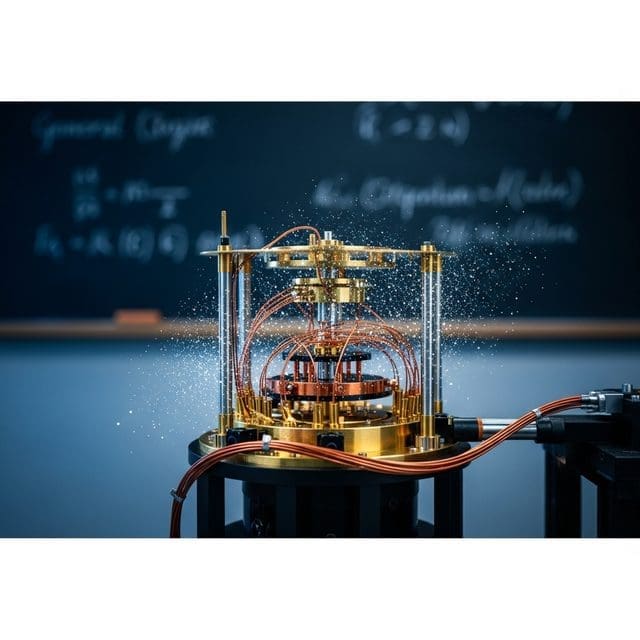
International researchers have discovered that quantum collapse models linked to gravity create a tiny, inherent uncertainty in time, setting a theoretical limit on how precisely any clock can ever measure the passage of seconds.
The quest to reconcile the microscopic world of quantum mechanics with the vast reaches of gravitational theory has long been the ‘holy grail’ of modern physics. While the two frameworks have historically operated in separate silos, a new discovery published in Physical Review Research suggests that the bridge between them may be found in the very fabric of time. Researchers supported by the Foundational Questions Institute (FQxI) have identified a fundamental ‘flaw’ or uncertainty in time that arises when gravity interacts with quantum systems.
At the heart of the study are quantum collapse models, which attempt to explain why subatomic particles can exist in multiple states at once while the macroscopic objects of our daily lives—like a house or a car—remain fixed in one place. Unlike standard quantum theory, which relies on an observer to ‘collapse’ a particle’s state, these models suggest that the collapse happens spontaneously. Nicola Bortolotti of the Enrico Fermi Museum and Research Centre and his colleagues examined the Diósi-Penrose model and Continuous Spontaneous Localization, finding that these processes are tied to fluctuations in gravity.
The implications for timekeeping are profound, if currently theoretical. The team’s analysis shows that if these models are correct, time cannot be measured with infinite precision. Gravity-induced fluctuations create a baseline of uncertainty that would eventually prevent any clock, no matter how advanced, from achieving perfect accuracy. For a one-year optimal clock, this uncertainty is estimated at approximately one part in 10 to the 31st power—a number so small it defies common intuition.
From a sovereignty and national security perspective, the stability of timekeeping is a cornerstone of modern infrastructure, from GPS navigation to financial markets. However, the researchers, including Catalina Curceanu and Kristian Piscicchia, were quick to note that this discovery does not threaten current technological standards. Modern atomic clocks, while incredibly precise, are still many orders of magnitude away from reaching this fundamental limit. The findings effectively reassure us that the ‘pillars’ of our physical measurements remain secure against these quantum fluctuations for the foreseeable future.
This research represents a significant step toward a unified theory of the universe. By treating time not as a static, external background but as something influenced by the dance of gravity and matter, physicists are beginning to understand the limits of the physical world. As we look toward future frontiers in space exploration and high-precision sensing, understanding these fundamental boundaries ensures that American innovation remains grounded in the hard realities of physical law.
While the study was funded in part by programs exploring consciousness in the physical world, its primary value lies in its testable predictions. By establishing a quantitative link between gravity and quantum collapse, the team has provided a roadmap for future experiments that could finally prove how the smallest particles in the universe are governed by the same gravitational forces that move the stars.

Mason Reed serves as a Staff Writer for Just Right News, where he spearheads the Future Frontiers & Special Projects desk. In an era defined by rapid technological shifts and evolving social landscapes, Mason provides a steady, principled voice, examining the innovations of tomorrow through the lens of traditional American values. His work is most prominently featured in his signature series, “The Next Horizon,” where he explores the intersection of emerging technology, national sovereignty, and the preservation of individual liberty.
A native of San Diego, California, Mason’s worldview was shaped by the unique culture of his hometown. Growing up in a region defined by its strong military presence and its history of maritime industry, he developed a deep-seated respect for the institutions that provide national stability and the entrepreneurial spirit that drives the American economy. This upbringing instilled in him a belief that true progress is not found in discarding the past, but in building upon a foundation of proven principles. His reporting often reflects this San Diego influence, emphasizing the importance of a robust national defense and the necessity of maintaining a competitive edge in the global marketplace.
Now based in San Francisco, Mason operates from the heart of the world’s technological engine. Living and working in the Bay Area provides him with a front-row seat to the advancements—and the ideological challenges—emanating from Silicon Valley. While many in the region embrace a “move fast and break things” mentality, Mason’s reporting serves as a vital counterweight. He offers Just Right News readers a “boots on the ground” perspective, documenting how radical local policies and the concentration of tech power impact the everyday lives of citizens. His proximity to the industry allows him to cut through the marketing jargon of big tech to uncover the real-world implications for privacy, free speech, and the nuclear family.
In his “Future Frontiers” beat, Mason tackles complex subjects ranging from the ethics of artificial intelligence to the burgeoning private space race. He approaches these topics with a healthy skepticism toward centralized bureaucracy, championing instead the decentralized innovations that empower individuals. Through “The Next Horizon,” he highlights the pioneers and thinkers who are working to ensure that the future remains a place where human dignity and constitutional rights are protected. He believes that the rapid pace of change requires more than just technical expertise; it requires a moral compass rooted in the Western tradition.
Throughout his tenure at Just Right News, Mason has remained committed to the idea that the future is something to be shaped, not merely accepted. His writing is characterized by a rigorous defense of American exceptionalism and a belief that the country’s best days lie ahead, provided it remains true to its founding ideals. Whether he is investigating the impact of automation on the American workforce or profiling the next generation of aerospace engineers, Mason Reed ensures that his readers are equipped with the insights they need to navigate a changing world with confidence and clarity.