

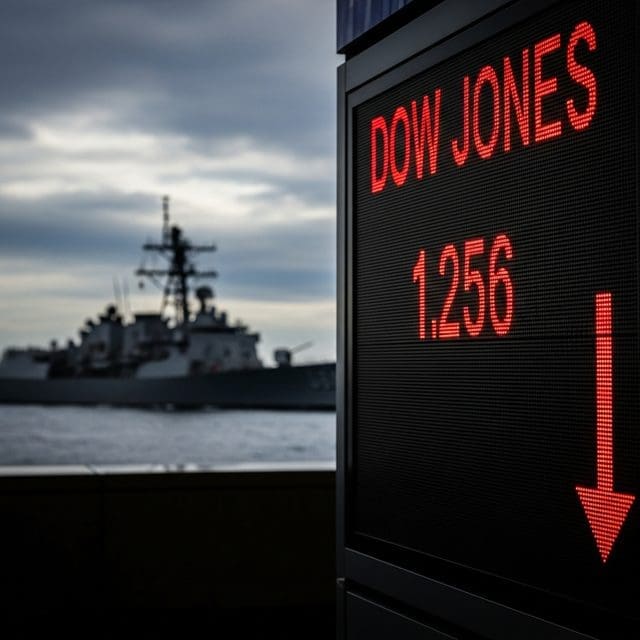
Wall Street faced a sharp sell-off as escalating Middle East tensions pushed oil prices above $110 and Treasury yields climbed, impacting household borrowing costs.
The American economy faced a volatile start to the week as geopolitical friction in the Middle East rippled through domestic markets. On May 4, 2026, the Dow Jones Industrial Average plummeted 550 points, a reaction largely fueled by the launch of ‘Project Freedom.’ The U.S. Navy began escorting foreign vessels through the Strait of Hormuz on May 5, following a directive from the Trump administration to use military force if Iran disrupts maritime traffic. These developments pushed global oil prices above $110 per barrel after reports surfaced of a disputed strike on a U.S. Navy vessel.
For the American taxpayer, this volatility extends beyond the gas pump. The 10-year Treasury yield rose to 4.3525%, a move that typically signals higher interest rates for mortgages and consumer loans. Simultaneously, the federal government announced that the Series I bond rate will rise to 4.26% for the May-October period. While this offers a slight bump for savers, it reflects an underlying inflationary environment that continues to pressure the purchasing power of working families.
In the commodities sector, a massive shift is underway as the U.S. moves to reshore defense procurement. Tungsten prices have surged approximately 900% year-over-year. This spike is driven by a looming January 2027 federal ban on Chinese tungsten in defense applications, forcing a rapid and expensive pivot toward domestic supply chains. While vital for national sovereignty, the immediate cost of this transition is being felt across the industrial sector.
Corporate America presented a mixed bag of signals. Jim Cramer of the CNBC Investing Club noted that Amazon leadership appears more confident than ever, suggesting that some tech behemoths remain insulated from the broader market rout. However, other speculative corners of the market are facing scrutiny. GameStop launched a surprising $56 billion bid to acquire eBay, a move Wall Street analysts have largely dismissed as financially unfeasible. Meanwhile, Palantir shares have retreated 30% from recent highs, drawing heavy activity from options traders looking to hedge against further downside.
Institutional activity remained steady despite the chaos, with West Enclave Merger Corp. and Plutonian Acquisition Corp II both closing $100 million initial public offerings. Lazard Inc. also moved to consolidate its position in the market by entering an agreement to acquire Campbell Lutyens. However, these high-level maneuvers offer little comfort to students and families facing new federal graduate loan caps, which experts warn may push borrowers toward riskier private debt markets.
As the U.S. Navy continues its operations in the Strait of Hormuz, the stability of the global energy market remains tethered to the success of diplomatic efforts. While Iran has delivered a response to U.S. amendments regarding a draft peace plan, the immediate market reaction suggests investors are bracing for a prolonged period of uncertainty and centralized intervention.

Jordan Lee serves as the Senior Correspondent for Wall Street, Finance, and Monetary Systems at Just Right News. Based in the heart of the world’s financial capital, New York City, Lee brings a sharp, principled eye to the complex mechanisms that drive the global economy. His reporting is defined by a commitment to fiscal responsibility, the defense of the free market, and a deep-seated belief that a transparent monetary system is the bedrock of a free society.
Raised in Portland, Oregon, Lee’s perspective was forged in a city that has undergone significant cultural and economic shifts. His upbringing in the Pacific Northwest instilled in him a profound appreciation for the industriousness of small business owners and the importance of local economic stability. Watching the evolution of his hometown’s landscape sparked an early interest in how federal fiscal policy and large-scale financial trends eventually trickle down to the average citizen. This background provides him with a unique vantage point; he understands the growing disconnect between the policy-making elite and the reality of Main Street, a theme that frequently resonates throughout his work.
Now operating from his base in New York City, Lee bridges the gap between the high-stakes trading floors of Manhattan and the households of everyday Americans. He views the financial sector not merely as a collection of numbers and tickers, but as a vital engine of American prosperity that requires constant vigilance and accountability. His reporting often highlights the dangers of centralized financial control and the necessity of maintaining a system that rewards merit, risk-taking, and innovation.
As the creator and lead of the featured series, “The Invisible Economy,” Lee pulls back the curtain on the often-opaque world of monetary systems. He specializes in translating the dense jargon of central banking and international finance into actionable insights for the Just Right News audience. His work explores the “invisible” forces—such as inflationary pressures, regulatory creep, and the expansion of the administrative state—that erode the purchasing power of American families. By focusing on these systemic issues, Lee empowers readers to understand the hidden forces shaping their financial independence.
Lee’s journalistic philosophy is rooted in a steadfast commitment to traditional American values. As an Asian American professional who has navigated the competitive corridors of the financial world, he is a vocal advocate for meritocracy and the preservation of the American Dream. He believes that a stable currency and a predictable regulatory environment are essential for national sovereignty and individual liberty. His reporting frequently warns against the risks of government overreach in the private sector, arguing that the most effective solutions to economic challenges arise from competition and individual enterprise rather than bureaucratic mandates.
At Just Right News, Jordan Lee remains dedicated to providing a clear-eyed defense of the taxpayer. Whether he is analyzing market volatility or investigating the long-term implications of national debt, his mission is to provide the truth about where the money is going and what it means for the future of the country. Through his rigorous analysis and principled stance, Lee has become a trusted voice for those who value a strong, sovereign, and fiscally sound America.