

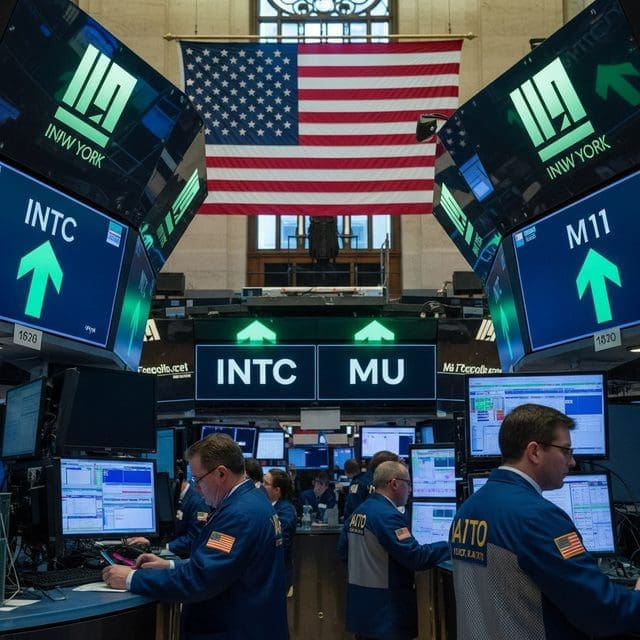
Major indices surged Tuesday behind a massive semiconductor rally led by Intel and Micron, while cooling Middle East tensions provided much-needed relief for energy prices and Treasury yields.
Wall Street’s major indices surged on Tuesday as a powerful rally in the semiconductor sector propelled the Nasdaq Composite to a fresh all-time high. The tech-heavy index climbed 0.9%, surpassing its previous record of 7272.52, while the S&P 500 and Dow Jones Industrial Average followed suit with gains of 0.8% and 0.6%, respectively. This momentum signals a resilient appetite for growth-oriented assets despite a backdrop of geopolitical friction and shifting trade policies.
The day’s gains were anchored by a dramatic surge in chipmakers. Intel shares jumped 12%, while Micron Technology and SanDisk both advanced approximately 9%. Micron’s performance was particularly notable, with the stock hitting a record high of $651.74. These moves come as institutional leaders, including JPMorgan Chase CEO Jamie Dimon, continue to endorse massive capital expenditures in artificial intelligence, suggesting that the infrastructure buildout for the next generation of computing remains a primary driver of market liquidity.
For the American household, the most critical developments occurred in the commodities and bond markets. Oil prices, which had spiked on fears of supply chain disruptions in the Strait of Hormuz, saw a significant retreat. West Texas Intermediate (WTI) crude fell 4% to $102.15 per barrel after Defense Secretary Pete Hegseth confirmed that the U.S.-Iran ceasefire remains in effect. This pullback offers a vital buffer against the inflationary pressures that have plagued domestic manufacturing, which recently marked its fourth consecutive month of growth.
In the fixed-income market, the 10-year Treasury yield—a benchmark that dictates the cost of mortgages and consumer loans—slipped to 4.42%. This minor easing provides some relief to a credit market that has been strained by high interest rates. However, the Federal Reserve Bank of New York recently highlighted a growing disparity in the economy, noting that spending growth is increasingly concentrated among top-tier earners who benefit from financial asset gains, leaving working-class households to navigate a more precarious landscape.
While the broader market celebrated, the labor market faced fresh reminders of the disruptive power of automation. Coinbase announced it would lay off 14% of its workforce, joining the likes of Meta and Microsoft in reducing headcount to optimize for the “AI era.” This trend underscores a shifting meritocracy where technical efficiency is being prioritized over traditional labor, even as companies like Palantir report record revenue growth.
Looking ahead, the fiscal environment remains complex. The White House is moving forward with a new series of “Plan B” tariffs under Section 301 of the Trade Act, seeking a more legally resilient framework for import taxes after previous measures were struck down. As these hearings begin, the potential for renewed price hikes on imported goods remains a looming concern for domestic stability and national sovereignty.

Jordan Lee serves as the Senior Correspondent for Wall Street, Finance, and Monetary Systems at Just Right News. Based in the heart of the world’s financial capital, New York City, Lee brings a sharp, principled eye to the complex mechanisms that drive the global economy. His reporting is defined by a commitment to fiscal responsibility, the defense of the free market, and a deep-seated belief that a transparent monetary system is the bedrock of a free society.
Raised in Portland, Oregon, Lee’s perspective was forged in a city that has undergone significant cultural and economic shifts. His upbringing in the Pacific Northwest instilled in him a profound appreciation for the industriousness of small business owners and the importance of local economic stability. Watching the evolution of his hometown’s landscape sparked an early interest in how federal fiscal policy and large-scale financial trends eventually trickle down to the average citizen. This background provides him with a unique vantage point; he understands the growing disconnect between the policy-making elite and the reality of Main Street, a theme that frequently resonates throughout his work.
Now operating from his base in New York City, Lee bridges the gap between the high-stakes trading floors of Manhattan and the households of everyday Americans. He views the financial sector not merely as a collection of numbers and tickers, but as a vital engine of American prosperity that requires constant vigilance and accountability. His reporting often highlights the dangers of centralized financial control and the necessity of maintaining a system that rewards merit, risk-taking, and innovation.
As the creator and lead of the featured series, “The Invisible Economy,” Lee pulls back the curtain on the often-opaque world of monetary systems. He specializes in translating the dense jargon of central banking and international finance into actionable insights for the Just Right News audience. His work explores the “invisible” forces—such as inflationary pressures, regulatory creep, and the expansion of the administrative state—that erode the purchasing power of American families. By focusing on these systemic issues, Lee empowers readers to understand the hidden forces shaping their financial independence.
Lee’s journalistic philosophy is rooted in a steadfast commitment to traditional American values. As an Asian American professional who has navigated the competitive corridors of the financial world, he is a vocal advocate for meritocracy and the preservation of the American Dream. He believes that a stable currency and a predictable regulatory environment are essential for national sovereignty and individual liberty. His reporting frequently warns against the risks of government overreach in the private sector, arguing that the most effective solutions to economic challenges arise from competition and individual enterprise rather than bureaucratic mandates.
At Just Right News, Jordan Lee remains dedicated to providing a clear-eyed defense of the taxpayer. Whether he is analyzing market volatility or investigating the long-term implications of national debt, his mission is to provide the truth about where the money is going and what it means for the future of the country. Through his rigorous analysis and principled stance, Lee has become a trusted voice for those who value a strong, sovereign, and fiscally sound America.