

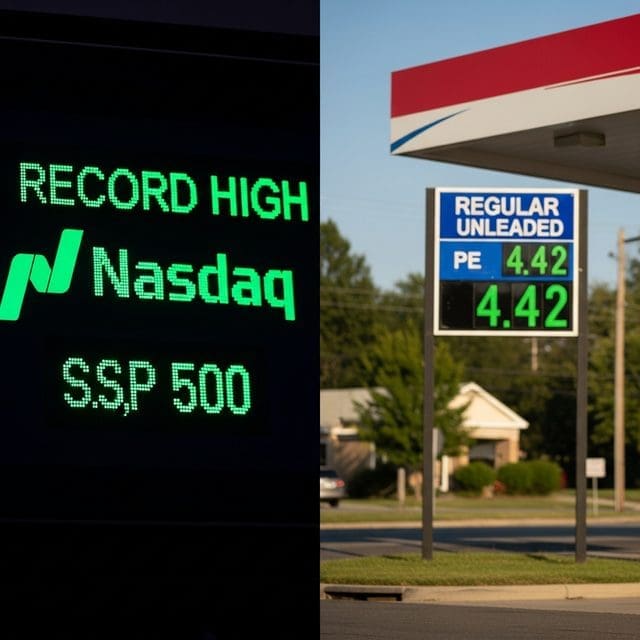
The Nasdaq and S&P 500 reached historic peaks behind strong tech earnings, even as domestic gasoline prices climbed to $4.42 per gallon.
The divergence between Wall Street’s record-breaking performance and the fiscal reality for American households widened this week. On May 1, the Nasdaq Composite closed above the 25,000 mark for the first time, ending at 25,114.44, while the S&P 500 reached a new high of 7,230.12. These gains were propelled by a resurgence in the technology sector, specifically Apple, which reported second-quarter revenue of $111.2 billion and a 22% jump in earnings per share.
While institutional investors celebrated the highest earnings growth since 2021, the broader economy remains under the shadow of the ongoing conflict with Iran. Regular unleaded gasoline hit $4.42 per gallon on May 1, representing a 50% surge since the start of hostilities. This energy inflation persists despite a 2% dip in Brent crude to $108.17 per barrel following reports of a mediation proposal from Tehran. President Trump has since rejected the proposal, which sought to reopen the Strait of Hormuz in exchange for ending the U.S. blockade, stating he was not satisfied with the terms.
For the American taxpayer, the cost of living is being further pressured by a massive capital shift into artificial intelligence. Big Tech firms including Alphabet, Amazon, Meta, and Microsoft have allocated approximately $700 billion toward AI spending in 2026, depleting cash reserves and increasing debt loads. This aggressive spending comes as U.S. manufacturers report a fourth consecutive month of growth, the longest streak in four years, signaling resilience in the face of rising input costs and regional instability. This manufacturing strength persists despite the headwinds of war-related inflation and the volatility of the global energy market.
Global financial shifts are also complicating the monetary landscape. The United Arab Emirates is set to depart OPEC on May 2, a move driven by strategic realignment and regional tensions. Simultaneously, international interest in alternative monetary reserves is growing; in Taiwan, Legislator Dr. Ko Ju-Chun recently presented a Bitcoin Policy Institute report regarding the establishment of a national Bitcoin reserve. Even traditional manufacturing is being upended by the tech race, as seen with Japanese firm Toto supplying electrostatic chucks critical to semiconductor memory-chip production.
On the corporate front, the consolidation of financial power continues. Lazard Inc. has entered a definitive agreement to acquire Campbell Lutyens, while the IPO market saw activity from West Enclave Merger Corp. and Plutonian Acquisition Corp II, both closing $100 million offerings. While these maneuvers bolster the indices, the average worker remains focused on the pump and the grocery aisle, where the ‘Invisible Economy’ of war-related inflation continues to erode purchasing power despite the record-setting numbers on the ticker tape. The Dow Jones Industrial Average, which slipped 0.3% on May 1, perhaps better reflects the cautious sentiment of those watching the geopolitical risks rather than the tech-fueled exuberance of the Nasdaq.

Jordan Lee serves as the Senior Correspondent for Wall Street, Finance, and Monetary Systems at Just Right News. Based in the heart of the world’s financial capital, New York City, Lee brings a sharp, principled eye to the complex mechanisms that drive the global economy. His reporting is defined by a commitment to fiscal responsibility, the defense of the free market, and a deep-seated belief that a transparent monetary system is the bedrock of a free society.
Raised in Portland, Oregon, Lee’s perspective was forged in a city that has undergone significant cultural and economic shifts. His upbringing in the Pacific Northwest instilled in him a profound appreciation for the industriousness of small business owners and the importance of local economic stability. Watching the evolution of his hometown’s landscape sparked an early interest in how federal fiscal policy and large-scale financial trends eventually trickle down to the average citizen. This background provides him with a unique vantage point; he understands the growing disconnect between the policy-making elite and the reality of Main Street, a theme that frequently resonates throughout his work.
Now operating from his base in New York City, Lee bridges the gap between the high-stakes trading floors of Manhattan and the households of everyday Americans. He views the financial sector not merely as a collection of numbers and tickers, but as a vital engine of American prosperity that requires constant vigilance and accountability. His reporting often highlights the dangers of centralized financial control and the necessity of maintaining a system that rewards merit, risk-taking, and innovation.
As the creator and lead of the featured series, “The Invisible Economy,” Lee pulls back the curtain on the often-opaque world of monetary systems. He specializes in translating the dense jargon of central banking and international finance into actionable insights for the Just Right News audience. His work explores the “invisible” forces—such as inflationary pressures, regulatory creep, and the expansion of the administrative state—that erode the purchasing power of American families. By focusing on these systemic issues, Lee empowers readers to understand the hidden forces shaping their financial independence.
Lee’s journalistic philosophy is rooted in a steadfast commitment to traditional American values. As an Asian American professional who has navigated the competitive corridors of the financial world, he is a vocal advocate for meritocracy and the preservation of the American Dream. He believes that a stable currency and a predictable regulatory environment are essential for national sovereignty and individual liberty. His reporting frequently warns against the risks of government overreach in the private sector, arguing that the most effective solutions to economic challenges arise from competition and individual enterprise rather than bureaucratic mandates.
At Just Right News, Jordan Lee remains dedicated to providing a clear-eyed defense of the taxpayer. Whether he is analyzing market volatility or investigating the long-term implications of national debt, his mission is to provide the truth about where the money is going and what it means for the future of the country. Through his rigorous analysis and principled stance, Lee has become a trusted voice for those who value a strong, sovereign, and fiscally sound America.