

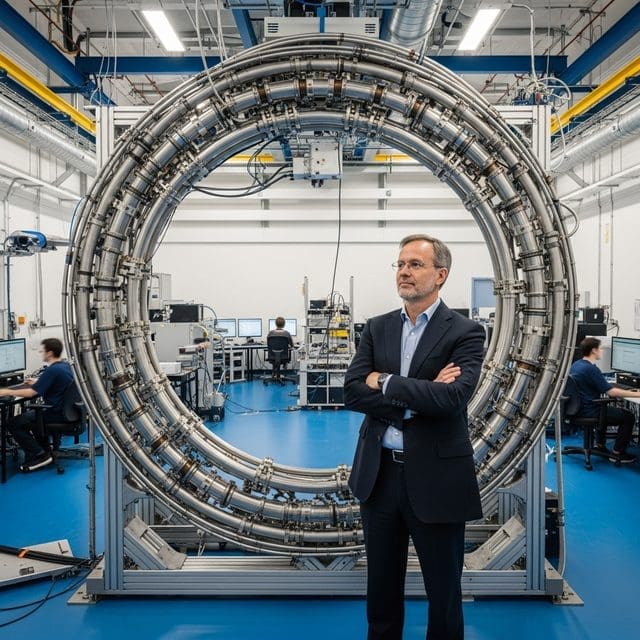
Professor David Kawall and his team earned the prestigious Breakthrough Prize in Physics for measuring subatomic magnetism with unprecedented precision, potentially revealing gaps in our fundamental understanding of the universe.
In the quiet laboratories of UMass Amherst, a decades-long pursuit of the invisible has culminated in one of science’s highest honors. David Kawall, a professor in the Department of Physics, has been named a co-recipient of the 2026 Breakthrough Prize in Fundamental Physics. The award recognizes his pivotal role in the Muon g-2 Collaborations, an international effort to measure the magnetic properties of a tiny, enigmatic particle known as the muon.
The muon is often described as a heavy cousin to the electron, sharing its charge but weighing 200 times more. For over 60 years, physicists at CERN, Brookhaven National Laboratory, and most recently Fermi National Accelerator Laboratory (Fermilab) have studied the muon’s magnetic moment—a form of internal magnetism. The goal is to see if the muon’s behavior deviates from the Standard Model, the reigning rulebook of particle physics. If the measurement, known as g-2, differs even slightly from theoretical predictions, it suggests the existence of undiscovered particles or forces acting upon the universe.
Kawall’s contribution centered on the sheer mechanical and mathematical precision required to observe such a minute phenomenon. His team at UMass was responsible for stabilizing the magnetic field within a 50-foot-diameter superconducting ring at Fermilab. To ensure the field was uniform, Kawall’s group developed a system using 8,000 laser-cut iron foils. This innovation made the magnetic field three times more homogeneous than in previous experiments, allowing for calibration probes accurate to an astonishing 15 parts per billion.
This level of detail is necessary because the Standard Model, while successful, cannot explain mysteries like dark matter or the imbalance between matter and antimatter. By measuring the muon to eight significant figures, the collaboration is effectively looking for a needle in a cosmic haystack—a tiny discrepancy that would signal a ‘new era’ of physics. Kawall noted that while the Standard Model is robust, it remains ‘woefully incomplete,’ and these experiments are the best chance to find what lies beyond it.
The $3 million prize will be shared among the collaboration members, including six current and former UMass scientists. Among the laureates are post-docs David Flay, Jimin George, and Matthew Bressler, along with graduate students Alyssa Conway and David Kessler. The recognition marks the third time UMass Amherst researchers have been part of a Breakthrough Prize-winning team, following previous awards for black hole imaging and advanced particle physics.
While the 2026 prize celebrates the completion of the Fermilab experiment, the work of analyzing the data continues. For the local community in Amherst, the award serves as a reminder that the most profound questions about the fabric of reality are being answered through the grit and intellectual rigor of local institutions and the next generation of American scientists.

Ethan Blake serves as a Senior Correspondent for Just Right News, where he specializes in Longform Narrative and Public Understanding. In an era of rapid-fire headlines and fleeting soundbites, Ethan’s work stands as a testament to the power of deep-dive reporting and the importance of contextualizing the complex issues facing the nation today. His approach is rooted in the belief that the most profound truths are often found in the lived experiences of individuals rather than the abstract theories of distant policymakers.
Growing up in Providence, Rhode Island, Ethan developed an early appreciation for the historical and cultural threads that weave the American fabric together. Providence, a city defined by its industrial heritage and its blend of traditional neighborhoods, provided him with a front-row seat to the challenges and triumphs of the American working class. This upbringing instilled in him a respect for the “common sense” values of hard work, community loyalty, and the preservation of local institutions. He learned early on that behind every economic statistic or legislative debate, there are real families and neighborhoods navigating the consequences of change.
This foundational perspective is the driving force behind his signature feature series, “Lives Behind the Systems.” Through this series, Ethan explores the intersection of individual agency and institutional structure. Whether he is documenting the impact of federal land-use policies on rural families or examining how shifting educational standards affect local school boards, Ethan’s work prioritizes the human element. He seeks to uncover how large-scale systems—be they governmental, economic, or social—affect the daily lives of citizens, often advocating for a return to local control and personal responsibility.
Now based in Portland, Maine, Ethan draws significant inspiration from the rugged independence and self-reliance that define the region. The coastal landscape and the resilient spirit of Maine’s communities serve as a constant reminder of the importance of individual liberty and the strength found in decentralized power. Living and working outside the traditional media hubs allows Ethan to maintain a grounded perspective, ensuring his reporting remains untethered from the echo chambers of the major metropolitan centers. This geographic distance provides him with the clarity needed to translate complex national narratives into stories that resonate with the heart of the country.
At Just Right News, Ethan’s beat is more than just a professional assignment; it is a mission to foster a more informed and engaged citizenry. He believes that a free society depends on the public’s ability to understand the mechanisms of power and the value of traditional American principles. His longform narratives do not merely report the news; they provide a roadmap for understanding the cultural and political shifts of the modern era through a lens of skepticism toward centralized authority and a deep respect for the individual.
Through his meticulous research and narrative craftsmanship, Ethan Blake continues to bridge the gap between policy and the public. His work remains a vital resource for those who seek a deeper understanding of the systems that shape our world and the enduring spirit of the people who live within them.