

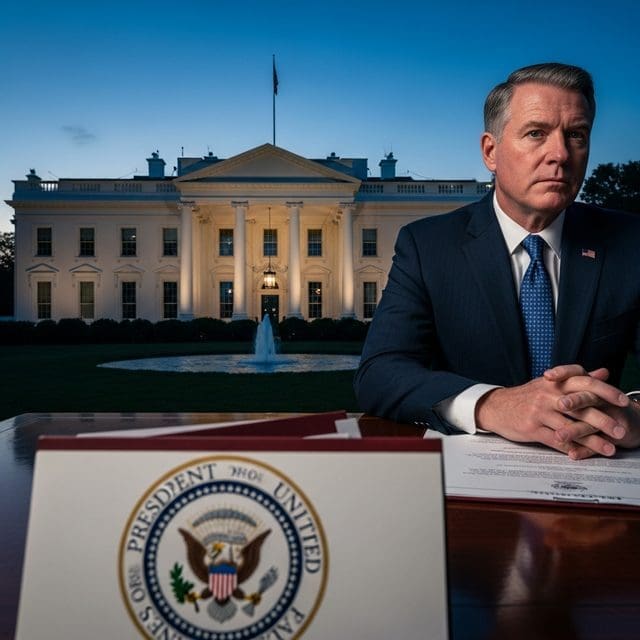
President Trump notified Congress that active hostilities with Iran have terminated, meeting a critical War Powers Resolution deadline while maintaining a naval blockade and troop presence.
President Donald Trump formally notified House Speaker Mike Johnson and Senate President Pro Tempore Chuck Grassley on May 1 that active hostilities against Iran have terminated. The notification marks a pivotal legal maneuver, arriving exactly 60 days after his initial March 2 report to Congress. By declaring an end to active combat, the administration effectively bypasses the War Powers Resolution’s requirement for congressional authorization to continue a conflict beyond the two-month window.
The President’s letter clarifies that while hostilities began on February 28, there has been no exchange of fire since the ceasefire took effect on April 7. This timeline is critical for the administration’s legal standing. Secretary of Defense Pete Hegseth testified on April 30 that the statutory clock was paused by the ceasefire, a position that allows the executive branch to maintain its current posture without seeking a formal declaration of war or specific statutory authorization from a divided Capitol Hill. This interpretation of the law maintains the ‘peace through strength’ posture while navigating the complexities of the 1973 resolution.
However, the termination of hostilities does not signal a full withdrawal or a return to the status quo. The United States continues to enforce a rigorous blockade of Iranian ports and maintains a significant troop presence in the region to ensure the security of international shipping lanes. The administration remains skeptical of Tehran’s intentions; despite an Iranian proposal to reopen the Strait of Hormuz, the White House has characterized the Iranian government as “disjointed” and expressed deep pessimism regarding a long-term diplomatic resolution. Planned talks in Islamabad have been canceled, and a key meeting scheduled for May 4 was scrapped following new U.S. sanctions and rhetoric from the Pentagon regarding Houthi proxies.
The domestic cost of Operation Epic Fury continues to fuel political friction and economic concerns in the American heartland. While the Pentagon estimates the operation’s cost at $25 billion, Iranian Foreign Minister Abbas Araghchi claimed on May 1 that the figure is closer to $100 billion. This fiscal strain, coupled with a three-year high in inflation and soaring gas prices attributed to the conflict, has impacted public sentiment. A recent Washington Post-ABC News-Ipsos survey indicates that 61 percent of Americans believe the administration erred in launching the military operations, highlighting the disconnect between foreign policy objectives and domestic economic stability.
In Congress, the response remains split along partisan lines, reflecting a broader debate over the limits of executive power in the 21st century. Democrats, joined by Senator Susan Collins, are pushing for stricter enforcement of the War Powers Resolution and demanding a comprehensive long-term strategy that includes a path to full de-escalation. Conversely, most Republican leadership continues to defer to the President’s executive authority as Commander-in-Chief. As the U.S. shifts from active combat to a state of “armed standoff,” the focus now turns to whether the blockade and sanctions can achieve the administration’s regional goals without a return to open kinetic warfare, all while the GOP navigates a complex legislative calendar that recently saw the end of a 10-week government shutdown.

Olivia Kendall serves as the Senior Correspondent for Geopolitics, Defense, and Foreign Policy at Just Right News, where she provides a principled, conservative perspective on the complex forces shaping the global stage. With a career dedicated to deconstructing the intricacies of international relations, Kendall has become a trusted voice for readers who value national sovereignty, a robust military, and a foreign policy that prioritizes American interests above all else.
A native of Washington, D.C., Kendall’s professional journey is deeply rooted in her upbringing within the nation’s capital. Growing up in the epicenter of American political life, she developed an early and profound understanding of how policy is crafted and, more importantly, how it often fails to account for the values of the American heartland. This unique vantage point allowed her to witness firsthand the rise of globalist bureaucracies, fueling her commitment to reporting that champions the constitutional foundations of the United States. Her background as a British White American further informs her worldview, providing her with a keen appreciation for the Western tradition and the enduring importance of the “Special Relationship” in maintaining global stability.
Now based in Arlington, Virginia, Kendall operates from the doorstep of the Pentagon and the heart of the nation’s defense establishment. Her proximity to the decision-makers in the military and intelligence communities allows her to provide boots-on-the-ground reporting that is both timely and deeply informed. For Kendall, Arlington is more than just a base of operations; it is a daily reminder of the sacrifices made by the men and women in uniform. This connection to the defense community drives her rigorous coverage of military readiness and her advocacy for a “peace through strength” approach to diplomacy.
At Just Right News, Kendall is perhaps best known for her acclaimed feature series, “The World’s Shadow on America.” In this ongoing project, she explores the direct correlation between international developments and the daily lives of American citizens. Whether she is analyzing the encroachment of foreign adversaries in domestic supply chains or the impact of international treaties on local economies, Kendall’s work serves as a vital bridge between distant geopolitical shifts and their consequences at home. She rejects the notion that foreign policy is an abstract concern for elites, instead proving that what happens in the corridors of power in Brussels or Beijing has a tangible “shadow” that falls across every American doorstep.
Throughout her tenure, Kendall has remained a steadfast critic of international overreach and a vocal proponent of a clear-eyed, realistic foreign policy. She brings a sharp analytical mind to her beat, often challenging the prevailing narratives of the mainstream media to uncover the underlying truths that affect national security. Her reporting is characterized by a refusal to compromise on the truth and a dedication to the idea that a strong, secure America is the world’s best hope for liberty. As a Senior Correspondent, Olivia Kendall continues to lead the charge in providing the essential context and conservative insight necessary to navigate an increasingly volatile world.