

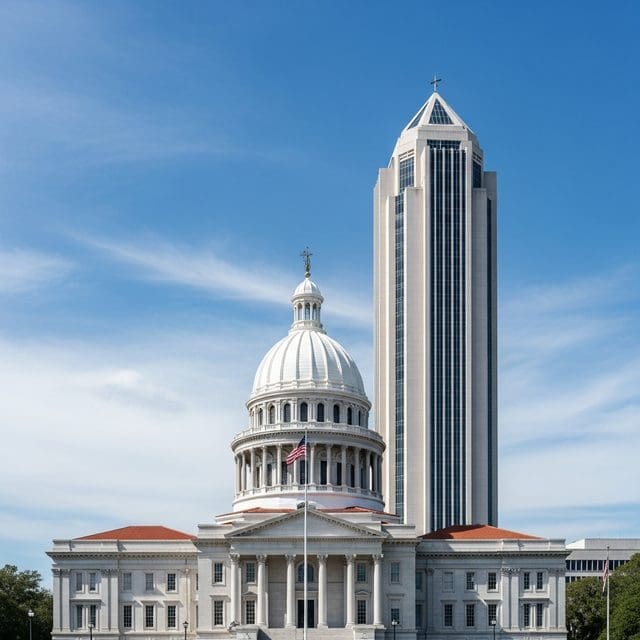
Governor Ron DeSantis convenes a special session to solidify Republican control through a new congressional map while exploring state-level AI regulations and vaccine mandate relaxations.
The Florida statehouse convened a special legislative session on April 28, 2026, marking a significant moment in the ongoing effort by Governor Ron DeSantis to assert state sovereignty and reshape the political landscape. At the heart of the session is a new congressional redistricting map, unveiled by the Governor just one day prior, which seeks to capitalize on a 1.5 million Republican voter registration edge and recent census data.
The proposed map represents a bold exercise in state-level authority, targeting Democratic strongholds in Orlando, Tampa Bay, and South Florida. If approved by the Republican supermajorities in the House and Senate, the plan is expected to shift the state’s congressional delegation from a 20-8 Republican split to a dominant 24-4 advantage. This move aligns with broader national efforts by the GOP to secure the U.S. House of Representatives, contrasting sharply with recent redistricting setbacks for the party in states like Virginia.
Central to the Governor’s legal argument is a memo from his counsel asserting that the new boundaries eliminate race-based minority districts. This approach challenges prevailing interpretations of the Voting Rights Act, with the administration citing population shifts and a desire to move toward colorblind jurisdictional lines. While some political consultants have expressed concern regarding potential Democratic backlash in the 2026 midterms, the Governor’s office remains firm in its commitment to a map that reflects Florida’s current demographic and political reality.
Beyond redistricting, the special session serves as a laboratory for policy experiments that push back against federal preemption. Although House Speaker Perez noted that formal bills have not yet been filed, the session’s agenda includes discussions on state-level artificial intelligence regulations and further relaxations of vaccine mandates. These initiatives underscore a growing trend among heartland states to insulate their citizens from federal overreach and centralized technocratic control.
This legislative push occurs against a backdrop of national instability. As Florida lawmakers debate the future of their districts, federal authorities in Washington are processing the initial court appearance of Cole Allen, the 31-year-old charged with attempting to assassinate President Trump at the White House Correspondents Association dinner on April 26. While the federal government grapples with security crises and international tensions in the Strait of Hormuz, Florida’s focus remains on the structural mechanics of governance.
The outcome of this special session will likely serve as a blueprint for other states seeking to maximize their influence within the federalist system. By asserting control over the electoral process and exploring independent regulatory frameworks for emerging technologies, Florida continues to lead the charge in the ‘Fifty Laboratories of Power,’ demonstrating that the most impactful governance often happens closest to home.

Dylan Brooks serves as the Senior Correspondent for Statehouses and Local Governance at Just Right News, where he brings a principled, constitutionalist lens to the often-overlooked machinery of state-level politics. As the lead voice behind the acclaimed feature series “Fifty Laboratories of Power,” Dylan has dedicated his career to the idea that the most impactful governance happens closest to home. His reporting consistently champions the Tenth Amendment, exploring how individual states can serve as testing grounds for innovative, conservative policy solutions that prioritize personal liberty and fiscal responsibility.
A native of Des Moines, Iowa, Dylan’s journalistic philosophy was forged in the heart of the American Midwest. Growing up in a community where local school board meetings and town halls were the bedrock of civic life, he developed a deep appreciation for the “retail politics” of the heartland. This upbringing instilled in him a fundamental belief that the American experiment is best preserved when power is decentralized. He carries the values of his Iowa roots into every assignment, maintaining a healthy skepticism of federal overreach and a steadfast commitment to the concerns of everyday citizens over the interests of the administrative state.
Now based in Madison, Wisconsin, Dylan operates from one of the nation’s most pivotal political battlegrounds. His location in a state capital known for its rigorous policy debates allows him to provide Just Right News readers with a front-row seat to the legislative process. From Madison, he tracks the ripple effects of statehouse decisions on local municipalities, ensuring that the connection between high-level policy and community impact is never lost. His work often highlights the success of conservative governors and legislatures in fostering economic growth, protecting parental rights, and securing the integrity of local institutions.
As an African American man in the conservative media landscape, Dylan offers a vital perspective on how limited government and free-market principles empower individuals and families. He frequently reports on how deregulation and school choice initiatives provide new avenues for success in underserved communities, challenging the monolithic narratives often presented by legacy media outlets. Dylan’s work is characterized by a commitment to the facts and a refusal to shy away from the complex realities of modern governance.
Throughout his tenure at Just Right News, Dylan has become a trusted authority for readers who value a rigorous, principled approach to the news. Whether he is dissecting a complex state budget or profiling a local grassroots movement, his goal remains the same: to provide the American public with the information they need to hold their local leaders accountable. By focusing on the “Fifty Laboratories of Power,” Dylan Brooks ensures that the vital work being done in statehouses across the country receives the national attention it deserves, always through a lens that respects the traditions and sovereignty of the American people.