

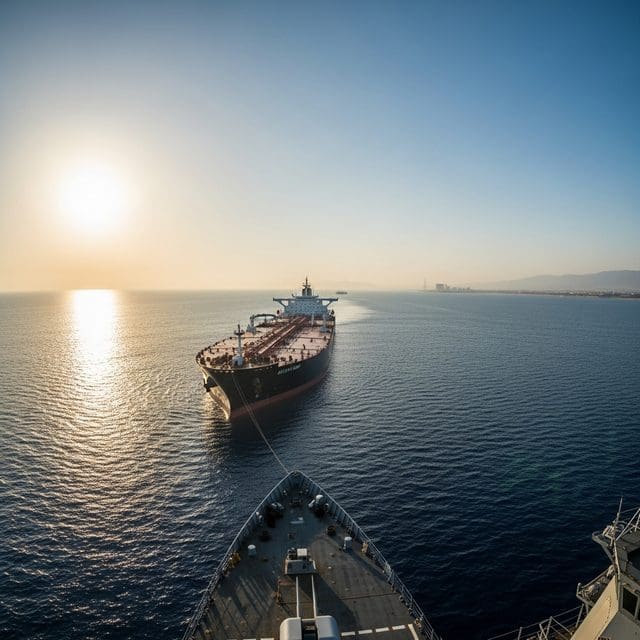
Crude prices fluctuate following a three-week Israel-Lebanon ceasefire extension while the U.S. and Iran navigate a tense naval standoff in the Strait of Hormuz.
Global energy markets are grappling with a complex web of geopolitical signals as diplomatic breakthroughs in the Levant contrast sharply with an escalating maritime standoff in the Persian Gulf. On Thursday, President Donald Trump announced that Israel and Lebanon have agreed to a three-week ceasefire extension following high-level White House talks. The news provided a brief reprieve for energy traders, yet the broader supply outlook remains clouded by the ongoing deadlock in the Strait of Hormuz.
Brent crude surged above $106 per barrel this morning, marking a staggering 73% increase year-to-date. The price action reflects the reality of a physical market under duress. While the U.S. Treasury recently extended sanctions relief for Russian and Iranian oil for an additional 30 days to mitigate consumer costs, the relief is largely theoretical as long as the Strait remains a theater of conflict. Iran’s closure of the waterway and the subsequent U.S. Navy blockade have effectively neutralized the impact of the Treasury’s policy.
In Washington, the administration’s strategy appears to be one of maximum leverage. President Trump stated he is in no rush to finalize a comprehensive deal with Tehran, noting that the economic impact on domestic stocks and oil prices has been less severe than initial projections suggested. However, this assessment may overlook the compounding pressure on the American taxpayer, who is now facing the highest energy costs in years. The U.S. Navy has expanded its role, with the President declaring that no vessel may enter or leave the Strait without American authorization, a move that has drawn sharp rebukes from Tehran.
Iranian officials have accused the United States of impeding peace negotiations through this naval blockade, setting a difficult stage for the upcoming round of talks in Pakistan. Despite the rhetoric, there are signs of movement; Iran’s top diplomat is expected in Islamabad this evening to discuss potential peace frameworks. This follows a brief window where Trump gave Iranian factions additional time to unify their government positions for a return to the negotiating table.
European leaders remain cautious. Meeting in Cyprus, EU Council President Antonio Costa emphasized that it is premature to discuss formal sanctions relief for Iran. This stance aligns with the current market reality where geopolitical risk premiums are being baked into every barrel. For the American energy sector, the volatility underscores the precarious nature of relying on global chokepoints. While diplomatic extensions in Lebanon offer a template for stability, the path to energy security remains blocked by the physical and political barriers in the Persian Gulf.
Mark Davis serves as the Senior Correspondent for Energy, Climate, and Resource Economics at Just Right News. In an era where the conversation around the environment is often dominated by alarmism and top-down mandates, Mark provides a vital, market-oriented perspective on the complex forces shaping our world. As the lead voice behind the acclaimed feature series “Power and the Planet,” he explores the intersection of environmental policy, global energy markets, and the fundamental economic principles that sustain modern civilization.
Mark’s pragmatic approach to resource management was forged in the high desert of his hometown, Albuquerque, New Mexico. Growing up in a region defined by both its breathtaking natural beauty and its rugged, resource-dependent landscape, he developed an early appreciation for the delicate balance between conservation and utilization. New Mexico’s unique position as a hub for both traditional energy production and cutting-edge scientific research provided Mark with a front-row seat to the evolution of the American energy sector. This upbringing instilled in him a deep-seated belief that true environmental stewardship is inseparable from economic prosperity and technological innovation.
Now based in Boulder, Colorado, Mark operates from the heart of the nation’s climate research community. While Boulder is often seen as a bastion of environmental idealism, Mark utilizes his post to provide a necessary counterweight, grounded in the realities of resource economics. He understands that energy policy does not exist in a vacuum; it has tangible consequences for the American taxpayer, the stability of the national power grid, and the strength of the domestic manufacturing sector. By reporting from the front lines of the climate debate, he is able to challenge prevailing narratives with hard data and a commitment to the principles of the free market.
Throughout his tenure at Just Right News, Mark has distinguished himself by focusing on the “Resource Economics” aspect of his beat. He frequently highlights the hidden costs of rapid energy transitions and advocates for an “all-of-the-above” energy strategy that prioritizes American energy independence. His work often shines a light on the geopolitical implications of resource scarcity, arguing that a secure nation must first be an energy-secure nation. Whether he is analyzing the impact of federal land-use regulations or investigating the supply chains required for new technologies, Mark remains focused on how policy decisions affect the lives and livelihoods of everyday citizens.
In “Power and the Planet,” Mark continues to bridge the gap between complex scientific concepts and the economic realities facing the country. He rejects the false choice between a healthy environment and a thriving economy, instead seeking out solutions that leverage American ingenuity and private-sector competition. For Mark, reporting on the climate is not about following the latest trends, but about ensuring that the conversation remains tethered to the foundational values of liberty, property rights, and fiscal responsibility. His contributions ensure that Just Right News readers receive a comprehensive, clear-eyed view of the challenges and opportunities defining the future of our planet.