

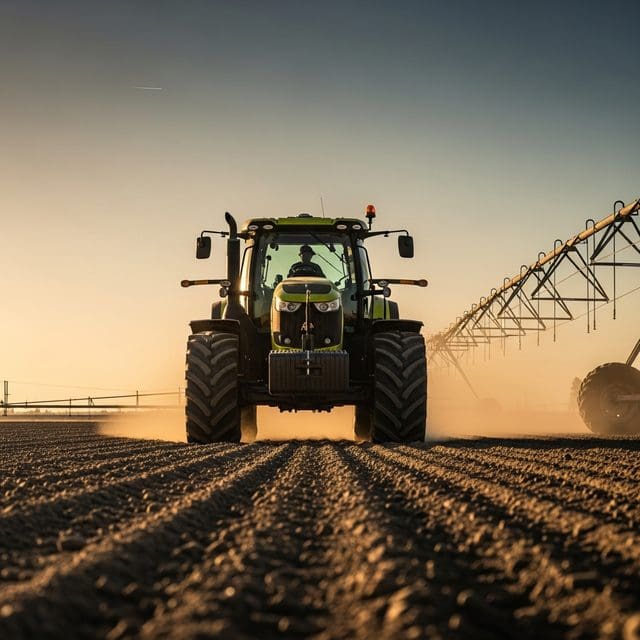
American farmers face a tightening vice of rising labor costs, increased certification fees, and new EPA pesticide mandates while the Iran war drives up essential input prices.
The American dinner table is becoming a battlefield of competing economic and regulatory pressures. As of late April 2026, the agricultural sector is navigating a perfect storm of geopolitical instability, rising labor costs, and a tightening regulatory environment that threatens to push food prices higher for the average family.
Energy costs remain a primary driver of instability. U.S. Energy Secretary Chris Wright recently warned that gasoline prices may stay above $3 per gallon into 2027, largely due to the ongoing impact of the Iran war. This energy crisis has a direct ripple effect on the farm, where fuel and fertilizer costs are inextricably linked to global oil markets. While the Trump administration invoked the Defense Production Act on April 20 to boost domestic fuel and electricity production, the immediate relief for producers remains to be seen. Business Insider reports that these war-driven hikes in oil and fertilizer are already fueling significant price rises in produce across the country.
On the regulatory front, the Environmental Protection Agency (EPA) finalized updates to pesticide tolerances for six ingredients, including hydrogen cyanide, effective April 22. While the agency cites child safety concerns for these updates, the move adds another layer of compliance for growers already struggling with thin margins. Simultaneously, the organic sector is facing its own internal cost spikes. CCOF organic certification fees are set to rise by 3.6 percent, and retailers with more than ten locations will see fee increases of $350 per location. These administrative burdens contribute to the widening gap between conventional and organic food prices, making healthy choices more difficult for the 19 percent of Californians who can barely afford median housing.
Labor remains the most volatile variable for American producers. Purdue University economists report that U.S. farms are currently spending 10 to 20 percent of their total income on labor. In California, legislative proposals like AB 2646 seek to raise agricultural wages to $19.75 per hour, a nearly $3 jump from the current minimum. To counter this unpredictability, some federal lawmakers have introduced the FARM Stability Act to codify Department of Labor wage tiers, aiming to provide farmers with a more predictable cost structure. This comes at a time when the National Police Association is also pushing for stricter commercial driver licensing, which could further tighten the logistics and transport labor pool for food distribution.
While federal regulators focus on pesticide ingredients and wage tiers, private sector initiatives are attempting to fill the gaps in infrastructure. The American Water Charitable Foundation recently awarded $1.5 million to various nonprofits to support water and environmental health through 2026. However, for the independent farmer in the San Joaquin Valley or the Midwest, these grants are small comfort against the systemic rise in the cost of doing business. As the USDA adjusts Thrifty Food Plan costs to account for inflation, the reality remains that domestic food security depends on the ability of the American farmer to remain solvent under an increasingly heavy regulatory hand and an uncertain global market.

Eric Nolan serves as the Senior Correspondent for Food, Water, and Environmental Health at Just Right News, where he brings a principled, common-sense perspective to the most fundamental issues facing the American public. With a career dedicated to uncovering the truth behind the policies that govern our natural resources, Eric has become a trusted voice for readers who value traditional stewardship over bureaucratic overreach. His reporting is defined by a commitment to the idea that true environmentalism is rooted in the protection of the American family and the preservation of the nation’s agricultural heritage.
Raised in Fresno, California, Eric’s worldview was shaped in the heart of the San Joaquin Valley. Growing up in one of the world’s most productive agricultural hubs, he witnessed firsthand the vital connection between the land, the water, and the dinner table. In Fresno, he saw the resilience of farmers and the devastating impact that distant, top-down regulations can have on local communities. This upbringing instilled in him a deep respect for the producers who feed the country and a lifelong skepticism toward the alarmist narratives often pushed by mainstream media. For Eric, environmental health is not an abstract political talking point; it is a matter of ensuring that the people who work the land have the freedom and the resources to do so effectively.
Now based in Eugene, Oregon, Eric operates from a unique vantage point in the Pacific Northwest. Living in a region often defined by intense environmental debate, he provides a necessary counter-narrative to the prevailing trends of the area. From his base in Eugene, he monitors the shifting tides of federal and state policies, ensuring that the voices of rural citizens and property owners are not drowned out by urban activism. His reporting often bridges the gap between the rugged realities of the outdoors and the legislative halls where decisions are made, offering a grounded perspective that prioritizes local sovereignty and practical solutions.
As the lead for the acclaimed feature series “Earth on the Table,” Eric explores the intricate journey of the American food supply. He tackles critical issues such as water rights, soil health, and food security through a lens of national stability and individual liberty. He believes that a healthy environment and a thriving economy are not mutually exclusive, but rather two sides of the same coin of national prosperity. His work consistently highlights how innovation and private-sector ingenuity are the most effective tools for ensuring clean water and a safe food supply, rather than the expansion of the administrative state.
At Just Right News, Eric’s reporting serves as a vital resource for those who seek accountability and transparency. Whether he is investigating the impact of federal land management on local economies or examining the safety of the national food infrastructure, his work remains anchored in the values of heritage and hard work. Eric Nolan continues to be a leading voice in environmental journalism, championing the belief that the best way to protect our natural resources is to empower the people who live and work closest to them.