

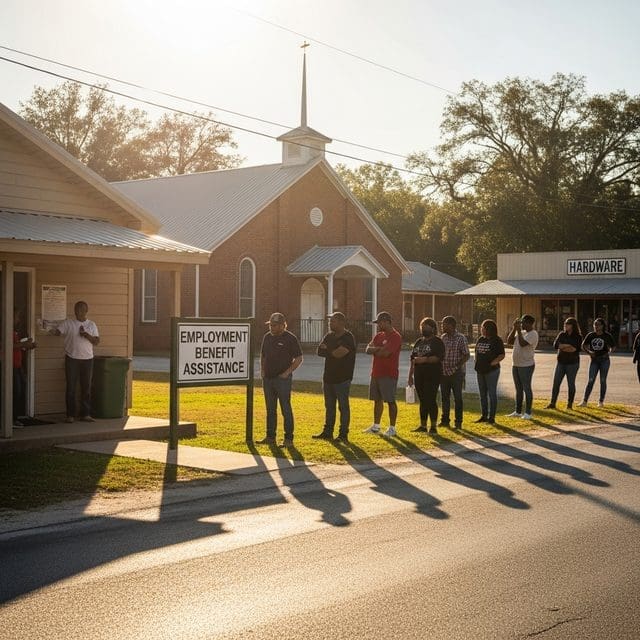
As federal SNAP work requirements expand to age 65, local governments and low-income families face a tightening fiscal squeeze and a widening national wealth gap.
The American social safety net is undergoing its most significant structural shift in decades as new federal mandates prioritize workforce participation over unconditional aid. Under the provisions of H.R. 1 and H.R. 5371, the Supplemental Nutrition Assistance Program (SNAP) has expanded its work requirements to include adults up to age 65, a notable increase from the previous threshold of 54. This policy shift, framed as a move toward economic self-sufficiency, requires recipients to complete 20 hours of weekly work, volunteering, or training to maintain eligibility.
The Congressional Budget Office projects that these expanded requirements will result in 2.4 million beneficiaries losing assistance. The impact is already being felt at the local level. In San Diego County, officials estimate that implementing these new verification systems will cost $300 million and require 1,000 additional staff members, even as 400,000 local residents face the risk of losing their benefits. Virginia has already begun enforcing these strict verification measures as of March 2026, placing a premium on administrative accuracy to avoid losing federal funding due to error rates exceeding 6%.
This tightening of the safety net coincides with an era of unprecedented economic divergence. Data from the third quarter of 2025 reveals that the top 1% of Americans now hold 32% of the nation’s wealth, while the bottom 50% hold just 2.5%. The Gini coefficient, a standard measure of income inequality, has reached a 60-year high. While stock market gains have bolstered high earners, the wage share of the economy has hit a 75-year low, creating a K-shaped recovery that leaves many working-class families behind. The poorest top 1% households have gained nearly 1,000 times more wealth than the richest bottom 20% households since 1989.
Beyond work requirements, administrative changes are further reducing the reach of federal aid. The removal of internet costs from SNAP benefit calculations is expected to cut monthly assistance by an average of $10 for 13 million households. Furthermore, an estimated 96,000 children are projected to lose access to free school meals as their families lose SNAP eligibility. In New York, the eligibility ceiling for the Essential Plan is set to drop from 250% to 200% of the Federal Poverty Level by July 2026, potentially displacing 450,000 residents from their current coverage. Additionally, new immigrant Medicaid restrictions taking effect in October 2026 will limit federal reimbursement to specific categories like green card holders with five years of residency.
States are responding to these federal shifts with varying strategies. Washington State has allocated $165 million in its 2026 budget to mitigate the impact of these cuts, whereas Oregon has directed agencies to propose 5% statewide budget reductions. As the federal government emphasizes fiscal discipline and work-based mobility through H.R. 1, the burden of maintaining community resilience and navigating the transition from dependency to the workforce increasingly falls upon local institutions and state legislatures. The goal of a springboard to mobility remains, but the path is becoming narrower for millions of Americans.

James Foster serves as the Senior Correspondent for Inequality and the Social Safety Net at Just Right News, where he brings a principled and nuanced perspective to the most pressing economic challenges facing the nation. With a career dedicated to exploring the intersection of policy and personal responsibility, Foster has become a leading voice in documenting how government programs and economic shifts impact the American family. His reporting is characterized by a commitment to the “human element,” moving beyond cold statistics to highlight the stories of resilience, work, and community that define the modern American experience.
Foster’s perspective is deeply rooted in his upbringing in Birmingham, Alabama. Growing up in a city with a rich industrial heritage and a history of economic transformation, he witnessed firsthand the importance of the dignity of work and the strength of local institutions. In Birmingham, he saw how the most effective safety nets were often those woven by neighbors, faith-based organizations, and local civic groups. This background instilled in him a lifelong skepticism of “one-size-fits-all” solutions from distant bureaucracies, favoring instead the localized, community-driven support systems that he frequently champions in his writing.
Now based in Atlanta, Georgia, Foster operates from one of the most dynamic and rapidly evolving metropolitan hubs in the South. His location provides a front-row seat to the stark contrasts of the modern economy. From the gleaming towers of Atlanta’s financial districts to the struggling neighborhoods on the city’s periphery, Foster finds the stories that illustrate the complexities of upward mobility. His reporting from the Sun Belt serves as a microcosm for the national debate on poverty, highlighting how inflation, housing costs, and labor market shifts affect the working class in real-time.
As the lead for the acclaimed feature series “America’s Balancing Act,” Foster explores the delicate tension between providing a necessary hand up and fostering long-term independence. The series has become a cornerstone of Just Right News, offering a deep dive into the unintended consequences of social welfare policies. Foster’s work often focuses on the “cliff effect” and other systemic hurdles that can inadvertently discourage employment, arguing that true compassion is measured by how many people are empowered to leave the safety net, rather than how many are added to it.
Throughout his tenure, Foster has remained dedicated to the mission of Just Right News, providing a clear-eyed, conservative analysis of social issues. He believes that a free society thrives when individuals are empowered and the private sector is allowed to innovate. Whether he is interviewing small business owners about the challenges of a changing workforce or documenting the success of private charitable initiatives, Foster’s goal is to provide readers with the truth about the state of the American Dream. His work serves as a vital reminder that while the challenges of inequality are great, the solutions are often found in the strength of the American spirit and the preservation of traditional values.