

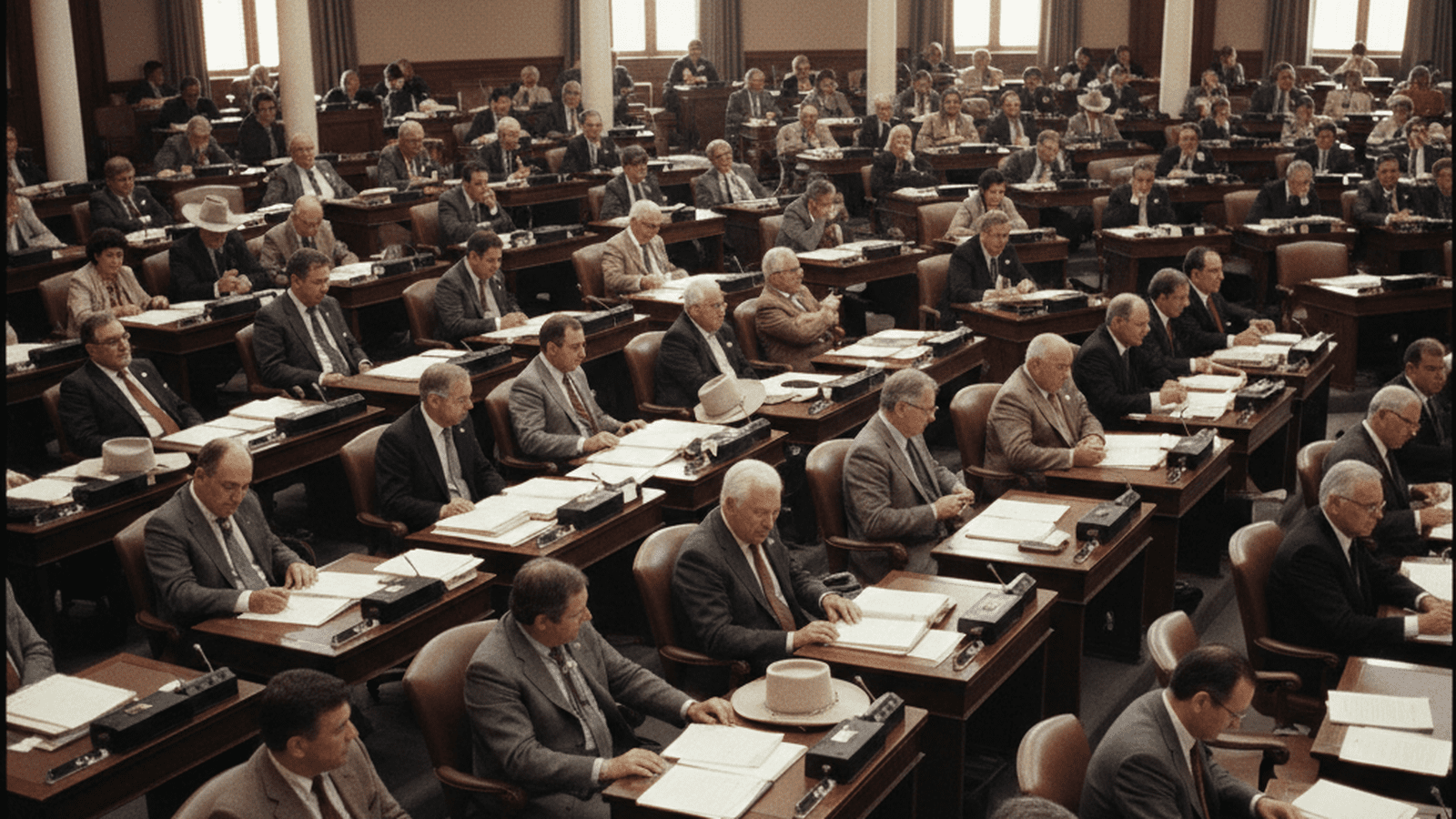
In 1982, a group of conservative Democrats known as the ‘Cowboys’ formed a coalition with Republicans to seize control of the New Mexico House of Representatives. This realignment bypassed traditional party leadership in the United States and dictated the state’s legislative agenda for several years.
TLDR: In 1982, ten conservative ‘Cowboy’ Democrats in New Mexico broke party lines to form a governing coalition with Republicans. This parliamentary maneuver stripped the Democratic leadership of power and shifted the state’s legislative focus toward fiscal conservatism and rural interests, fundamentally altering the political dynamics of the Mountain West.
In January 1982, the New Mexico House of Representatives underwent a dramatic structural shift that redefined the state’s political landscape for nearly a decade. While the Democratic Party held a nominal 41-29 majority following the previous elections, internal ideological fractures led to a sudden parliamentary coup. A group of ten conservative Democrats, colloquially known as the “Cowboys,” broke ranks with their party leadership to form a governing alliance with the Republican minority. This maneuver effectively transferred control of the chamber to a bipartisan coalition, bypassing the traditional party hierarchy and installing a new leadership structure that favored rural and conservative interests.
The catalyst for this realignment was a deep-seated dissatisfaction among rural and conservative Democrats regarding the progressive direction of the state party. These members, representing districts in the southeastern region of New Mexico and other rural areas, felt that the Democratic leadership in Santa Fe was increasingly urban-centric. They argued that the party’s agenda was becoming out of step with the fiscal and social values of their constituents, particularly regarding land use, energy regulation, and state spending. By joining forces with Republicans, the “Cowboys” sought to influence committee assignments, budget priorities, and the critical redistricting process that followed the 1980 census.
The move was orchestrated with remarkable precision, catching the regular Democratic caucus off guard during the opening days of the legislative session. Representative C. Gene Samberson, a Democrat from Lovington, emerged as a central figure in the coalition’s formation. Under the new arrangement, the coalition elected a Speaker who would accommodate the interests of both the Republican minority and the conservative Democratic defectors. This power-sharing agreement fundamentally altered the legislative process, as every major piece of legislation required the approval of this diverse and often fragile voting bloc. The coalition prioritized fiscal restraint, energy development, and a more conservative approach to criminal justice, often clashing with the more liberal state Senate.
The 1982 realignment was not merely a temporary protest but a sustained governing strategy that persisted through multiple sessions. The coalition maintained its grip on the House for several years, surviving subsequent elections and intense internal challenges. This period was marked by significant partisan friction, as loyalist Democrats viewed the defectors as traitors to the party platform and the voters who had elected them. Political battles became increasingly personal, with leadership fights spilling over into public denunciations and primary challenges. Conversely, supporters of the coalition argued that the arrangement provided a necessary check on partisan extremism and ensured that rural interests were not sidelined by the growing influence of Albuquerque.
The coalition’s influence extended into the mid-1980s, shaping the state’s response to economic fluctuations and the declining revenues from the oil and gas industry. By controlling the House Appropriations and Finance Committee, the coalition was able to dictate the terms of the state budget, often forcing the executive branch to accept significant spending cuts. This era of coalition politics forced a generation of New Mexico politicians to master the art of cross-party negotiation, as the traditional rules of party discipline no longer applied.
The legacy of the 1982 coalition era in New Mexico highlights the fluidity of legislative power in the Mountain West. It demonstrated that nominal party majorities could be rendered irrelevant by strategic cross-party alliances. This period of parliamentary realignment eventually faded as the state’s demographics shifted and the Republican Party grew strong enough to compete for outright majorities in its own right. However, the precedent set by the Cowboys remains a significant case study in how internal dissent can reshape statehouse governance and force bipartisan cooperation through unconventional means.

Dylan Brooks serves as the Senior Correspondent for Statehouses and Local Governance at Just Right News, where he brings a principled, constitutionalist lens to the often-overlooked machinery of state-level politics. As the lead voice behind the acclaimed feature series “Fifty Laboratories of Power,” Dylan has dedicated his career to the idea that the most impactful governance happens closest to home. His reporting consistently champions the Tenth Amendment, exploring how individual states can serve as testing grounds for innovative, conservative policy solutions that prioritize personal liberty and fiscal responsibility.
A native of Des Moines, Iowa, Dylan’s journalistic philosophy was forged in the heart of the American Midwest. Growing up in a community where local school board meetings and town halls were the bedrock of civic life, he developed a deep appreciation for the “retail politics” of the heartland. This upbringing instilled in him a fundamental belief that the American experiment is best preserved when power is decentralized. He carries the values of his Iowa roots into every assignment, maintaining a healthy skepticism of federal overreach and a steadfast commitment to the concerns of everyday citizens over the interests of the administrative state.
Now based in Madison, Wisconsin, Dylan operates from one of the nation’s most pivotal political battlegrounds. His location in a state capital known for its rigorous policy debates allows him to provide Just Right News readers with a front-row seat to the legislative process. From Madison, he tracks the ripple effects of statehouse decisions on local municipalities, ensuring that the connection between high-level policy and community impact is never lost. His work often highlights the success of conservative governors and legislatures in fostering economic growth, protecting parental rights, and securing the integrity of local institutions.
As an African American man in the conservative media landscape, Dylan offers a vital perspective on how limited government and free-market principles empower individuals and families. He frequently reports on how deregulation and school choice initiatives provide new avenues for success in underserved communities, challenging the monolithic narratives often presented by legacy media outlets. Dylan’s work is characterized by a commitment to the facts and a refusal to shy away from the complex realities of modern governance.
Throughout his tenure at Just Right News, Dylan has become a trusted authority for readers who value a rigorous, principled approach to the news. Whether he is dissecting a complex state budget or profiling a local grassroots movement, his goal remains the same: to provide the American public with the information they need to hold their local leaders accountable. By focusing on the “Fifty Laboratories of Power,” Dylan Brooks ensures that the vital work being done in statehouses across the country receives the national attention it deserves, always through a lens that respects the traditions and sovereignty of the American people.