

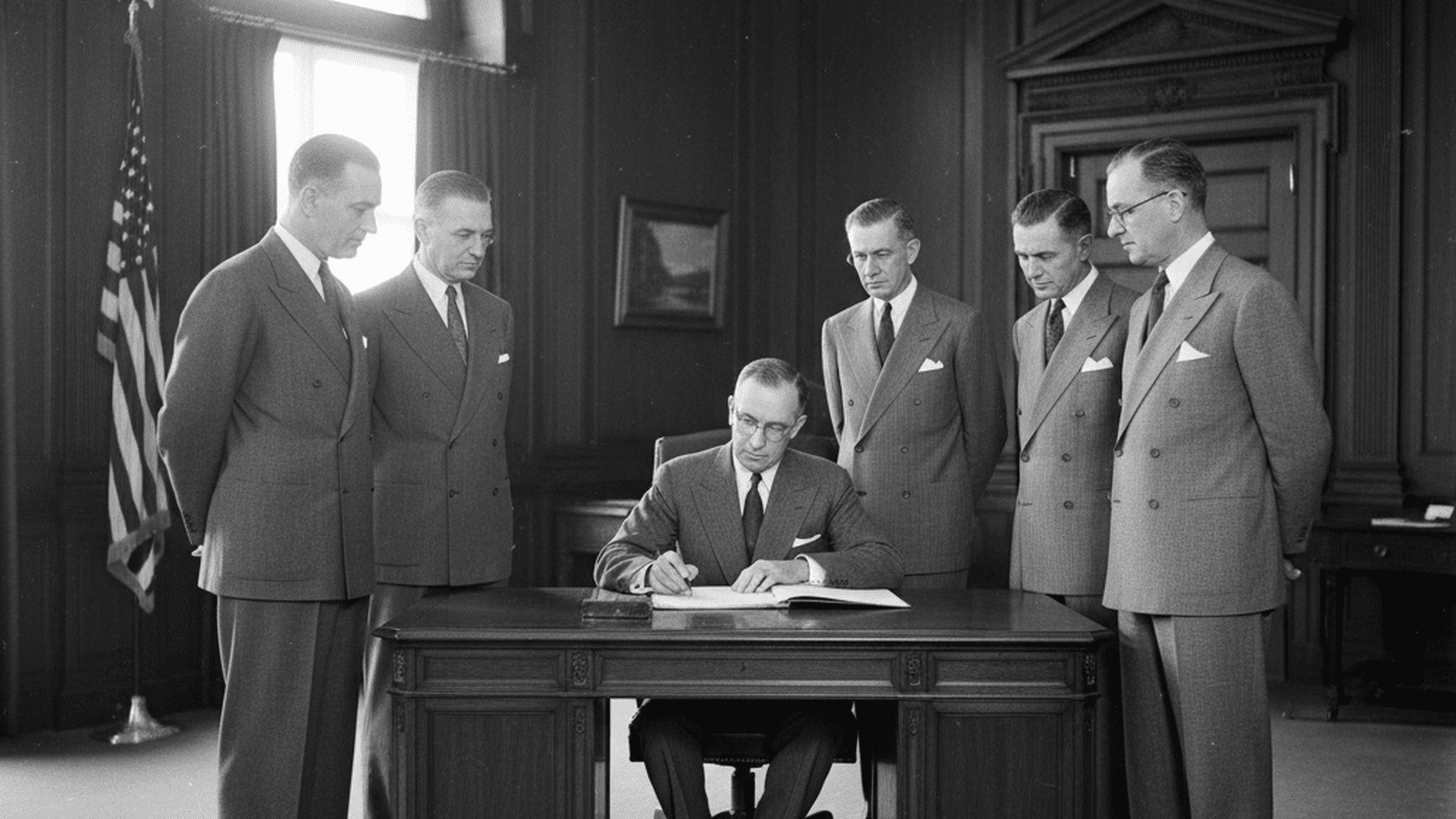
In 1943, Connecticut became the first state in the United States to establish a permanent administrative agency dedicated to civil rights. The Inter-racial Commission was created to address systemic discrimination in employment and housing during the height of World War II.
TLDR: Connecticut pioneered state-level civil rights enforcement in 1943 by creating the Inter-racial Commission. This landmark agency, the first of its kind in the United States, sought to eliminate discrimination in the defense industry and housing, setting a precedent for future state and federal human rights legislation.
In 1943, as the United States funneled its industrial might into the “Arsenal of Democracy,” the state of Connecticut found itself at the epicenter of the nation’s wartime production. Cities like Hartford, Bridgeport, and New Haven were bustling with activity as factories operated around the clock to supply the Allied forces. This industrial boom triggered a massive migration of workers, including many African Americans from the South and immigrants from various backgrounds, all seeking employment in the state’s defense plants. However, this rapid demographic shift also brought long-standing racial and ethnic tensions to the surface, revealing systemic barriers in both the labor market and the housing sector.
Recognizing that social friction could undermine wartime productivity and domestic stability, the Connecticut General Assembly took a historic and unprecedented step. On June 29, 1943, Governor Raymond E. Baldwin signed into law the act creating the Inter-racial Commission. This legislative milestone made Connecticut the first state in the union to establish a permanent administrative agency specifically dedicated to the protection of civil rights. While the federal government had established the temporary Fair Employment Practice Committee (FEPC) via executive order in 1941, Connecticut’s move was unique because it created a permanent, state-sanctioned body with a broad mandate to address discrimination.
The creation of the commission was the result of intense advocacy from a coalition of religious leaders, labor organizers, and civil rights activists. Organizations such as the NAACP and the Connecticut Council of Churches argued that the state could not effectively fight for democracy abroad while permitting systemic inequality at home. They pushed for a legal framework that moved beyond the judicial system, which was often too slow or expensive for the average citizen to navigate. The Inter-racial Commission was designed to be a proactive administrative body, capable of investigating social conditions and mediating disputes before they reached a breaking point.
Initially, the commission consisted of ten members appointed by the Governor, serving without compensation. Their primary mission was to investigate the “possibilities of affording equal opportunity of profitable employment to all persons, with particular reference to race, color, religious creed, national origin, or ancestry.” In its early years, the commission focused heavily on research and education. Members conducted extensive surveys of industrial plants and housing developments to document the extent of discriminatory practices. They acted as a bridge between marginalized communities and the state’s industrial leadership, advocating for the integration of workforces in critical sectors like aerospace and munitions.
The commission’s early work was often delicate, relying on persuasion and public reports rather than the heavy-handed enforcement powers that would characterize later civil rights legislation. However, its very existence signaled a fundamental shift in the role of state government. By acknowledging that discrimination was a matter of public policy and state concern, Connecticut set a precedent that other Northern states would soon follow. New York established its own commission against discrimination in 1945, and Massachusetts followed in 1946, both using the Connecticut model as a blueprint for their own administrative structures.
Over the decades, the agency’s powers expanded significantly. In 1947, Connecticut passed the Fair Employment Practices Act, which gave the commission the authority to issue “cease and desist” orders against employers found guilty of discrimination. In 1967, the agency was renamed the Commission on Human Rights and Opportunities (CHRO) to reflect its broader jurisdiction, which eventually grew to include protections against discrimination based on sex, age, disability, and sexual orientation. Today, the CHRO remains the oldest state civil rights agency in the country, serving as a testament to Connecticut’s early commitment to institutionalizing equality and providing a model for the federal Civil Rights Act of 1964.

James Foster serves as the Senior Correspondent for Inequality and the Social Safety Net at Just Right News, where he brings a principled and nuanced perspective to the most pressing economic challenges facing the nation. With a career dedicated to exploring the intersection of policy and personal responsibility, Foster has become a leading voice in documenting how government programs and economic shifts impact the American family. His reporting is characterized by a commitment to the “human element,” moving beyond cold statistics to highlight the stories of resilience, work, and community that define the modern American experience.
Foster’s perspective is deeply rooted in his upbringing in Birmingham, Alabama. Growing up in a city with a rich industrial heritage and a history of economic transformation, he witnessed firsthand the importance of the dignity of work and the strength of local institutions. In Birmingham, he saw how the most effective safety nets were often those woven by neighbors, faith-based organizations, and local civic groups. This background instilled in him a lifelong skepticism of “one-size-fits-all” solutions from distant bureaucracies, favoring instead the localized, community-driven support systems that he frequently champions in his writing.
Now based in Atlanta, Georgia, Foster operates from one of the most dynamic and rapidly evolving metropolitan hubs in the South. His location provides a front-row seat to the stark contrasts of the modern economy. From the gleaming towers of Atlanta’s financial districts to the struggling neighborhoods on the city’s periphery, Foster finds the stories that illustrate the complexities of upward mobility. His reporting from the Sun Belt serves as a microcosm for the national debate on poverty, highlighting how inflation, housing costs, and labor market shifts affect the working class in real-time.
As the lead for the acclaimed feature series “America’s Balancing Act,” Foster explores the delicate tension between providing a necessary hand up and fostering long-term independence. The series has become a cornerstone of Just Right News, offering a deep dive into the unintended consequences of social welfare policies. Foster’s work often focuses on the “cliff effect” and other systemic hurdles that can inadvertently discourage employment, arguing that true compassion is measured by how many people are empowered to leave the safety net, rather than how many are added to it.
Throughout his tenure, Foster has remained dedicated to the mission of Just Right News, providing a clear-eyed, conservative analysis of social issues. He believes that a free society thrives when individuals are empowered and the private sector is allowed to innovate. Whether he is interviewing small business owners about the challenges of a changing workforce or documenting the success of private charitable initiatives, Foster’s goal is to provide readers with the truth about the state of the American Dream. His work serves as a vital reminder that while the challenges of inequality are great, the solutions are often found in the strength of the American spirit and the preservation of traditional values.