

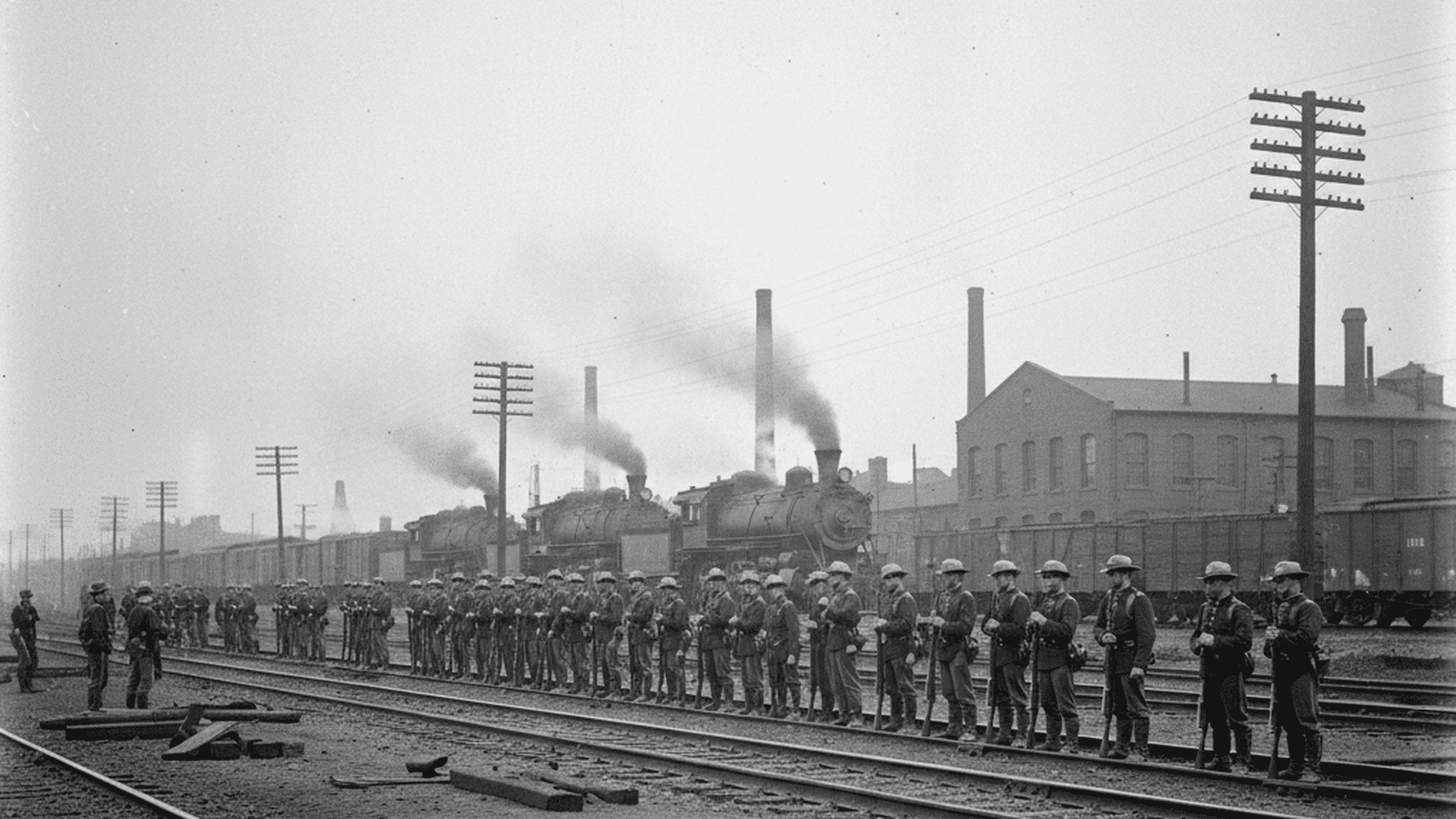
In 1894, President Grover Cleveland deployed federal troops to Chicago to suppress the Pullman Strike, overriding the objections of Illinois Governor John Peter Altgeld. This event in the United States marked a significant expansion of executive power and established the federal government’s authority to intervene in labor disputes that affected interstate commerce.
TLDR: President Grover Cleveland’s 1894 decision to send federal troops to Chicago during the Pullman Strike bypassed state authority to break a national rail boycott. The move, later upheld by the Supreme Court, solidified the executive branch’s power to use the military and federal injunctions against organized labor.
The 1894 Pullman Strike stands as a watershed moment in American history, representing a collision between industrial labor, corporate power, and the expanding reach of the federal executive. What began as a localized dispute in a company town near Chicago quickly escalated into a national crisis that tested the boundaries of the U.S. Constitution and the limits of state sovereignty. The event fundamentally altered the relationship between the government and organized labor for decades to come.
The roots of the conflict lay in the model town of Pullman, Illinois, established by George Pullman for his Palace Car Company. Following the Panic of 1893, Pullman slashed worker wages by approximately 25 percent but refused to lower the rents or utility costs in his company-owned housing. This economic squeeze pushed workers to the brink. In May 1894, they went on strike and sought the support of the American Railway Union (ARU), led by the charismatic Eugene V. Debs. The ARU responded by calling for a national boycott of all trains pulling Pullman cars. Within weeks, nearly 250,000 workers across 27 states joined the movement, effectively paralyzing the nation’s rail infrastructure west of Detroit.
The disruption posed a direct threat to the national economy and the delivery of the United States mail. Attorney General Richard Olney, a former railroad attorney who remained on the boards of several rail companies, viewed the strike not as a labor dispute but as a challenge to federal authority. Olney secured a sweeping federal injunction from the U.S. Circuit Court in Chicago, arguing that the strike constituted a conspiracy in restraint of trade under the Sherman Antitrust Act and interfered with the transport of mail. This legal maneuver provided the pretext for direct executive action.
President Grover Cleveland, a Democrat known for his commitment to law and order, supported Olney’s aggressive stance. On July 3, 1894, Cleveland ordered federal troops into Chicago to enforce the injunction and ensure the movement of trains. This decision was made over the vehement protests of Illinois Governor John Peter Altgeld. Altgeld, a progressive, argued that the situation was under control and that federal intervention without a state request was an unconstitutional violation of state sovereignty. Cleveland famously dismissed these concerns, asserting that if it took the entire army and navy of the United States to deliver a single postcard in Chicago, that card would be delivered.
The arrival of the U.S. Army transformed the strike into a scene of violent conflict. In Chicago, strikers and sympathizers clashed with soldiers, leading to the burning of hundreds of rail cars and the deaths of approximately 30 people. The military presence eventually broke the momentum of the boycott. Eugene V. Debs and other ARU leaders were arrested for contempt of court for violating the injunction. With its leadership imprisoned and the federal government arrayed against it, the ARU collapsed, and the strike ended in failure for the workers.
The legal fallout reached the Supreme Court in the 1895 case In re Debs. The Court unanimously upheld the federal government’s right to intervene, affirming that the executive branch possessed the inherent power to protect interstate commerce and the mail. This ruling established a powerful precedent for “government by injunction,” allowing the federal government to bypass state authorities to suppress labor unrest.
The Pullman Strike demonstrated that the federal government would side with corporate interests in the name of national stability. However, the brutality of the intervention also sparked a national conversation about labor rights, eventually leading to the creation of Labor Day as a federal holiday and the passage of future legislation like the Railway Labor Act, which sought to provide more equitable mediation for industrial disputes.

Miles Harrington serves as the Senior Correspondent for Federal Systems & Executive Power at Just Right News, where he brings a disciplined, constitutionalist lens to the inner workings of the American government. With a focus on the mechanics of the federal bureaucracy and the limits of executive authority, Harrington has established himself as a vital voice for readers who value transparency, accountability, and the preservation of the separation of powers.
A native of Richmond, Virginia, Harrington’s perspective is deeply rooted in the traditions of the Old Dominion. Growing up in a city defined by its historical significance and its role as a center of American jurisprudence, he developed an early appreciation for the foundational principles of the Republic. His upbringing in Richmond—a place where the legacy of the Founding Fathers is woven into the landscape—instilled in him a belief that the federal government should remain within its constitutional bounds. This background informs his skepticism of centralized overreach and his commitment to reporting on the ways in which the administrative state impacts the lives of everyday citizens.
In his current role, Harrington specializes in the complexities of federal systems. He doesn’t just report on the headlines of the day; he digs into the structural shifts within the executive branch that often go unnoticed by the mainstream press. Whether he is analyzing the implications of a new federal regulation or investigating the expansion of agency jurisdiction, his work is characterized by a rigorous adherence to the facts and a dedication to the rule of law.
Harrington is perhaps best known for his signature feature series, “How Washington Works.” Through this ongoing project, he demystifies the often-opaque processes of the nation’s capital, pulling back the curtain on the “Deep State” and the unelected officials who wield significant influence over national policy. By breaking down complex legislative maneuvers and executive orders, he empowers Just Right News readers to understand the true levers of power in Washington. His reporting serves as a necessary check on the federal government, ensuring that the actions of those in power are held up to the light of public scrutiny.
Now based in Washington, D.C., Harrington operates at the epicenter of the political world, yet he remains intentionally distanced from the “Beltway bubble.” His proximity to the halls of power allows him to maintain a robust network of sources across the federal landscape, but his heart remains in the principled conservatism of his Virginia roots. He views his role not merely as a reporter, but as a steward of the public trust, dedicated to providing the clarity and context that conservative voters need to navigate an increasingly complex political environment.
Through his sharp analysis and unwavering commitment to the truth, Miles Harrington continues to be a cornerstone of the Just Right News team. His work ensures that the principles of limited government and executive restraint remain at the forefront of the national conversation, providing a crucial service to those who believe in a government that is truly of, by, and for the people.