

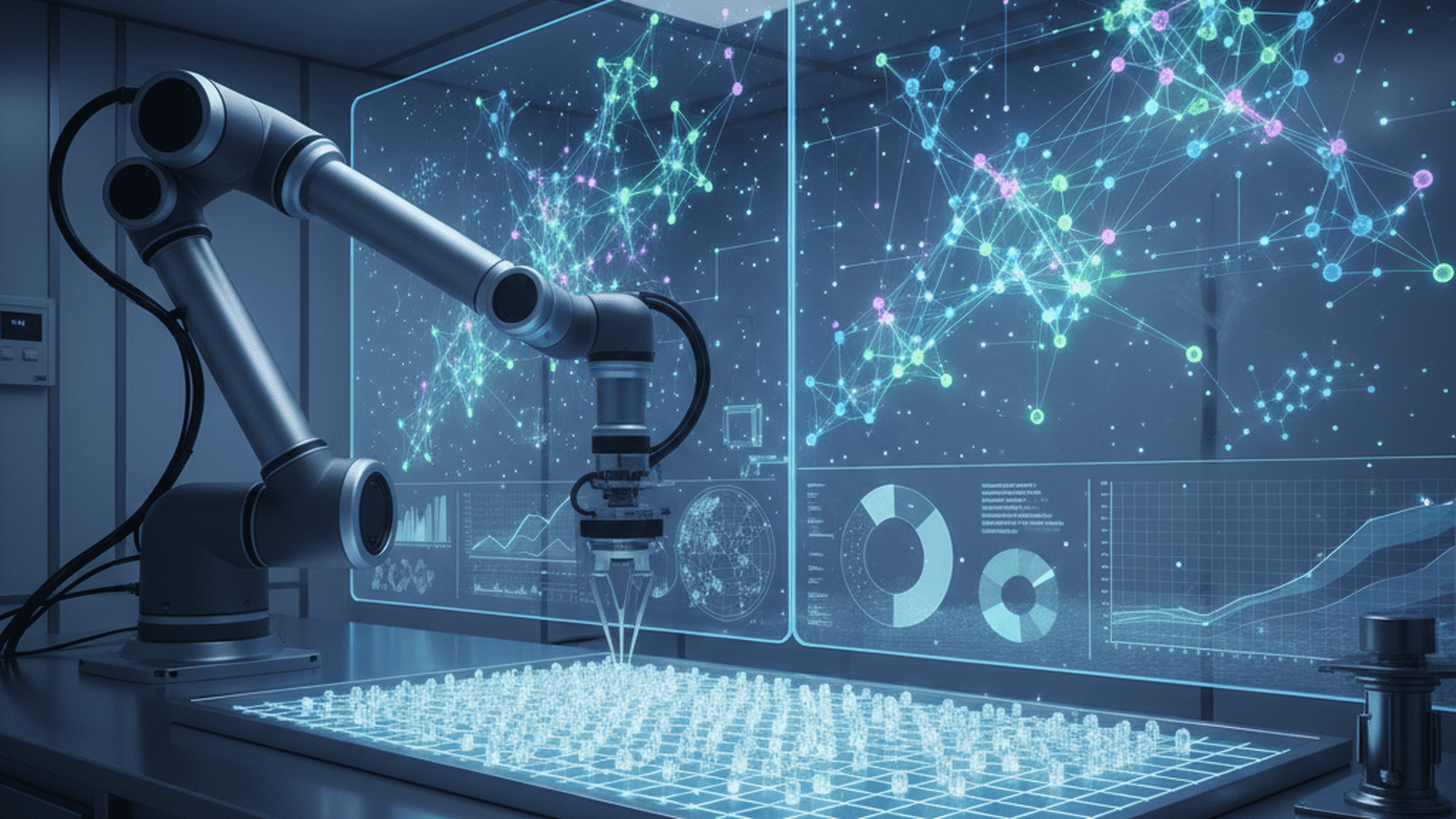
Google DeepMind researchers have utilized a deep learning tool called GNoME to predict the existence of 2.2 million new crystal structures, significantly expanding the catalog of known stable materials. This breakthrough provides a massive database for developing next-generation technologies like high-performance batteries and superconductors.
TLDR: Google DeepMind’s GNoME AI has predicted 2.2 million new crystal structures, including 381,000 stable materials that could revolutionize energy storage and electronics. By bypassing traditional trial-and-error methods, this discovery provides a massive roadmap for experimentalists to develop more efficient batteries, solar cells, and superconductors.
Researchers at Google DeepMind have unveiled a transformative deep learning tool that has predicted the existence of 2.2 million new crystal structures, a monumental leap that could drastically accelerate the development of next-generation technologies. This tool, known as Graph Networks for Materials Exploration (GNoME), identifies stable materials that were previously unknown to science. Published in the journal Nature, this breakthrough represents an order-of-magnitude increase in the catalog of known stable materials, providing a massive, open-access database for experimentalists to explore. Historically, the discovery of new materials has been a painstakingly slow and labor-intensive process. For centuries, scientists relied on “Edisonian” trial-and-error methods or expensive, time-consuming computational simulations to identify stable crystal structures. Before this AI intervention, approximately 48,000 stable materials had been identified and cataloged throughout human history. The GNoME system has expanded this list by nearly ten times, identifying 381,000 materials that are predicted to be stable under standard conditions. This expansion is equivalent to nearly 800 years of knowledge accumulated in a fraction of the time. The GNoME model utilizes graph neural networks (GNNs), a sophisticated type of AI architecture specifically suited for modeling the complex relationships between atoms in a crystal lattice. In these models, atoms are treated as nodes and the bonds between them as edges. By training on extensive data from the Materials Project—an open-access database of known materials—the AI learned to predict the stability and decomposition energy of new atomic arrangements with unprecedented accuracy. The researchers employed an iterative “active learning” process: the AI proposed new structures, which were then verified using rigorous Density Functional Theory (DFT) calculations. The results of these high-fidelity simulations were fed back into the model, creating a self-improving loop that refined the AI’s predictive capabilities. Among the millions of predictions are materials with the potential to revolutionize various industries. The database includes 52,000 new layered compounds similar to graphene, which could be used to develop advanced electronics, more efficient transistors, or even room-temperature superconductors. Furthermore, the AI identified 529 potential lithium-ion conductors—a 25-fold increase over previously known candidates. These materials are the “holy grail” for battery technology, essential for creating faster-charging, higher-capacity batteries for electric vehicles and large-scale renewable energy grid storage. To demonstrate the practical utility of these predictions, Google DeepMind collaborated with researchers at the Lawrence Berkeley National Laboratory. The Berkeley team utilized an autonomous laboratory, known as the A-Lab, to attempt the synthesis of several predicted materials. This facility combines robotics with AI-driven decision-making to perform experiments 24/7 without human intervention. In a stunning display of efficiency, the A-Lab successfully synthesized 41 new compounds out of 58 targets over a period of just 17 days. This high success rate not only validates the accuracy of GNoME’s predictions but also showcases a future where the “closed-loop” discovery process—from AI prediction to robotic synthesis—becomes the standard. The implications of this work extend far beyond the specific materials discovered. By providing a vast roadmap of stable structures, GNoME allows experimentalists to bypass the initial, often fruitless search phase and focus their resources on synthesizing and testing the most promising candidates. This shift could reduce the time required to bring new materials from the laboratory to the commercial market, a process that currently takes an average of ten to twenty years. As the global community gains access to the GNoME database, the synergy between artificial intelligence and experimental robotics is poised to catalyze a new era of rapid innovation.

Mason Reed serves as a Staff Writer for Just Right News, where he spearheads the Future Frontiers & Special Projects desk. In an era defined by rapid technological shifts and evolving social landscapes, Mason provides a steady, principled voice, examining the innovations of tomorrow through the lens of traditional American values. His work is most prominently featured in his signature series, “The Next Horizon,” where he explores the intersection of emerging technology, national sovereignty, and the preservation of individual liberty.
A native of San Diego, California, Mason’s worldview was shaped by the unique culture of his hometown. Growing up in a region defined by its strong military presence and its history of maritime industry, he developed a deep-seated respect for the institutions that provide national stability and the entrepreneurial spirit that drives the American economy. This upbringing instilled in him a belief that true progress is not found in discarding the past, but in building upon a foundation of proven principles. His reporting often reflects this San Diego influence, emphasizing the importance of a robust national defense and the necessity of maintaining a competitive edge in the global marketplace.
Now based in San Francisco, Mason operates from the heart of the world’s technological engine. Living and working in the Bay Area provides him with a front-row seat to the advancements—and the ideological challenges—emanating from Silicon Valley. While many in the region embrace a “move fast and break things” mentality, Mason’s reporting serves as a vital counterweight. He offers Just Right News readers a “boots on the ground” perspective, documenting how radical local policies and the concentration of tech power impact the everyday lives of citizens. His proximity to the industry allows him to cut through the marketing jargon of big tech to uncover the real-world implications for privacy, free speech, and the nuclear family.
In his “Future Frontiers” beat, Mason tackles complex subjects ranging from the ethics of artificial intelligence to the burgeoning private space race. He approaches these topics with a healthy skepticism toward centralized bureaucracy, championing instead the decentralized innovations that empower individuals. Through “The Next Horizon,” he highlights the pioneers and thinkers who are working to ensure that the future remains a place where human dignity and constitutional rights are protected. He believes that the rapid pace of change requires more than just technical expertise; it requires a moral compass rooted in the Western tradition.
Throughout his tenure at Just Right News, Mason has remained committed to the idea that the future is something to be shaped, not merely accepted. His writing is characterized by a rigorous defense of American exceptionalism and a belief that the country’s best days lie ahead, provided it remains true to its founding ideals. Whether he is investigating the impact of automation on the American workforce or profiling the next generation of aerospace engineers, Mason Reed ensures that his readers are equipped with the insights they need to navigate a changing world with confidence and clarity.