

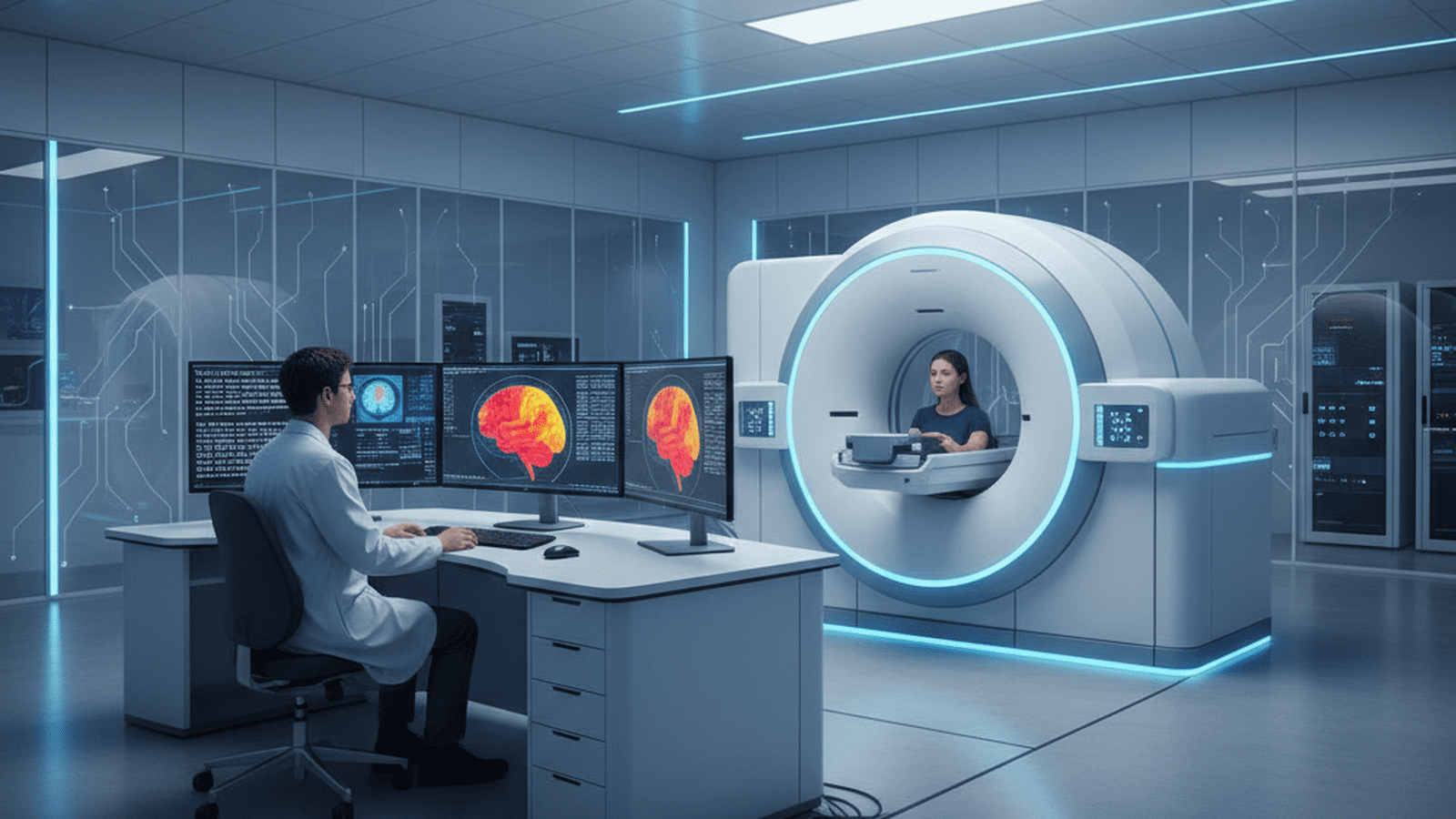
Researchers at UT Austin have created an AI-powered semantic decoder that translates brain activity into text using non-invasive fMRI scans. The system maps neural blood flow to linguistic concepts, allowing it to reconstruct the essence of a person’s thoughts or the stories they are hearing.
TLDR: Scientists at the University of Texas at Austin have developed a non-invasive AI system that decodes human brain activity into text. By analyzing fMRI data with large language models, the decoder can reconstruct the gist of a person’s thoughts, offering a potential communication lifeline for individuals with speech-impairing neurological conditions.
Researchers at the University of Texas at Austin have achieved a landmark breakthrough in the field of neuroscience and artificial intelligence. They have developed a “semantic decoder” capable of translating a person’s brain activity into a continuous stream of text. Unlike previous brain-computer interfaces (BCIs), this system is entirely non-invasive, requiring no surgical implants. Published in the journal Nature Neuroscience, the study demonstrates a sophisticated synergy between functional magnetic resonance imaging (fMRI) and large language models, similar to those powering modern AI assistants. This innovation represents a paradigm shift, moving away from decoding individual letters or motor commands toward interpreting the high-level meaning of human thought.
The system’s foundation lies in fMRI technology, which tracks changes in blood flow and oxygenation levels in the brain. While fMRI provides excellent spatial resolution, its temporal resolution is notoriously slow; blood flow changes take several seconds to peak, whereas human speech occurs at a rate of several words per second. To overcome this lag, the UT Austin team, led by Jerry Tang and Alex Huth, utilized a decoding approach that predicts the most likely sequences of words based on neural patterns. The AI was trained by having three participants listen to 16 hours of narrative podcasts while lying in a scanner. This allowed the system to learn how specific semantic concepts—ranging from family relationships to physical actions—manifested as unique blood-flow signatures in each individual’s brain.
Once calibrated, the decoder could generate text that captured the essence of what a participant was hearing or even thinking. The researchers noted that the system does not produce a word-for-word transcript. Instead, it captures the “gist” of the narrative. For instance, when a participant heard the phrase “I don’t have my driver’s license yet,” the decoder translated the brain activity as “She has not even started to learn to drive yet.” This suggests the AI is accessing the underlying conceptual framework of the thought rather than just the linguistic structure. The decoder proved equally effective when participants watched silent films or mentally narrated their own stories, proving that the brain uses similar pathways for both external perception and internal monologue.
Given the potential for misuse, the research team placed a heavy emphasis on mental privacy. They conducted rigorous testing to determine if the decoder could be used without a subject’s consent. They found that the system requires the active cooperation of the user to function. If a participant resisted by performing distracting mental tasks—such as counting by sevens or imagining a list of animals—the decoder failed to produce any coherent text. Furthermore, a model trained on one person’s brain data could not be used to decode another person’s thoughts, as the mapping of semantic concepts to neural activity is highly personalized. This “biological encryption” ensures that the technology remains a tool for the user rather than a means of surveillance.
The primary goal for this technology is to provide a communication lifeline for individuals who are cognitively intact but physically unable to speak, such as those suffering from locked-in syndrome or advanced Amyotrophic Lateral Sclerosis (ALS). Currently, the reliance on bulky and expensive fMRI machines limits the system to laboratory or clinical settings. However, the researchers are optimistic about transitioning the software to more portable platforms, such as functional near-infrared spectroscopy (fNIRS). fNIRS uses infrared light to measure blood flow and can be integrated into a wearable headset. As the AI models become more efficient and the hardware more accessible, this semantic decoder could eventually offer a permanent, non-invasive voice to those who have lost theirs, fundamentally changing the landscape of rehabilitative medicine.

Mason Reed serves as a Staff Writer for Just Right News, where he spearheads the Future Frontiers & Special Projects desk. In an era defined by rapid technological shifts and evolving social landscapes, Mason provides a steady, principled voice, examining the innovations of tomorrow through the lens of traditional American values. His work is most prominently featured in his signature series, “The Next Horizon,” where he explores the intersection of emerging technology, national sovereignty, and the preservation of individual liberty.
A native of San Diego, California, Mason’s worldview was shaped by the unique culture of his hometown. Growing up in a region defined by its strong military presence and its history of maritime industry, he developed a deep-seated respect for the institutions that provide national stability and the entrepreneurial spirit that drives the American economy. This upbringing instilled in him a belief that true progress is not found in discarding the past, but in building upon a foundation of proven principles. His reporting often reflects this San Diego influence, emphasizing the importance of a robust national defense and the necessity of maintaining a competitive edge in the global marketplace.
Now based in San Francisco, Mason operates from the heart of the world’s technological engine. Living and working in the Bay Area provides him with a front-row seat to the advancements—and the ideological challenges—emanating from Silicon Valley. While many in the region embrace a “move fast and break things” mentality, Mason’s reporting serves as a vital counterweight. He offers Just Right News readers a “boots on the ground” perspective, documenting how radical local policies and the concentration of tech power impact the everyday lives of citizens. His proximity to the industry allows him to cut through the marketing jargon of big tech to uncover the real-world implications for privacy, free speech, and the nuclear family.
In his “Future Frontiers” beat, Mason tackles complex subjects ranging from the ethics of artificial intelligence to the burgeoning private space race. He approaches these topics with a healthy skepticism toward centralized bureaucracy, championing instead the decentralized innovations that empower individuals. Through “The Next Horizon,” he highlights the pioneers and thinkers who are working to ensure that the future remains a place where human dignity and constitutional rights are protected. He believes that the rapid pace of change requires more than just technical expertise; it requires a moral compass rooted in the Western tradition.
Throughout his tenure at Just Right News, Mason has remained committed to the idea that the future is something to be shaped, not merely accepted. His writing is characterized by a rigorous defense of American exceptionalism and a belief that the country’s best days lie ahead, provided it remains true to its founding ideals. Whether he is investigating the impact of automation on the American workforce or profiling the next generation of aerospace engineers, Mason Reed ensures that his readers are equipped with the insights they need to navigate a changing world with confidence and clarity.