

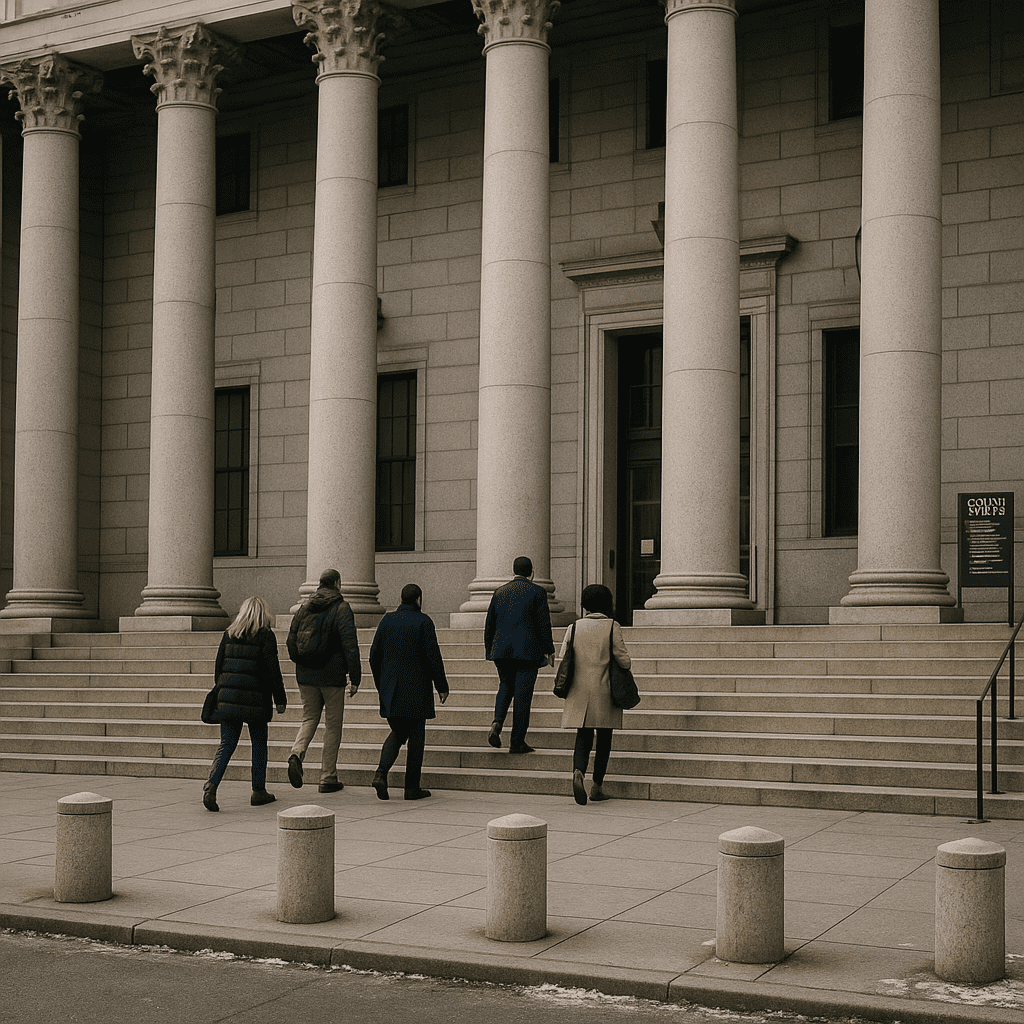
A federal judge dismissed the Justice Department’s challenge to New York’s Protect Our Courts Act, which bars civil immigration arrests in and around state courthouses without a judge-signed warrant. U.S. District Judge Mae D’Agostino ruled that New York’s stance is protected by the 10th Amendment, rejecting arguments that the state obstructed federal immigration enforcement. New York Attorney General Letitia James said the decision safeguards the “dignity and rights of immigrant communities” and ensures people can seek justice “without fear.” The Justice Department said it will continue to vigorously defend President Trump’s immigration enforcement agenda in court. The ruling keeps New York’s courthouse-access protections in place and shapes how officials communicate safety and access to court users.
A federal judge has dismissed the Justice Department’s challenge to New York’s Protect Our Courts Act, a 2020 law limiting civil immigration arrests in and around state courthouses, in a ruling that centers courthouse access and the constitutional balance between state and federal authority. U.S. District Judge Mae D’Agostino held that New York’s choice not to participate in enforcing civil immigration law is protected by the 10th Amendment, a finding that state officials cast as essential to public trust in the courts and community safety.
The law prohibits federal immigration officials from arresting people who are entering, leaving, or appearing in New York state courts for proceedings unless the officers have a warrant signed by a judge. It does not apply to federal immigration courts. The Trump administration’s Justice Department sued, arguing that the statute and two related New York executive orders unconstitutionally obstructed federal immigration enforcement.
D’Agostino rejected that claim. “Fundamentally, the United States fails to identify any federal law mandating that state and local officials generally assist or cooperate with federal immigration enforcement efforts. Nor could it,” she wrote. “No such federal laws exist because the Tenth Amendment prohibits Congress from conscripting state and local officials and resources to assist with federal regulatory schemes, like immigration enforcement.”
New York Attorney General Letitia James, whose office urged the court to dismiss the suit, framed the decision as a validation of courthouse neutrality and access. She said she was fighting for the “dignity and rights of immigrant communities,” adding, “Everyone deserves to seek justice without fear.” James said the ruling “ensures that anyone can use New York’s state courts without being targeted by federal authorities.”
The Justice Department underscored that immigration enforcement remains a national priority. A department spokesperson stated that “President Trump’s immigration enforcement agenda is a top national security and public safety priority that this Department of Justice will continue to vigorously defend whenever challenged in court.” The administration had brought several legal actions targeting state and local policies over immigration enforcement, of which the New York lawsuit was one.
The Protect Our Courts Act was enacted in response to immigration enforcement actions at courthouses during President Donald Trump’s first term. By requiring judge-signed warrants for civil immigration arrests in state judicial settings, the measure delineates state courthouse space as a venue for adjudication rather than immigration enforcement, except under judicial oversight. The judge’s ruling affirms that boundary under the 10th Amendment’s anti-commandeering principles.
For court users and administrators, the decision clarifies operational expectations: people attending state proceedings should not face civil immigration arrest in or around courthouses absent a judicial warrant. State officials have linked that clarity to public confidence, arguing that the justice system depends on the willingness of victims, witnesses, and defendants to appear without fear of unrelated detention.
The ruling also carries implications for how arrests in judicial venues are described and contextualized in public communications and news coverage. In New York’s state courts, the default condition is no civil immigration arrests without a judge’s sign-off. That legal baseline, which excludes federal immigration courts, sets a clear standard that officials say is aimed at preserving access to justice while respecting the federal government’s separate authority to enforce immigration law outside the statute’s scope.
While the Justice Department argued that New York’s policy obstructed federal operations, D’Agostino’s decision emphasizes that the Constitution limits the federal government’s ability to require state participation in federal regulatory schemes. The opinion does not prevent federal authorities from obtaining judicial warrants where appropriate; instead, it bars warrantless civil immigration arrests in the state courthouse context.
State leaders signaled that the ruling will be used in messaging to communities concerned about courthouse safety and fairness. By highlighting the judge’s reasoning and the statutory limits, officials aim to reassure court users that seeking justice in state tribunals should not expose them to unrelated civil immigration detention. That reassurance, they contend, is a practical component of maintaining the courts’ function and credibility.
The decision leaves New York’s Protect Our Courts Act in force as written, with its exclusion for federal immigration courts intact. As the Justice Department noted, immigration enforcement remains a broader policy priority, and the department pledged continued defense of that agenda when challenged. With the federal lawsuit dismissed, the state’s courthouse-arrest rules continue to govern proceedings in New York’s judicial venues, and officials say they will continue communicating those protections to the public.
The ruling concludes the government’s challenge at the district court level. The opinion did not specify additional steps, and public statements accompanying the decision focused on the constitutional rationale and on outreach to communities that rely on state courts. For now, courthouse access in New York remains under the Protect Our Courts Act while oversight of immigration enforcement proceeds through other channels and cases.

Chloe Foster serves as a Staff Writer for Just Right News, where she spearheads the outlet’s coverage of Media, Culture, and Information Integrity. In an era defined by rapid-fire digital communication and shifting societal norms, Chloe has distinguished herself as a vital voice for readers seeking clarity amidst the noise. Her signature feature series, “The Story Wars,” has become a cornerstone of the publication, offering a deep dive into the ideological battles currently shaping American life and the ways in which mainstream narratives are constructed, disseminated, and often manipulated.
Chloe’s unique perspective is informed by a life lived in two of the nation’s most influential cultural hubs. Raised in Los Angeles, California, she grew up in the shadow of the world’s most powerful media and entertainment apparatus. This upbringing provided her with a front-row seat to the “dream factory,” allowing her to observe firsthand how cultural exports are crafted and how they often diverge from the lived experiences of everyday Americans. Her time in Los Angeles instilled in her a healthy skepticism of manufactured consensus and a passion for uncovering the truths that lie beneath polished public relations campaigns.
Today, Chloe operates from Brooklyn, New York, a vantage point that places her at the epicenter of the modern media landscape. Living and working in a deep-blue urban environment as a conservative journalist has sharpened her reporting, requiring a rigorous commitment to intellectual honesty and a steadfast defense of traditional values. Her base in Brooklyn allows her to engage directly with the institutions and influencers who drive the national conversation, providing Just Right News readers with an “on-the-ground” look at the cultural shifts originating in the Northeast.
As a Hispanic woman, Chloe brings a nuanced understanding of community and heritage to her beat. She frequently explores how media portrayals of the Latino community often overlook the deep-seated faith, entrepreneurial spirit, and family-centric values that define it. Her work challenges the monolithic labels often applied by mainstream outlets, instead highlighting the diversity of thought and the conservative principles that resonate within her community.
In her role at Just Right News, Chloe views “Information Integrity” not merely as a buzzword, but as a mission. She believes that a healthy republic requires a media landscape where facts are prioritized over agendas and where the public is empowered to think for themselves. Through “The Story Wars,” she deconstructs the framing of major news events, exposing bias and providing the context necessary for readers to understand the broader cultural implications of the day’s headlines.
Chloe Foster’s reporting is more than just a collection of articles; it is a sustained effort to reclaim the narrative for those who feel sidelined by the prevailing media establishment. By bridging the gap between her West Coast roots and her East Coast base, she continues to provide essential commentary on the forces that define our shared American culture.