

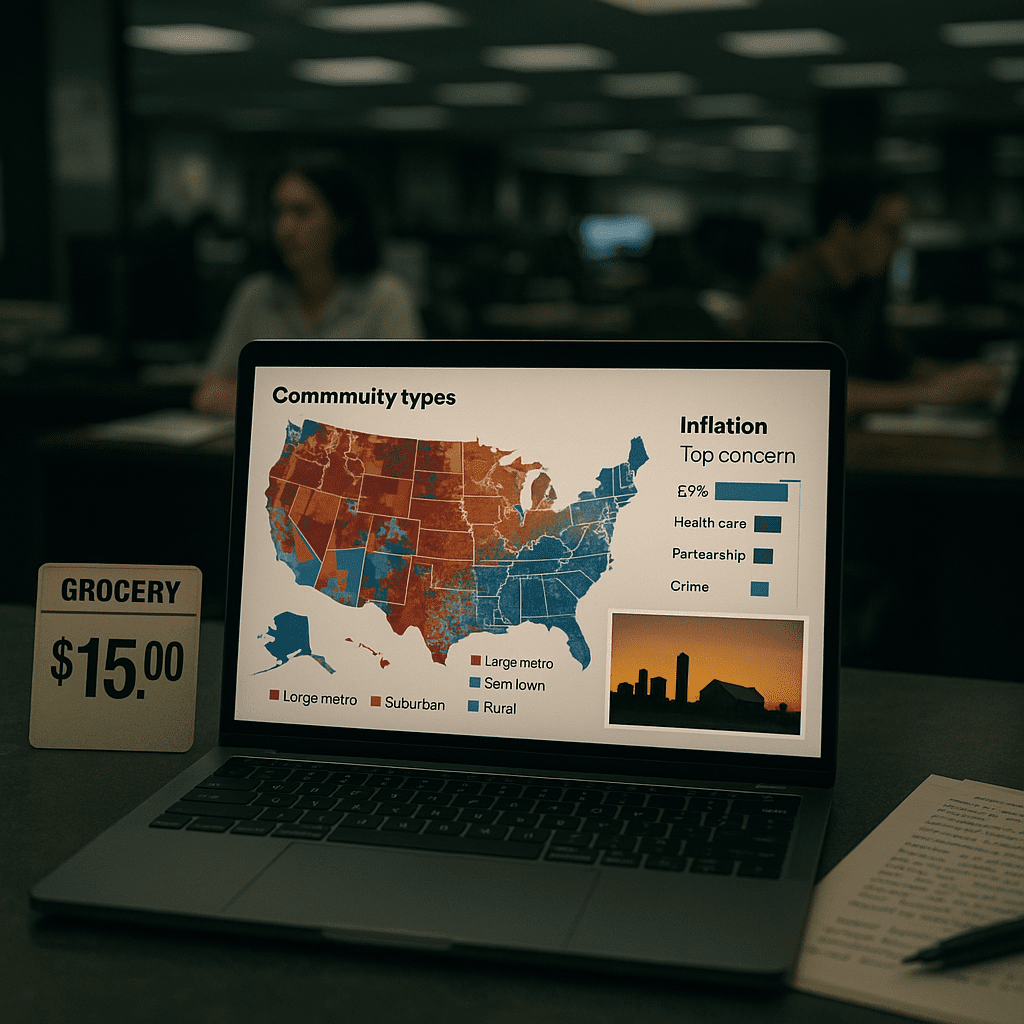
The American Communities Project/Ipsos Fragmentation Study of 5,489 adults (Aug. 18–Sept. 4, 2025; ±1.8 points) finds worries about household costs unite diverse communities even as media spotlight different issues. Rural Middle America’s optimism rose to about 60% from 43% in 2024, while Big Cities fell to 45%. The report urges newsrooms to map 15 community types and use local data to reflect residents’ priorities.
A new American Communities Project/Ipsos fragmentation study finds that a single issue — worries about everyday household costs — united communities across 15 community types even as media and political narratives emphasized different problems. The survey of 5,489 U.S. adults, conducted Aug. 18–Sept. 4, 2025 using the Ipsos probability-based online panel and RDD telephone interviews, carries a margin of sampling error of plus or minus 1.8 percentage points for adults overall. Its breakdown by community type is designed to surface local differences that national news coverage can obscure.
The poll shows inflation-related anxiety is widespread. Dante Chinni, founder and director of the American Communities Project, summarized the finding: “Concerns about inflation are across the board,” adding that “one thing that truly unites the country is economic angst.” Consumer prices, cited in the reporting, rose at an annual rate of 3% in September, up from 2.3% in April, a shift the story links to tariff policy that began earlier in the year.
At the same time, the study reveals contrasting moods between geographies and demographic clusters. Rural Middle America registered a meaningful increase in optimism: about six in 10 residents in that community type said they were hopeful about the country’s future, up from 43% in the 2024 ACP survey. By contrast, residents of the nation’s Big Cities reported falling optimism, from 55% last year to 45% in the new survey. Heavily Hispanic areas also recorded a drop in local confidence, with community-level hope sliding from 78% last year to 58% this year.
Those numbers help explain why media narratives sometimes diverge from local sentiment. National attention to urban crime, driven in part by repeated presidential statements and threats to deploy the National Guard to cities such as Chicago and New York, contrasts with the poll’s finding that residents of Big Cities and Middle Suburbs are less likely than in 2023 to list crime or gun violence among their top concerns. The study also finds Big Cities are comparatively more likely to report recent immigration-related change — 65% of Big City respondents said they’d seen changes in immigration locally over the past 12 months, compared with roughly four in 10 in Evangelical Hubs or Rural Middle America — which helps explain why local coverage and civic attention in those places centers on immigration and health care rather than crime.
Personal accounts in the reporting underscore the gap between national frames and local impressions. Angel Gamboa, a retired municipal worker in Austin, said, “I don’t want to say it’s overblown, because crime is a serious subject,” and added, “But I feel like there’s an agenda to scare Americans, and it’s so unnecessary.” In rural Newark, Ohio, Carl Gruber described grocery sticker shock — a $15 variety pack of Halloween candy at Kroger — but remained hopeful the economy could improve if businesses returned. Kimmie Pace, a 33-year-old mother in northwest Georgia, described anxiety at the grocery store while nonetheless expressing political faith in the president.
For journalists and editors, the poll suggests two practical lessons. First, national headlines that emphasize a single frame — for example, urban crime — can understate how pervasive economic concerns are across community types. Second, community-level data yield different priorities: heavily Hispanic areas registered a marked decline in hope about the future of children and community, and Big Cities prioritized immigration and health care.
Visualizing the ACP/Ipsos results would make those distinctions clearer. Effective graphics would include a county-level map shaded by ACP community type, side-by-side bar charts of top concerns by community type (inflation, crime, immigration, health care), and trend lines showing optimism shifts from 2024 to 2025. Those visualizations would help newsrooms show why a national broadcast segment about crime might not reflect what a given county’s residents say they care about.
The study’s methodology also matters for interpretation. The ACP/Ipsos project used a probability-based online panel supplemented by random-digit-dial telephone interviews, and it reports a 1.8 point margin of error for adults overall. That framing supports comparisons across the 15 community types but also requires care: smaller subgroups will have larger margins of error, and local administrative data — for instance, crime statistics or local price indices — remain relevant to understanding day-to-day experience.
The poll arrives amid policy shifts and a political calendar that will keep public concerns under close watch. Tariff rollouts referenced in the reporting began earlier this year and were cited alongside the change in consumer prices between April and September. Political actors are preparing for the 2026 midterms, and journalists covering national debates will need to use community-level evidence to avoid amplifying single narratives at the expense of the public’s most widespread worries.
Newsrooms and civic actors have an immediate opportunity to act on the survey’s design: use ACP community-type breakdowns and local indicators to tailor coverage and public information. Future polls and local data releases will show whether the economic worry that now unites communities deepens, eases, or shifts to other priorities as policies and markets evolve.
Chloe Foster serves as a Staff Writer for Just Right News, where she spearheads the outlet’s coverage of Media, Culture, and Information Integrity. In an era defined by rapid-fire digital communication and shifting societal norms, Chloe has distinguished herself as a vital voice for readers seeking clarity amidst the noise. Her signature feature series, “The Story Wars,” has become a cornerstone of the publication, offering a deep dive into the ideological battles currently shaping American life and the ways in which mainstream narratives are constructed, disseminated, and often manipulated.
Chloe’s unique perspective is informed by a life lived in two of the nation’s most influential cultural hubs. Raised in Los Angeles, California, she grew up in the shadow of the world’s most powerful media and entertainment apparatus. This upbringing provided her with a front-row seat to the “dream factory,” allowing her to observe firsthand how cultural exports are crafted and how they often diverge from the lived experiences of everyday Americans. Her time in Los Angeles instilled in her a healthy skepticism of manufactured consensus and a passion for uncovering the truths that lie beneath polished public relations campaigns.
Today, Chloe operates from Brooklyn, New York, a vantage point that places her at the epicenter of the modern media landscape. Living and working in a deep-blue urban environment as a conservative journalist has sharpened her reporting, requiring a rigorous commitment to intellectual honesty and a steadfast defense of traditional values. Her base in Brooklyn allows her to engage directly with the institutions and influencers who drive the national conversation, providing Just Right News readers with an “on-the-ground” look at the cultural shifts originating in the Northeast.
As a Hispanic woman, Chloe brings a nuanced understanding of community and heritage to her beat. She frequently explores how media portrayals of the Latino community often overlook the deep-seated faith, entrepreneurial spirit, and family-centric values that define it. Her work challenges the monolithic labels often applied by mainstream outlets, instead highlighting the diversity of thought and the conservative principles that resonate within her community.
In her role at Just Right News, Chloe views “Information Integrity” not merely as a buzzword, but as a mission. She believes that a healthy republic requires a media landscape where facts are prioritized over agendas and where the public is empowered to think for themselves. Through “The Story Wars,” she deconstructs the framing of major news events, exposing bias and providing the context necessary for readers to understand the broader cultural implications of the day’s headlines.
Chloe Foster’s reporting is more than just a collection of articles; it is a sustained effort to reclaim the narrative for those who feel sidelined by the prevailing media establishment. By bridging the gap between her West Coast roots and her East Coast base, she continues to provide essential commentary on the forces that define our shared American culture.