

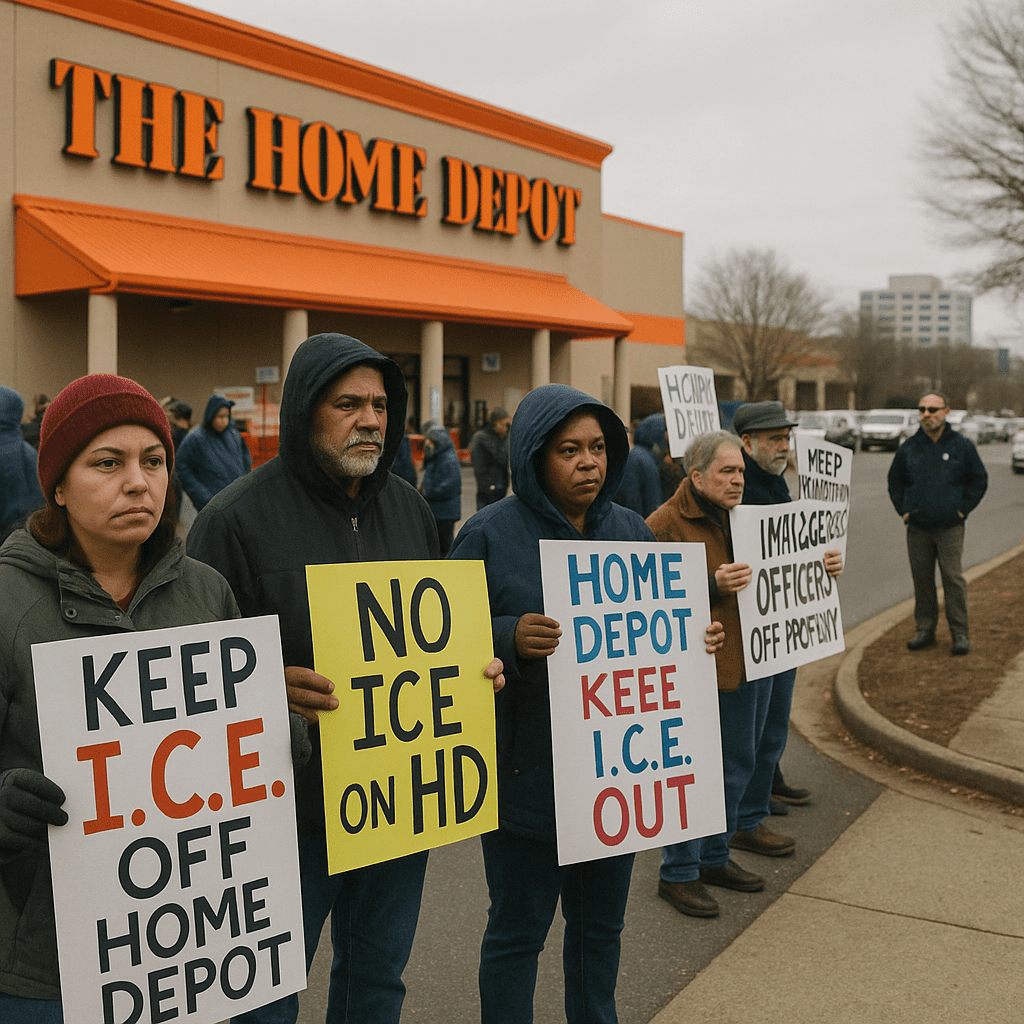
Protesters in Charlotte urged Home Depot to bar immigration officers from operating on store property, focusing public attention on how enforcement activities can reach workplaces and community spaces. The Associated Press video documents the demonstration but does not provide details about organizers, turnout, or a corporate response. The story sits within broader legal disputes about enforcement access: AP reporting notes a judge tossed a Justice Department lawsuit that challenged a New York law barring immigration agents from state courts, an example of courts limiting enforcement in particular forums. Organizers framed their appeal around worker safety and employment stability, while the available material leaves Home Depot’s policies and private-security practices unspecified. Further clarity will depend on statements from the company, any local oversight, and whether legal protections or corporate policies emerge in response.
Protesters in Charlotte gathered to urge Home Depot to prevent immigration officers from operating on store property, highlighting broader concerns about enforcement activity spilling into workplaces and community spaces. The demonstration, captured in an Associated Press video, framed the issue as one of workplace safety and corporate responsibility. Organizers and participants demanded clearer corporate limits on enforcement activity, while advocates called attention to the intersections of public enforcement, private property, and worker vulnerability.
The AP video provides the immediate fact that protesters urged Home Depot to keep immigration agents off its property. Beyond that, the available material does not include specific details such as names of organizers, the number of participants, or how Home Depot and any private security contractors responded at the scene. Those details remain unspecified in the excerpt, leaving questions about the local dynamics of the event.
National legal developments underline why demonstrators seek limits on enforcement in nontraditional settings. The AP material notes a recent court action in which a judge tossed a Justice Department lawsuit challenging a New York law that bars immigration agents from state courts. The ruling and related reporting about migrants being lured into what some advocates describe as a deportation trap illustrate how enforcement practices in one public space can translate into concerns about other community locations, including businesses and workplaces.
Corporate policy is central to the debate activists raised in Charlotte. The excerpt does not contain Home Depot’s official position or any contemporaneous statement from the retailer. Similarly, the AP material does not describe the chain’s contracts with private security or whether those contracts include protocols for interaction with federal immigration officers. Those gaps point to the need for greater transparency about how large employers and property owners set boundaries for federal enforcement on private land.
Private security arrangements are an important practical layer when enforcement agents appear on or near company sites. The available AP content does not specify how security personnel acted at the protest or whether Home Depot maintains standing instructions for encounters with law enforcement. Observers and workforce advocates often call for written policies that delineate when staff or contractors should cooperate with federal authorities and when they should prioritize employee safety and legal counsel, but the excerpt does not document whether such policies exist at the Charlotte store.
Worker safety and employment stability were core themes for protesters, according to the AP video’s description. The excerpt does not include direct quotes from workers or management, so the account cannot verify individual experiences or claims about workplace disruptions. Still, the framing in the video places worker perspectives at the center of organizers’ appeals, suggesting that protesters view enforcement activity on private property as a workplace issue as much as an immigration one.
The legal and public-relations dimensions of protesters’ demands intersect in predictable ways. Court rulings that limit enforcement access to particular public forums affect the range of lawful action by federal agents, while corporate leaders must weigh compliance with the law against reputational risk and employee relations. The AP excerpt documents the existence of that conversation — protesters urging Home Depot to act — but it does not report on any legal filings or policy changes tied directly to the Charlotte demonstration.
Solutions advocated by labor and immigrant-rights groups generally include clear corporate policies that protect employee safety, training for private security to de-escalate encounters with law enforcement, and municipal or state-level protections that restrict enforcement activity in certain community settings. The AP material does not indicate whether any of these steps have been proposed or adopted in Charlotte in response to the protest.
The protest captured in the AP video contributes to an ongoing national discussion about where enforcement should and should not occur. The available reporting connects that local action to a broader legal context in which courts are addressing limits on immigration agents’ access to certain venues. The Charlotte demonstration underscores the stakes for workers, employers, and communities as they navigate competing legal, operational, and human-rights considerations.
It is not clear from the AP excerpt whether Home Depot or local officials have issued statements, scheduled meetings, or set deadlines in response to the protest. Future developments to watch include any corporate policy announcements, local government inquiries, or additional demonstrations that could prompt formal oversight or legal challenges. Absent further reporting, specifics about organizer demands, company responses, and worker accounts remain unconfirmed.

Daniel Owens serves as a Senior Correspondent for Just Right News, where he leads the newsroom’s coverage of Education, Workforce, and Upward Mobility. In an era where the national conversation often overlooks the practical foundations of success, Owens brings a principled perspective to the forefront of the media landscape. His work is defined by a commitment to the idea that a strong society is built on the pillars of quality education, a robust work ethic, and the removal of bureaucratic barriers to individual achievement.
Born and raised in Cleveland, Ohio, Owens’s worldview was shaped by the industrial landscape of the Midwest. Growing up in a city known for its grit and resilience, he witnessed firsthand the transformative power of steady employment and the devastating effects of economic stagnation. This background instilled in him a deep respect for the American worker and a healthy skepticism toward top-down government solutions that often fail to reach the communities they intend to help. As an African American man who has navigated the path to professional success, Owens approaches his beat with a nuanced understanding of how meritocracy and personal responsibility intersect with opportunity. He frequently draws on his roots to highlight the importance of family stability and community-led initiatives in fostering the next generation of leaders.
At Just Right News, Owens is the architect of the acclaimed feature series, “The Learning Curve.” Through this platform, he explores the evolving landscape of American schooling, from the rise of the school choice movement to the revitalization of trade schools and vocational training. He frequently challenges the status quo of higher education, advocating for a return to academic rigor and the practical alignment of degrees with market demands. For Owens, education is not merely about obtaining credentials; it is about equipping young people with the tools necessary to lead self-sufficient, meaningful lives. His reporting on “The Learning Curve” has become essential reading for parents and policymakers who believe that educational competition and parental rights are the keys to a brighter future.
Now based in Raleigh, North Carolina, Owens finds himself at the heart of one of the nation’s most dynamic regions for innovation and growth. Raleigh’s unique blend of traditional values and a fast-paced economy provides the perfect backdrop for his reporting on the modern workforce. From the tech hubs of the Research Triangle to the rural communities of the South, he tracks how shifts in the economy are impacting families and local industries. His reporting often highlights the success stories of entrepreneurs and workers who are thriving by embracing the values of hard work and innovation.
Throughout his career, Daniel Owens has remained a steadfast voice for the student seeking a better path and the worker striving for a better life. His reporting for Just Right News serves as a vital resource for readers who value common-sense solutions to the challenges of the 21st-century economy. By focusing on the intersection of policy and the human spirit, Owens continues to provide a roadmap for how individuals and communities can achieve lasting upward mobility.