

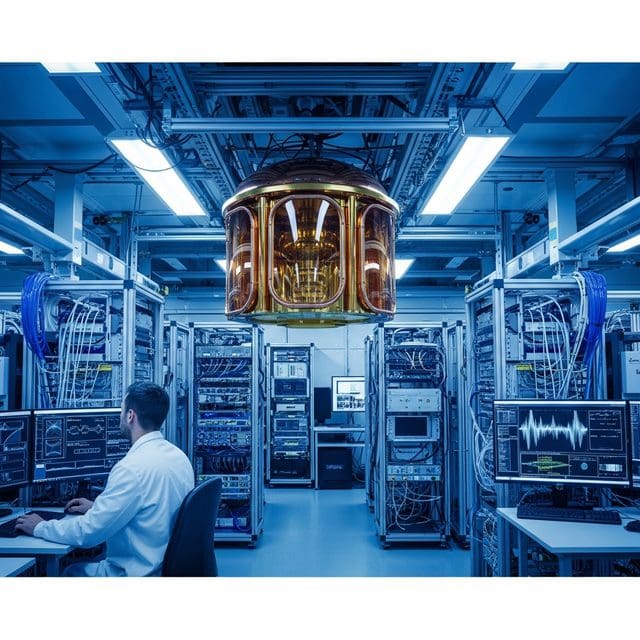
The Department of Energy has unveiled a strategic initiative to deploy the world’s first fault-tolerant quantum computer by 2028, integrating advanced physics with national security.
The race for the next frontier of computational power has entered a decisive phase. On June 23, the U.S. Department of Energy (DOE) officially launched Quantum Genesis, an ambitious federal initiative designed to create and deploy the world’s first fault-tolerant, scientifically relevant quantum computing capability by 2028. This move signals a shift from laboratory experimentation to the establishment of permanent national infrastructure, ensuring that American interests remain at the vanguard of the digital age.
Central to this effort is the DOE Q Competition. The program challenges American innovators to develop systems featuring low hundreds of logical qubits—the building blocks of quantum information that can survive the inherent noise and errors of the quantum realm. Unlike current ‘noisy’ quantum processors, these fault-tolerant systems are intended to provide reliable results for high-stakes research in chemistry, plasma physics, and materials science. By focusing on practical scientific targets, the initiative aims to move beyond theoretical proofs and into the realm of tangible innovation that benefits the nuclear family and the national economy through breakthroughs in energy and medicine.
Quantum Genesis is framed as a core component of the broader Genesis Mission, aligning with executive orders aimed at ushering in a new era of quantum innovation. The strategy emphasizes a unified ecosystem where quantum processors are not isolated curiosities but are instead integrated with existing exascale high-performance computing (HPC) and artificial intelligence platforms. To facilitate this, the DOE plans to establish a National Quantum Supercomputing User Facility, ensuring that American scientists have the tools necessary to maintain a competitive edge over foreign adversaries without relying on centralized global bureaucracies.
While the DOE builds the computers of tomorrow, researchers at the Large Hadron Collider (LHC) in Europe are currently probing the fundamental building blocks of the universe. Recent reports from the LHCb experiment have identified a ‘four-sigma tension’ in rare B-meson ‘penguin’ decays. In the language of particle physics, this suggests a significant discrepancy between observed data and the Standard Model—the prevailing mathematical framework that describes how particles interact. These rare transformations probe loop-level quantum effects, where subtle deviations in decay rates can signal the presence of unknown heavy particles like leptoquarks or exotic bosons.
While a four-sigma result is not yet a formal discovery, which requires five-sigma certainty, it represents a compelling hint of ‘new physics.’ Simultaneously, the ATLAS Collaboration at the LHC announced the observation of the Bc*+ meson, an excited composite particle consisting of a charm quark and a bottom antiquark. This marks the 84th new hadron discovered at the collider, further refining the map of the subatomic world. These discoveries highlight the rich spectrum of composite particles that emerge when matter is probed at high energies, providing a precise new data point for heavy-quark bound-state physics.
These dual tracks—the engineering of quantum computers and the discovery of new particles—are increasingly intertwined. The DOE’s 2028 target for fault-tolerant systems is specifically designed to provide the massive computing power required to simulate the very quantum loops and particle interactions being observed at the LHC. The next milestones for the American quantum push are fast approaching. The DOE is expected to finalize technical specifications for these new systems by September 2026. By December of that same year, the department and the Office of Management and Budget intend to establish frameworks for private-sector partnerships. These collaborations will be essential for the manufacturing and delivery of the hardware that will define the next century of American scientific and economic sovereignty, ensuring that the future of technology is built on a foundation of individual liberty and national strength.

Mason Reed serves as a Staff Writer for Just Right News, where he spearheads the Future Frontiers & Special Projects desk. In an era defined by rapid technological shifts and evolving social landscapes, Mason provides a steady, principled voice, examining the innovations of tomorrow through the lens of traditional American values. His work is most prominently featured in his signature series, “The Next Horizon,” where he explores the intersection of emerging technology, national sovereignty, and the preservation of individual liberty.
A native of San Diego, California, Mason’s worldview was shaped by the unique culture of his hometown. Growing up in a region defined by its strong military presence and its history of maritime industry, he developed a deep-seated respect for the institutions that provide national stability and the entrepreneurial spirit that drives the American economy. This upbringing instilled in him a belief that true progress is not found in discarding the past, but in building upon a foundation of proven principles. His reporting often reflects this San Diego influence, emphasizing the importance of a robust national defense and the necessity of maintaining a competitive edge in the global marketplace.
Now based in San Francisco, Mason operates from the heart of the world’s technological engine. Living and working in the Bay Area provides him with a front-row seat to the advancements—and the ideological challenges—emanating from Silicon Valley. While many in the region embrace a “move fast and break things” mentality, Mason’s reporting serves as a vital counterweight. He offers Just Right News readers a “boots on the ground” perspective, documenting how radical local policies and the concentration of tech power impact the everyday lives of citizens. His proximity to the industry allows him to cut through the marketing jargon of big tech to uncover the real-world implications for privacy, free speech, and the nuclear family.
In his “Future Frontiers” beat, Mason tackles complex subjects ranging from the ethics of artificial intelligence to the burgeoning private space race. He approaches these topics with a healthy skepticism toward centralized bureaucracy, championing instead the decentralized innovations that empower individuals. Through “The Next Horizon,” he highlights the pioneers and thinkers who are working to ensure that the future remains a place where human dignity and constitutional rights are protected. He believes that the rapid pace of change requires more than just technical expertise; it requires a moral compass rooted in the Western tradition.
Throughout his tenure at Just Right News, Mason has remained committed to the idea that the future is something to be shaped, not merely accepted. His writing is characterized by a rigorous defense of American exceptionalism and a belief that the country’s best days lie ahead, provided it remains true to its founding ideals. Whether he is investigating the impact of automation on the American workforce or profiling the next generation of aerospace engineers, Mason Reed ensures that his readers are equipped with the insights they need to navigate a changing world with confidence and clarity.