

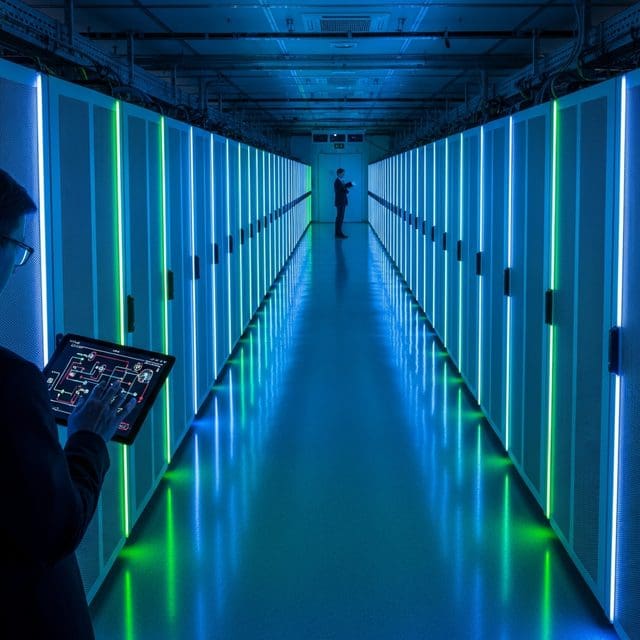
Scientists at Germany’s Jülich Supercomputing Centre successfully simulated a 50-qubit quantum computer using the JUPITER exascale system, marking a critical milestone for validating future quantum hardware and algorithms.
The race for quantum supremacy is often framed as a battle of exotic hardware, but a breakthrough in Germany reminds the world that traditional high-performance computing remains the essential yardstick for this frontier. Researchers at the Jülich Supercomputing Centre (JSC), in collaboration with NVIDIA, have successfully simulated a universal 50-qubit quantum computer, shattering the previous world record of 48 qubits set in 2019. This achievement was made possible by JUPITER, Europe’s first exascale supercomputer, launched at Forschungszentrum Jülich last September.
While a standard laptop can manage simulations involving roughly 30 qubits, scaling to 50 is an exponential challenge. Every single qubit added to a simulation doubles the required memory and computing power. To reach this milestone, JUPITER utilized approximately 2 petabytes of memory—equivalent to two million gigabytes. This staggering resource was necessary to track more than 2 quadrillion complex numerical values, which must remain perfectly synchronized across thousands of computing nodes to accurately reproduce the behavior of a real quantum processor.
Professor Kristel Michielsen, Director at the JSC, noted that the feat illustrates the deep interdependency between classical supercomputing and quantum research. The simulation acts as a digital twin for quantum processors, allowing scientists to test complex algorithms before physical hardware is fully ready. Key areas of focus include the Variational Quantum Eigensolver (VQE), which allows for the study of molecules at a molecular level, and the Quantum Approximate Optimisation Algorithm (QAOA), designed to solve complex logistics and finance problems that currently baffle traditional systems.
The technical backbone of the record-breaking run involved 16,000 NVIDIA GH200 Superchips. These chips are designed to tightly connect CPUs and GPUs, allowing data that exceeds GPU memory capacity to be temporarily stored in CPU memory without a catastrophic loss in performance. To leverage this architecture, engineers upgraded Jülich’s proprietary simulation software to a new version called JUQCS-50. This software employs a byte-encoding compression technique that reduces memory requirements by a factor of eight, alongside a dynamic optimization system that manages data exchange across the massive chip array.
This breakthrough arrives at a pivotal moment for global security. Just this week, the White House issued an executive order shortening the deadline for federal agencies to adopt post-quantum cryptography, citing national security risks from quantum-vulnerable encryption. Simultaneously, the Quantum Communication Fieldlab Rotterdam launched to operationalize secure links for critical infrastructure, while industry leaders like Amazon and QuEra projected useful quantum error correction by 2028. As the U.S. prepares to spend an estimated $42.7 billion on C5ISR funding through 2030, the JUPITER simulation provides a necessary reality check.
Professor Hans De Raedt, lead author of the study, emphasized that JUQCS-50 can emulate universal quantum computers with high fidelity, tackling questions that no existing quantum processor can yet solve. The project was developed as part of the JUPITER Research and Early Access Programme (JUREAP), a collaborative effort where hardware and software were co-designed during the supercomputer’s construction phase. This level of integration ensures that the West remains at the forefront of the quantum revolution.
Moving forward, JUQCS-50 will be made available to outside research organizations and private companies through JUNIQ—the Jülich UNified Infrastructure for Quantum Computing. This accessibility ensures that the simulation serves not only as a scientific tool for algorithm development but also as a rigorous benchmark for evaluating the performance of future supercomputers. By grounding quantum dreams in the hard reality of exascale computing, Jülich is ensuring that the transition to the quantum era is both measurable and secure.

Mason Reed serves as a Staff Writer for Just Right News, where he spearheads the Future Frontiers & Special Projects desk. In an era defined by rapid technological shifts and evolving social landscapes, Mason provides a steady, principled voice, examining the innovations of tomorrow through the lens of traditional American values. His work is most prominently featured in his signature series, “The Next Horizon,” where he explores the intersection of emerging technology, national sovereignty, and the preservation of individual liberty.
A native of San Diego, California, Mason’s worldview was shaped by the unique culture of his hometown. Growing up in a region defined by its strong military presence and its history of maritime industry, he developed a deep-seated respect for the institutions that provide national stability and the entrepreneurial spirit that drives the American economy. This upbringing instilled in him a belief that true progress is not found in discarding the past, but in building upon a foundation of proven principles. His reporting often reflects this San Diego influence, emphasizing the importance of a robust national defense and the necessity of maintaining a competitive edge in the global marketplace.
Now based in San Francisco, Mason operates from the heart of the world’s technological engine. Living and working in the Bay Area provides him with a front-row seat to the advancements—and the ideological challenges—emanating from Silicon Valley. While many in the region embrace a “move fast and break things” mentality, Mason’s reporting serves as a vital counterweight. He offers Just Right News readers a “boots on the ground” perspective, documenting how radical local policies and the concentration of tech power impact the everyday lives of citizens. His proximity to the industry allows him to cut through the marketing jargon of big tech to uncover the real-world implications for privacy, free speech, and the nuclear family.
In his “Future Frontiers” beat, Mason tackles complex subjects ranging from the ethics of artificial intelligence to the burgeoning private space race. He approaches these topics with a healthy skepticism toward centralized bureaucracy, championing instead the decentralized innovations that empower individuals. Through “The Next Horizon,” he highlights the pioneers and thinkers who are working to ensure that the future remains a place where human dignity and constitutional rights are protected. He believes that the rapid pace of change requires more than just technical expertise; it requires a moral compass rooted in the Western tradition.
Throughout his tenure at Just Right News, Mason has remained committed to the idea that the future is something to be shaped, not merely accepted. His writing is characterized by a rigorous defense of American exceptionalism and a belief that the country’s best days lie ahead, provided it remains true to its founding ideals. Whether he is investigating the impact of automation on the American workforce or profiling the next generation of aerospace engineers, Mason Reed ensures that his readers are equipped with the insights they need to navigate a changing world with confidence and clarity.