

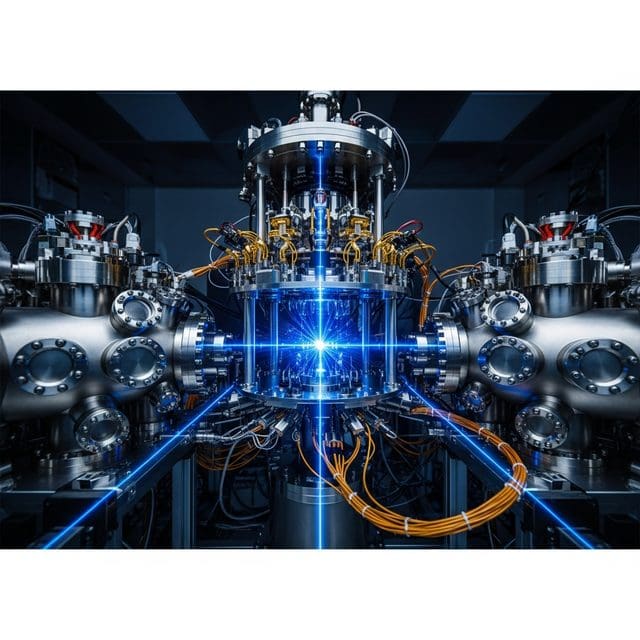
Researchers successfully simulated the fermionic Laughlin state on a trapped-ion quantum computer, marking a significant milestone for topological physics and the future of decentralized materials simulation.
A team of researchers from the University of Washington and Amazon Braket has achieved a landmark result in the field of condensed matter physics by successfully simulating a fermionic Laughlin state on a digital quantum processor. The study, published in Nature Communications, utilized IonQ’s Aria-1 and Forte-1 systems to observe a phenomenon that has long been a cornerstone of topological physics but remained difficult to replicate outside of specialized material environments.
The Laughlin state is a phase of matter associated with the fractional quantum Hall effect, where electrons behave in a collective, highly correlated manner. While previous experiments demonstrated similar effects using simpler bosonic particles or analog simulators, this breakthrough represents the first time a genuine fermionic version—the kind governing electrons in real-world materials—has been realized on a programmable digital quantum computer. This distinction is critical; it suggests that the secrets of advanced materials can be unlocked through computation rather than relying solely on rare-earth mineral dependencies.
To achieve this, the team developed a highly efficient Hamiltonian Variational Ansatz (HVA). This protocol mapped the complex interactions of electrons onto a 16-qubit circuit using 369 two-qubit gates. The team focused on a specific filling fraction, known as ν = 1/3, where electrons are precisely arranged to minimize repulsion. By truncating interaction terms to a manageable range, the researchers maintained a wavefunction fidelity of over 0.95 compared to the exact theoretical state. This meticulous approach ensured the digital simulation remained physically accurate while staying within the depth limits of current hardware.
One of the most impressive technical feats was the use of “warm-starting” for variational parameters. The scientists discovered that parameters optimized on smaller, 6-electron systems could be successfully transferred to larger 12-electron systems without costly re-optimization. This scalability is essential for the future of quantum computing, providing a pathway to simulate larger systems that are currently impossible to model on classical supercomputers. The IonQ hardware performed with high precision, reporting mean two-qubit gate fidelities of 98.5% on the Aria-1 system and 99.7% on the Forte-1 system.
Despite inherent noise in modern quantum devices, the team utilized rigorous error-mitigation techniques to extract clear physical signals. They employed a symmetry-verification postselection protocol that discarded approximately 90% of the data to focus only on results obeying fundamental physical laws, such as particle number conservation. Through this process, they successfully measured three key signatures of topological order: the bulk-edge density structure, correlation holes, and topological entanglement entropy. The experimental entropy value of -0.92 was remarkably consistent with the theoretical value of -1.10, confirming the processor was mimicking the exotic behavior of a topological liquid.
This development is particularly noteworthy for its use of commercial, cloud-accessible hardware. By running the full pipeline via Amazon Braket, the researchers demonstrated that high-level physics research is no longer confined to elite institutional laboratories. This democratization of high-performance computing aligns with a broader vision of decentralized innovation.
Looking ahead, the researchers position this workflow as a blueprint for simulating even more complex states of matter, such as non-Abelian topological phases. These states are theorized to be the key to building fault-tolerant quantum computers—machines that could eventually revolutionize materials science for national defense and energy independence. As the private sector continues to outpace centralized bureaucracy, this experiment serves as a reminder that the frontier of physics is increasingly being settled by agile, innovative collaborations.

Mason Reed serves as a Staff Writer for Just Right News, where he spearheads the Future Frontiers & Special Projects desk. In an era defined by rapid technological shifts and evolving social landscapes, Mason provides a steady, principled voice, examining the innovations of tomorrow through the lens of traditional American values. His work is most prominently featured in his signature series, “The Next Horizon,” where he explores the intersection of emerging technology, national sovereignty, and the preservation of individual liberty.
A native of San Diego, California, Mason’s worldview was shaped by the unique culture of his hometown. Growing up in a region defined by its strong military presence and its history of maritime industry, he developed a deep-seated respect for the institutions that provide national stability and the entrepreneurial spirit that drives the American economy. This upbringing instilled in him a belief that true progress is not found in discarding the past, but in building upon a foundation of proven principles. His reporting often reflects this San Diego influence, emphasizing the importance of a robust national defense and the necessity of maintaining a competitive edge in the global marketplace.
Now based in San Francisco, Mason operates from the heart of the world’s technological engine. Living and working in the Bay Area provides him with a front-row seat to the advancements—and the ideological challenges—emanating from Silicon Valley. While many in the region embrace a “move fast and break things” mentality, Mason’s reporting serves as a vital counterweight. He offers Just Right News readers a “boots on the ground” perspective, documenting how radical local policies and the concentration of tech power impact the everyday lives of citizens. His proximity to the industry allows him to cut through the marketing jargon of big tech to uncover the real-world implications for privacy, free speech, and the nuclear family.
In his “Future Frontiers” beat, Mason tackles complex subjects ranging from the ethics of artificial intelligence to the burgeoning private space race. He approaches these topics with a healthy skepticism toward centralized bureaucracy, championing instead the decentralized innovations that empower individuals. Through “The Next Horizon,” he highlights the pioneers and thinkers who are working to ensure that the future remains a place where human dignity and constitutional rights are protected. He believes that the rapid pace of change requires more than just technical expertise; it requires a moral compass rooted in the Western tradition.
Throughout his tenure at Just Right News, Mason has remained committed to the idea that the future is something to be shaped, not merely accepted. His writing is characterized by a rigorous defense of American exceptionalism and a belief that the country’s best days lie ahead, provided it remains true to its founding ideals. Whether he is investigating the impact of automation on the American workforce or profiling the next generation of aerospace engineers, Mason Reed ensures that his readers are equipped with the insights they need to navigate a changing world with confidence and clarity.