

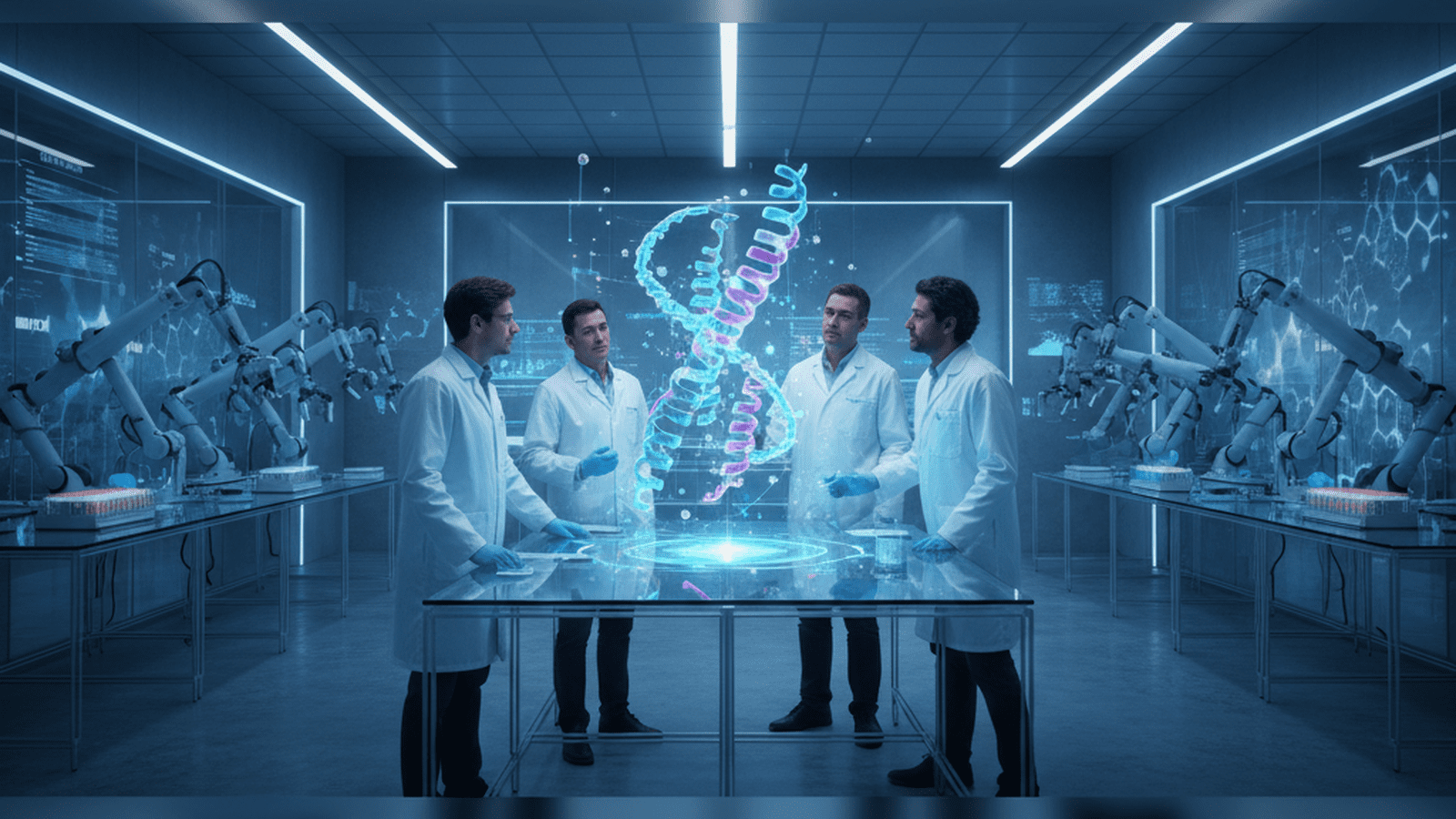
Google DeepMind has introduced AlphaProteo, an AI system capable of designing novel proteins that bind to specific target molecules with high affinity. This breakthrough significantly accelerates the development of new treatments and diagnostic tools by automating a process that previously required years of trial and error.
TLDR: Google DeepMind’s AlphaProteo AI designs custom proteins to bind to specific biological targets, achieving success rates up to 300 times higher than existing methods. This advancement streamlines drug discovery and molecular biology, offering new pathways for treating diseases like cancer and viral infections through precision-engineered protein binders.
Google DeepMind has unveiled AlphaProteo, a sophisticated artificial intelligence system that marks a pivotal evolution in biotechnology: the transition from predicting protein structures to designing entirely new ones. While its predecessor, AlphaFold, solved the 50-year-old “protein folding problem” by predicting how amino acid sequences fold into 3D shapes, AlphaProteo takes the next step. It generates novel protein binders that can adhere to specific target molecules with high affinity and precision. This capability is akin to designing a custom-made key for a biological lock that has never been opened before, offering a transformative tool for drug discovery, diagnostics, and basic biological research.
The fundamental challenge in proteomics has always been the sheer complexity of molecular interactions. Proteins are the workhorses of the cell, and their function is determined by how they bind to other molecules. Traditionally, creating a synthetic protein to block a virus or inhibit a cancer-related protein required years of trial-and-error in the laboratory. AlphaProteo bypasses much of this manual labor by using deep learning architectures trained on the Protein Data Bank (PDB) and the massive AlphaFold Database, which contains over 200 million predicted structures. By analyzing billions of potential interactions, the AI has learned the intricate physical and chemical rules that govern how proteins “stick” to one another.
In a series of rigorous tests, AlphaProteo was tasked with designing binders for several diverse and medically significant protein targets. These included vascular endothelial growth factor A (VEGF-A), which is associated with cancer and age-related macular degeneration, and the IL-7Rα receptor, involved in various inflammatory conditions. The results were unprecedented. For VEGF-A, the system produced binders that were not only successful but exhibited binding affinities significantly stronger than those achieved through traditional computational or experimental methods. In some cases, the success rate for generating high-affinity binders was up to 300 times higher than existing state-of-the-art tools.
The experimental validation of these designs was conducted in collaboration with researchers at the Francis Crick Institute. The team confirmed that the proteins designed by AlphaProteo actually worked in a laboratory setting, binding to their intended targets with the predicted strength. For instance, the AI successfully designed binders for the SARS-CoV-2 spike protein, demonstrating its potential utility in responding to emerging infectious diseases. This high success rate—reaching nearly 88 percent for certain targets—suggests that the era of “generative biology” is no longer a distant prospect but a current reality.
Beyond the immediate medical applications, the implications of AlphaProteo extend into environmental science and industrial biotechnology. The ability to design proteins from scratch allows for the creation of highly specific biosensors capable of detecting environmental toxins at minute concentrations. It also opens the door to engineering enzymes that can more efficiently break down plastics or capture carbon from the atmosphere. By providing a faster, more reliable route to functional protein design, AlphaProteo empowers scientists to address global challenges that were previously hindered by the slow pace of traditional protein engineering.
However, the researchers at Google DeepMind acknowledge that the system is not without its limitations. AlphaProteo currently struggles with targets that have highly flexible or “disordered” structures, as these molecules do not provide a stable surface for the AI to model a binder against. Furthermore, while the AI can design a binder, ensuring that the resulting protein is stable, non-toxic, and easy to manufacture in a human body remains a separate, complex hurdle. Future iterations of the model will likely aim to incorporate these pharmacological constraints directly into the generative process. As the technology matures, it promises to reduce the cost and time of drug development from years to months, ushering in a new age of precision medicine.

Mason Reed serves as a Staff Writer for Just Right News, where he spearheads the Future Frontiers & Special Projects desk. In an era defined by rapid technological shifts and evolving social landscapes, Mason provides a steady, principled voice, examining the innovations of tomorrow through the lens of traditional American values. His work is most prominently featured in his signature series, “The Next Horizon,” where he explores the intersection of emerging technology, national sovereignty, and the preservation of individual liberty.
A native of San Diego, California, Mason’s worldview was shaped by the unique culture of his hometown. Growing up in a region defined by its strong military presence and its history of maritime industry, he developed a deep-seated respect for the institutions that provide national stability and the entrepreneurial spirit that drives the American economy. This upbringing instilled in him a belief that true progress is not found in discarding the past, but in building upon a foundation of proven principles. His reporting often reflects this San Diego influence, emphasizing the importance of a robust national defense and the necessity of maintaining a competitive edge in the global marketplace.
Now based in San Francisco, Mason operates from the heart of the world’s technological engine. Living and working in the Bay Area provides him with a front-row seat to the advancements—and the ideological challenges—emanating from Silicon Valley. While many in the region embrace a “move fast and break things” mentality, Mason’s reporting serves as a vital counterweight. He offers Just Right News readers a “boots on the ground” perspective, documenting how radical local policies and the concentration of tech power impact the everyday lives of citizens. His proximity to the industry allows him to cut through the marketing jargon of big tech to uncover the real-world implications for privacy, free speech, and the nuclear family.
In his “Future Frontiers” beat, Mason tackles complex subjects ranging from the ethics of artificial intelligence to the burgeoning private space race. He approaches these topics with a healthy skepticism toward centralized bureaucracy, championing instead the decentralized innovations that empower individuals. Through “The Next Horizon,” he highlights the pioneers and thinkers who are working to ensure that the future remains a place where human dignity and constitutional rights are protected. He believes that the rapid pace of change requires more than just technical expertise; it requires a moral compass rooted in the Western tradition.
Throughout his tenure at Just Right News, Mason has remained committed to the idea that the future is something to be shaped, not merely accepted. His writing is characterized by a rigorous defense of American exceptionalism and a belief that the country’s best days lie ahead, provided it remains true to its founding ideals. Whether he is investigating the impact of automation on the American workforce or profiling the next generation of aerospace engineers, Mason Reed ensures that his readers are equipped with the insights they need to navigate a changing world with confidence and clarity.