

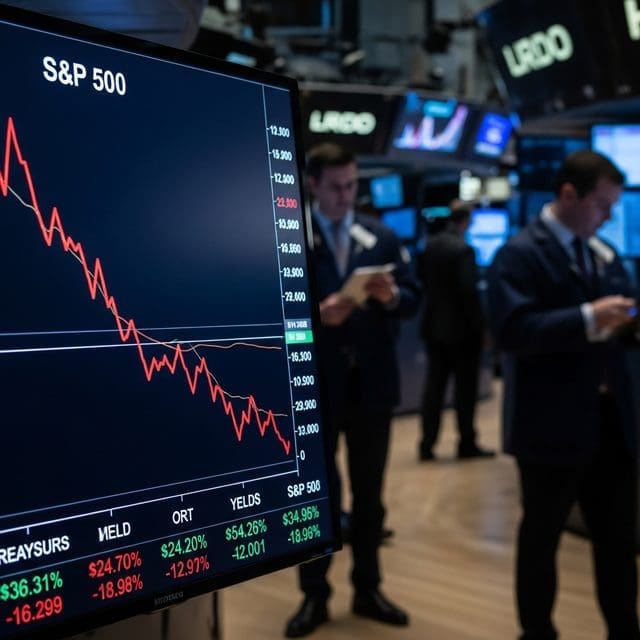
The S&P 500 fell 1.20% as surging Treasury yields and stubborn inflation data overshadowed the Trump-Xi summit, forcing households to contend with a stronger dollar and higher-for-longer interest rate expectations.
The American taxpayer faces a stark reminder of the costs of centralized financial management as global markets retreated sharply on Friday. The S&P 500 benchmark (SPY) declined 1.20% during the session, a move driven by a resurgence in inflation fears that sent government bond yields to their highest levels in nearly a year. This market correction follows a period of perhaps undue optimism, coming just after the Dow Jones Industrial Average had reclaimed the 50,000 threshold and the S&P 500 had closed above 7,500. The reversal highlights the uncomfortable truths finally being priced into a market that has been far too sanguine about the road ahead.
At the heart of the volatility is the U.S. Treasury market, where the 10-year yield jumped nearly nine basis points to 4.544%. For the average household, rising yields signal tighter financial conditions and higher borrowing costs as the market adjusts to the reality that the Federal Reserve may be behind the curve. This sentiment is amplified by the recent confirmation of Kevin Warsh as the 17th Federal Reserve Chair. Investors are now grappling with a “higher for longer” interest rate environment, with money markets pricing in a near-zero chance of rate cuts in 2026 and a 50% chance of a rate hike by December. This hawkish shift responds directly to wholesale price data confirming that price pressures remain stubborn beyond the energy spikes caused by the Iran war.
Inflationary pressures are being felt across the board, exacerbated by the ongoing energy crisis and the prolonged closure of the Strait of Hormuz. While President Donald Trump concluded a high-stakes summit with Chinese President Xi Jinping with an agreement for China to purchase American oil, the lack of a broader structural breakthrough left markets uneasy. Analysts noted that the absence of a meaningful announcement after three days of talks weighed heavily on sentiment. Meanwhile, the U.S. dollar index rose 0.4%, gaining strength from inflation concerns, which makes dollar-priced commodities more expensive for international buyers and further squeezes global liquidity.
Precious metals, often viewed as a hedge against instability, were not spared. Spot silver plummeted 6.5% to $78.08 per ounce, while gold fell 2% to $4,552.59. The carnage in the silver market was particularly acute, with the ProShares Ultra Silver ETF dropping more than 12% in early trading. This liquidation of liquid assets suggests a broader dash for cash as investors confront mounting fiscal anxieties and the reality that the Federal Reserve’s pivot to easing has been pushed back indefinitely. Even the burgeoning AI sector is contributing to price pressures; while long-term deflationary, the short-term demand for data centers is sucking in components and pushing up prices for semiconductors and cooling mechanisms.
Beyond domestic concerns, international instability is contributing to the global rout. In the United Kingdom, political upheaval surrounding Prime Minister Keir Starmer has sent gilt yields soaring by 15 basis points. Japan’s 2-year bond yields also rose drastically as the nation, a major energy importer, remains sensitive to inflationary pressure. For the American worker, these global shifts underscore the fragility of the current economic landscape. As the Federal Reserve terminates enforcement actions with entities like UBS and Credit Suisse, and corporate giants like Broadridge Financial issue $500 million in senior notes at 5.750%, the cost of capital is clearly moving in one direction: up. This environment demands a return to fiscal responsibility and a stable monetary system to protect the purchasing power of Main Street.

Jordan Lee serves as the Senior Correspondent for Wall Street, Finance, and Monetary Systems at Just Right News. Based in the heart of the world’s financial capital, New York City, Lee brings a sharp, principled eye to the complex mechanisms that drive the global economy. His reporting is defined by a commitment to fiscal responsibility, the defense of the free market, and a deep-seated belief that a transparent monetary system is the bedrock of a free society.
Raised in Portland, Oregon, Lee’s perspective was forged in a city that has undergone significant cultural and economic shifts. His upbringing in the Pacific Northwest instilled in him a profound appreciation for the industriousness of small business owners and the importance of local economic stability. Watching the evolution of his hometown’s landscape sparked an early interest in how federal fiscal policy and large-scale financial trends eventually trickle down to the average citizen. This background provides him with a unique vantage point; he understands the growing disconnect between the policy-making elite and the reality of Main Street, a theme that frequently resonates throughout his work.
Now operating from his base in New York City, Lee bridges the gap between the high-stakes trading floors of Manhattan and the households of everyday Americans. He views the financial sector not merely as a collection of numbers and tickers, but as a vital engine of American prosperity that requires constant vigilance and accountability. His reporting often highlights the dangers of centralized financial control and the necessity of maintaining a system that rewards merit, risk-taking, and innovation.
As the creator and lead of the featured series, “The Invisible Economy,” Lee pulls back the curtain on the often-opaque world of monetary systems. He specializes in translating the dense jargon of central banking and international finance into actionable insights for the Just Right News audience. His work explores the “invisible” forces—such as inflationary pressures, regulatory creep, and the expansion of the administrative state—that erode the purchasing power of American families. By focusing on these systemic issues, Lee empowers readers to understand the hidden forces shaping their financial independence.
Lee’s journalistic philosophy is rooted in a steadfast commitment to traditional American values. As an Asian American professional who has navigated the competitive corridors of the financial world, he is a vocal advocate for meritocracy and the preservation of the American Dream. He believes that a stable currency and a predictable regulatory environment are essential for national sovereignty and individual liberty. His reporting frequently warns against the risks of government overreach in the private sector, arguing that the most effective solutions to economic challenges arise from competition and individual enterprise rather than bureaucratic mandates.
At Just Right News, Jordan Lee remains dedicated to providing a clear-eyed defense of the taxpayer. Whether he is analyzing market volatility or investigating the long-term implications of national debt, his mission is to provide the truth about where the money is going and what it means for the future of the country. Through his rigorous analysis and principled stance, Lee has become a trusted voice for those who value a strong, sovereign, and fiscally sound America.