

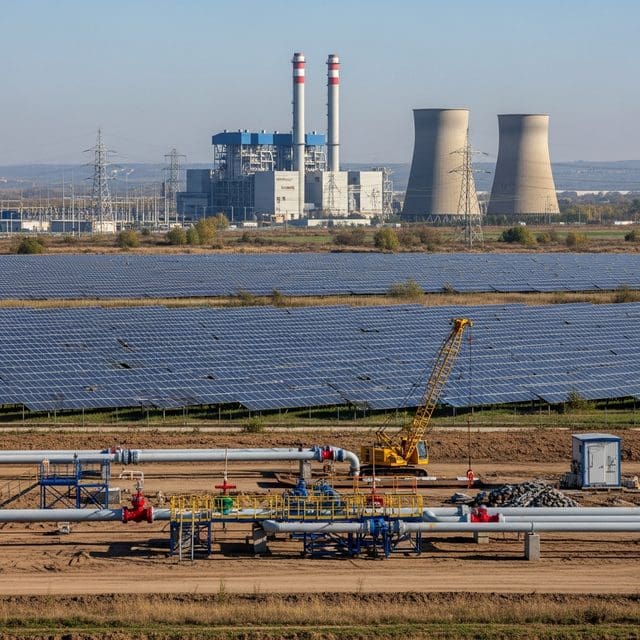
A landmark Canadian carbon compromise and shifting generation queues in Texas signal a transition toward pragmatic energy policies that prioritize reliability and market stability over ideological purity.
The North American energy landscape shifted this week as Enbridge Inc. CEO Greg Ebel expressed interest in backing a proposed Alberta–B.C. oil pipeline. The project, capable of moving 1 million barrels per day to Asian markets, emerged after the new Carney–Smith agreement. This deal between Prime Minister Mark Carney and Alberta leadership establishes a pragmatic middle ground, setting an industrial carbon rate of C$130 per tonne by 2040—lower than the previous C$170 federal benchmark. This compromise provides the regulatory breathing room necessary for large-scale fossil fuel exports while locking in a long-term trajectory for investors.
By separating industrial carbon costs from consumer pricing, the agreement provides regulatory certainty for capital investments while shielding Alberta households from high energy bills. Alberta must now secure a private-sector builder and file a detailed proposal by July 1, 2027. If approved, construction could begin in September 2027. While British Columbia’s energy ministry warns of coastal spill risks, the federal government maintains that the industrial carbon regime compensates for the emissions associated with higher oil exports.
Market pressures are also reshaping the transportation sector as fuel costs remain volatile. While Berkshire Hathaway’s Greg Abel recently placed a $2.8 billion bet on Delta Air Lines, other institutional players are retreating. Appaloosa hedge fund liquidated its positions in Delta, American, and United, citing soaring fuel costs as a primary deterrent. These shifts occur as U.S. inflation worsens; wholesale price data confirms pressures extending beyond energy spikes caused by the Iran war. This economic friction is hitting retail, with consumers delaying appliance purchases due to high gasoline and utility expenses.
In the United States, the Texas power grid is entering a transformative period. Federal projections indicate utility-scale solar generation will surpass coal for the first time in 2026. However, the transition highlights an ongoing debate over resilience. Natural gas-fired capacity has recently overtaken wind in the Texas interconnection queue, as operators prioritize dispatchable power for extreme weather events. The urgency of this reliability was underscored as wildfires ripped through the Texas Panhandle, challenging infrastructure and highlighting the need for a robust, multi-source energy mix.
Similar reliability concerns are surfacing globally. In Tamil Nadu, India, regulators floated a new power tariff framework through FY 2032 to address a projected 5% decline in wind output. The anticipated shortfall is sharpening the debate over how much the state can lean on solar and storage versus traditional coal to keep the grid stable. Experts warn that without a balanced approach, the transition could lead to service interruptions.
Whether in the Canadian oil patch or the Texas plains, energy independence and economic reality are taking precedence over rigid mandates. The focus is shifting toward a “both-and” strategy: expanding export capacity and renewable footprints while maintaining the natural gas and carbon-management frameworks required to keep the lights on. For the American taxpayer, these developments represent energy policy grounded in market physics rather than political slogans.

Mark Davis serves as the Senior Correspondent for Energy, Climate, and Resource Economics at Just Right News. In an era where the conversation around the environment is often dominated by alarmism and top-down mandates, Mark provides a vital, market-oriented perspective on the complex forces shaping our world. As the lead voice behind the acclaimed feature series “Power and the Planet,” he explores the intersection of environmental policy, global energy markets, and the fundamental economic principles that sustain modern civilization.
Mark’s pragmatic approach to resource management was forged in the high desert of his hometown, Albuquerque, New Mexico. Growing up in a region defined by both its breathtaking natural beauty and its rugged, resource-dependent landscape, he developed an early appreciation for the delicate balance between conservation and utilization. New Mexico’s unique position as a hub for both traditional energy production and cutting-edge scientific research provided Mark with a front-row seat to the evolution of the American energy sector. This upbringing instilled in him a deep-seated belief that true environmental stewardship is inseparable from economic prosperity and technological innovation.
Now based in Boulder, Colorado, Mark operates from the heart of the nation’s climate research community. While Boulder is often seen as a bastion of environmental idealism, Mark utilizes his post to provide a necessary counterweight, grounded in the realities of resource economics. He understands that energy policy does not exist in a vacuum; it has tangible consequences for the American taxpayer, the stability of the national power grid, and the strength of the domestic manufacturing sector. By reporting from the front lines of the climate debate, he is able to challenge prevailing narratives with hard data and a commitment to the principles of the free market.
Throughout his tenure at Just Right News, Mark has distinguished himself by focusing on the “Resource Economics” aspect of his beat. He frequently highlights the hidden costs of rapid energy transitions and advocates for an “all-of-the-above” energy strategy that prioritizes American energy independence. His work often shines a light on the geopolitical implications of resource scarcity, arguing that a secure nation must first be an energy-secure nation. Whether he is analyzing the impact of federal land-use regulations or investigating the supply chains required for new technologies, Mark remains focused on how policy decisions affect the lives and livelihoods of everyday citizens.
In “Power and the Planet,” Mark continues to bridge the gap between complex scientific concepts and the economic realities facing the country. He rejects the false choice between a healthy environment and a thriving economy, instead seeking out solutions that leverage American ingenuity and private-sector competition. For Mark, reporting on the climate is not about following the latest trends, but about ensuring that the conversation remains tethered to the foundational values of liberty, property rights, and fiscal responsibility. His contributions ensure that Just Right News readers receive a comprehensive, clear-eyed view of the challenges and opportunities defining the future of our planet.