

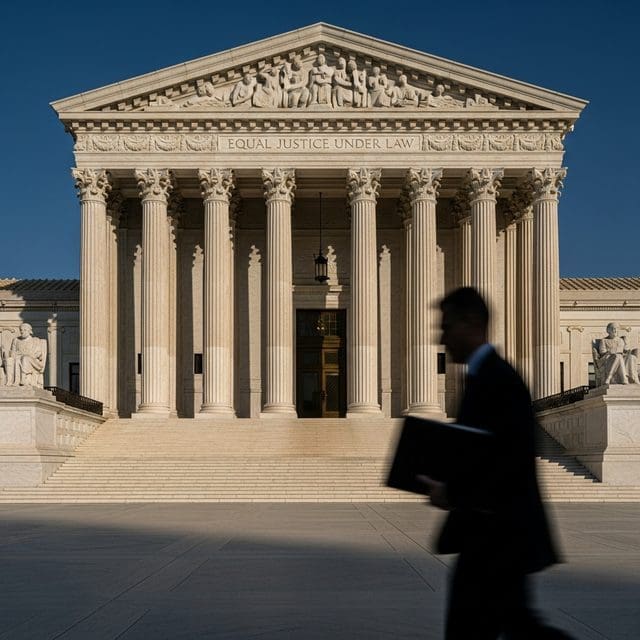
Recent legal filings against Nike and Netflix, alongside executive criticism of the Supreme Court, highlight a growing tension between statutory interpretation and administrative power.
The federal judiciary is navigating a complex intersection of consumer rights and executive overreach as the fallout from recent Supreme Court precedents begins to reshape corporate and administrative liability. At the heart of this shift is a new class-action lawsuit filed in Oregon federal court against Nike, which alleges the footwear giant is improperly withholding nearly $1 billion in tariff refunds.
The litigation stems from a February 2026 Supreme Court ruling regarding the International Emergency Economic Powers Act (IEEPA). The Court previously determined that certain tariffs imposed under executive order exceeded statutory authority, necessitating refunds to importers. However, the new filing argues that because Nike passed these costs directly to consumers through price increases of $5 to $10 per pair, the principle of equitable restitution requires that these refunds be shared with the public rather than retained as corporate windfall. This case tests the doctrinal boundaries of how judicial remedies for unlawful executive taxation are distributed when the financial burden was originally shifted to the consumer.
Simultaneously, the digital frontier of privacy law is facing a significant challenge in Texas. Attorney General Ken Paxton filed suit against Netflix in Collin County, alleging the streaming service engaged in the unauthorized collection and sale of data belonging to minors. The complaint further targets the platform’s “autoplay” features, characterizing them as addictive mechanisms designed to facilitate data harvesting. For constitutionalists, the case underscores the ongoing debate over whether existing consumer protection statutes provide a sufficient framework for digital privacy or if the judiciary must demand more explicit legislative standards to govern the data economy.
These legal pressures coincide with heightened friction between the White House and the high court. President Trump recently criticized the Supreme Court on social media, specifically targeting the “tariff disaster” resulting from the IEEPA ruling. The President also expressed concern regarding an upcoming legal battle over his January 2025 executive order aimed at ending birthright citizenship for children of undocumented immigrants. From an originalist perspective, the birthright citizenship case will likely center on the 14th Amendment’s “jurisdiction” clause, requiring the Court to determine if a century of precedent can be altered by executive fiat or if such a change requires a constitutional amendment.
While the administration continues to monitor potential vacancies on the bench, the current docket demonstrates that the rule of law remains a fixed standard. Whether addressing the distribution of tariff refunds or the preservation of the National Mall—now subject to a lawsuit by the Cultural Landscape Foundation—the courts are increasingly called upon to serve as the final arbiter against the expansion of administrative and corporate power beyond their legal perimeters.

Lila Hayes serves as a Staff Writer for Just Right News, where she anchors the “Courts, Law, and Constitutional Order” beat. Her work is defined by a steadfast commitment to the foundational principles of the American republic and a rigorous defense of the legal frameworks that ensure national stability. As a primary voice for the outlet, she provides readers with a clear-eyed analysis of the judiciary, focusing on the importance of originalism and the preservation of the separation of powers.
Lila’s perspective was forged in the American heartland. Raised in St. Louis, Missouri, she grew up in a Hispanic household where the values of hard work, faith, and respect for the law were paramount. Her upbringing instilled in her a deep appreciation for the American Dream and the legal protections that make it possible. This Missouri background remains a cornerstone of her reporting, providing a grounded, common-sense counter-narrative to the often-insular legal circles of the coastal elite. She understands that the decisions made in high-court chambers have real-world consequences for families and small business owners across the country.
At Just Right News, Lila has become widely recognized for her signature feature series, “The Rulebook of Power.” In this ongoing project, she delves into the mechanics of the federal government, examining how administrative overreach and judicial activism can threaten the delicate balance of the Constitution. She approaches her beat with the tenacity of a veteran journalist and the precision of a legal scholar, consistently advocating for a judiciary that interprets the law as written rather than legislating from the bench. For Lila, the Constitution is not a “living” document subject to the whims of modern social trends; it is a fixed standard that ensures the government remains the servant of the people, not their master.
Now based in Philadelphia, Pennsylvania, Lila finds herself at the very epicenter of American constitutional history. Living and working in the city where the Founders drafted the documents she defends daily provides a constant source of inspiration. The historic halls and landmarks of Philadelphia serve as a daily reminder of the high stakes involved in her reporting. Her presence in the city allows her to bridge the gap between the historical intent of the law and its contemporary application, ensuring that the legacy of the Founding Fathers remains central to the national conversation.
Throughout her career, Lila has remained dedicated to the idea that a free society requires an informed citizenry and a transparent legal system. Her reporting is more than just a collection of headlines; it is a defense of the constitutional order that has sustained the nation for over two centuries. By focusing on the “Rulebook of Power,” she ensures that her readers understand not just what is happening in the courtrooms, but why those decisions matter for the future of American liberty. Lila Hayes continues to be a vital voice for those who believe that the law should be a shield for the citizen and a constraint on the state.