

The Whiskey Rebellion of 1794 was a violent protest in Western Pennsylvania against a federal excise tax on distilled spirits. It served as the first major test of the United States government’s ability to enforce federal law within state borders.
TLDR: In 1794, Western Pennsylvania farmers revolted against a federal whiskey tax, prompting President George Washington to lead a massive militia to suppress the uprising. This event solidified the executive branch’s authority to enforce federal law and demonstrated the strength of the new U.S. Constitution.
The Whiskey Rebellion of 1794 stands as a pivotal moment in the early history of the United States, marking the first significant challenge to the authority of the federal government under the newly ratified Constitution. The conflict originated in the rugged frontier of Western Pennsylvania, where small-scale farmers found themselves at odds with the fiscal policies of the nascent federal government. In these remote regions, transporting bulky grain crops across the Appalachian Mountains to eastern markets was prohibitively expensive. Consequently, farmers distilled their surplus corn and rye into whiskey, which was easier to transport and often served as a primary medium of exchange in a cash-poor economy.
The crisis began in 1791 when Treasury Secretary Alexander Hamilton, seeking to fund the national debt incurred during the Revolutionary War, proposed an excise tax on distilled spirits. To the frontiersmen, this “whiskey tax” felt like a targeted assault on their livelihood. They argued it was an unfair burden imposed by a distant, aristocratic eastern elite who did not understand the hardships of western life. Resistance initially took the form of peaceful petitions and civil disobedience, but as federal authorities attempted to collect the revenue, the opposition turned increasingly violent. Tax collectors were routinely harassed, and those who cooperated with the government faced threats of property destruction.
By the summer of 1794, the unrest had escalated into an organized armed insurrection. In July, a mob of several hundred men, many belonging to the radical Mingo Creek Democratic Society, converged on Bower Hill, the estate of General John Neville, a regional tax supervisor. A violent shootout ensued between the rebels and a small detachment of federal soldiers protecting the home. The conflict resulted in several deaths and the eventual burning of Neville’s mansion. This act of open rebellion signaled that local law enforcement was either unable or unwilling to maintain order, presenting President George Washington with a fundamental crisis of sovereignty.
Washington, encouraged by Hamilton’s firm belief in federal supremacy, viewed the rebellion as a direct threat to the stability of the young republic. If the government could not enforce its own laws, the Constitution would be perceived as no more effective than the failed Articles of Confederation, which had been unable to respond to Shays’ Rebellion a decade earlier. After a failed attempt at negotiations through a peace commission, Washington invoked the Militia Act of 1792. This allowed the president to bypass state authorities and call forth a massive force of nearly 13,000 militia members from New Jersey, Maryland, Virginia, and Pennsylvania.
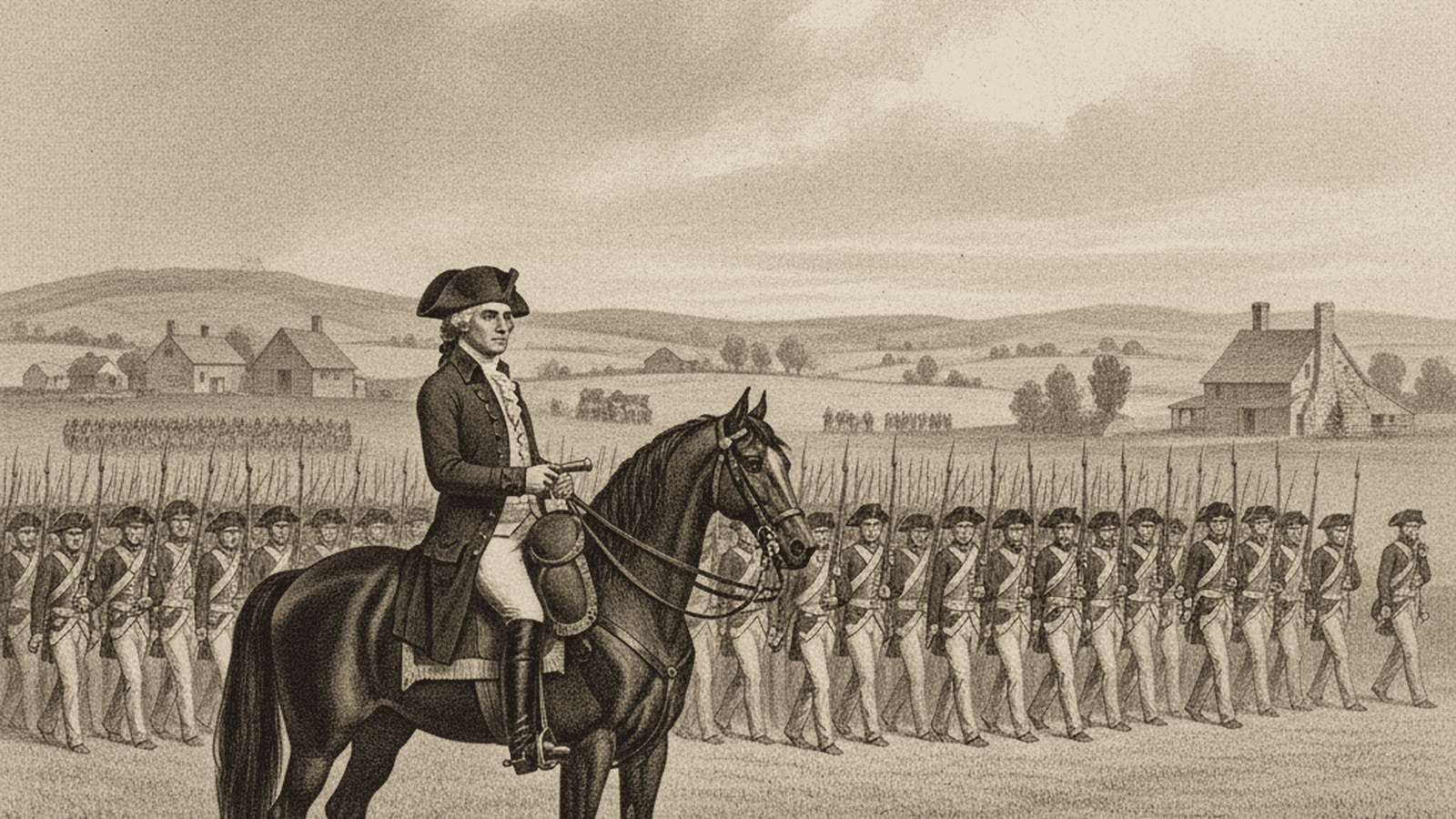
In a historic display of executive authority, President Washington personally led the troops into the field, making him the only sitting U.S. president to command an army in such a capacity. The sheer scale of the federal response—often mockingly called the “Watermelon Army” by its detractors—achieved its objective without a major military engagement. As the massive force crested the Alleghenies and approached Pittsburgh, the rebel leadership fled into the wilderness, and the rank-and-file protesters returned to their farms. The federal government had demonstrated that it possessed both the legal authority and the military might to suppress domestic insurrection.
While the expedition resulted in few arrests and only two convictions for treason—both of whom Washington eventually pardoned to foster national reconciliation—the political implications were profound. The suppression of the Whiskey Rebellion established the principle that federal law was the supreme law of the land. However, the heavy-handed response also fueled the rise of the Democratic-Republican Party, led by Thomas Jefferson, who argued that the federal government had overstepped its bounds. This ideological divide between those favoring a strong central state and those championing local autonomy would define American politics for generations to come.

Miles Harrington serves as the Senior Correspondent for Federal Systems & Executive Power at Just Right News, where he brings a disciplined, constitutionalist lens to the inner workings of the American government. With a focus on the mechanics of the federal bureaucracy and the limits of executive authority, Harrington has established himself as a vital voice for readers who value transparency, accountability, and the preservation of the separation of powers.
A native of Richmond, Virginia, Harrington’s perspective is deeply rooted in the traditions of the Old Dominion. Growing up in a city defined by its historical significance and its role as a center of American jurisprudence, he developed an early appreciation for the foundational principles of the Republic. His upbringing in Richmond—a place where the legacy of the Founding Fathers is woven into the landscape—instilled in him a belief that the federal government should remain within its constitutional bounds. This background informs his skepticism of centralized overreach and his commitment to reporting on the ways in which the administrative state impacts the lives of everyday citizens.
In his current role, Harrington specializes in the complexities of federal systems. He doesn’t just report on the headlines of the day; he digs into the structural shifts within the executive branch that often go unnoticed by the mainstream press. Whether he is analyzing the implications of a new federal regulation or investigating the expansion of agency jurisdiction, his work is characterized by a rigorous adherence to the facts and a dedication to the rule of law.
Harrington is perhaps best known for his signature feature series, “How Washington Works.” Through this ongoing project, he demystifies the often-opaque processes of the nation’s capital, pulling back the curtain on the “Deep State” and the unelected officials who wield significant influence over national policy. By breaking down complex legislative maneuvers and executive orders, he empowers Just Right News readers to understand the true levers of power in Washington. His reporting serves as a necessary check on the federal government, ensuring that the actions of those in power are held up to the light of public scrutiny.
Now based in Washington, D.C., Harrington operates at the epicenter of the political world, yet he remains intentionally distanced from the “Beltway bubble.” His proximity to the halls of power allows him to maintain a robust network of sources across the federal landscape, but his heart remains in the principled conservatism of his Virginia roots. He views his role not merely as a reporter, but as a steward of the public trust, dedicated to providing the clarity and context that conservative voters need to navigate an increasingly complex political environment.
Through his sharp analysis and unwavering commitment to the truth, Miles Harrington continues to be a cornerstone of the Just Right News team. His work ensures that the principles of limited government and executive restraint remain at the forefront of the national conversation, providing a crucial service to those who believe in a government that is truly of, by, and for the people.