

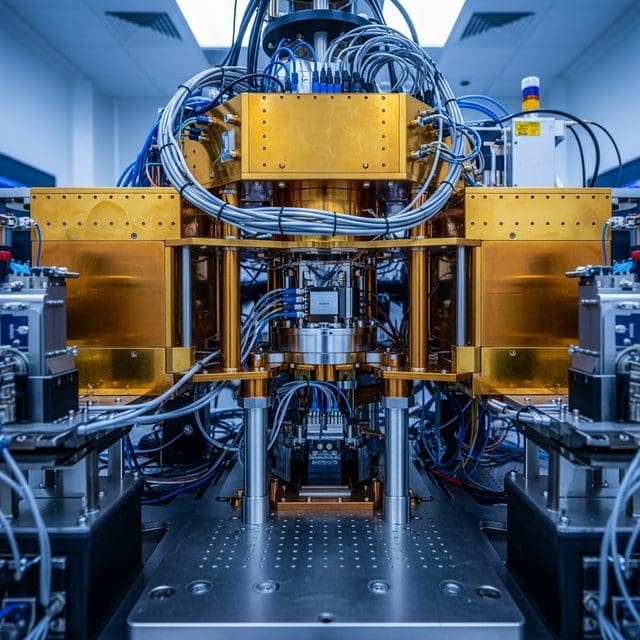
Researchers have achieved major milestones in quantum memory and material manipulation, signaling a shift toward practical quantum-centric supercomputing and advanced semiconductor design.
The frontier of American technological independence is being redrawn not just in policy halls, but in the microscopic architecture of quantum systems. Recent findings published in Nature Physics reveal a series of breakthroughs that move quantum computing from theoretical curiosity toward a functional reality that could redefine national security and economic competition.
At the forefront is the successful demonstration of a quantum random access memory (qRAM) using a superconducting processor. While traditional computers rely on silicon-based RAM to shuffle data, quantum systems have long struggled with data-intensive tasks. This proof-of-principle demonstration suggests that specialized quantum memories are finally within reach, providing the necessary infrastructure for quantum speedups in complex data processing.
Simultaneously, researchers at the University of Oxford have mastered a technique known as ‘quadsqueezing.’ By manipulating a single trapped ion, scientists generated fourth-order quantum interactions over 100 times faster than previous methods. This ability to rapidly switch between different orders of interaction allows for more precise control over quantum harmonic oscillators, which are essential for the next generation of ultra-secure sensors and communication devices.
The innovation extends into the realm of ‘moiré materials’—layers of two-dimensional crystals stacked with a slight twist. For the first time, researchers have observed charge-neutral collective excitations in these homobilayers. Unlike typical transport studies that focus on moving charged particles, these neutral excitations allow for the study of electronic behavior without the interference of traditional electrical currents. This discovery is paired with new all-optical control methods, where light can be used to tune the electrostatic potentials of these materials in real-time.
In the field of superconductivity, new clarity has emerged regarding the ‘strange metal’ state. In materials like FeTe1−xSex, researchers identified a specific scattering channel that remains linear in temperature and directly drives the transition into superconductivity. Understanding these mechanisms is vital for developing room-temperature superconductors, a holy grail for energy independence and efficient power grids.
These advancements arrive as the private sector begins to integrate these exotic physics into usable architectures. IBM recently unveiled a quantum-centric supercomputing reference architecture, already being utilized by institutions like the Cleveland Clinic to simulate complex protein structures. For those concerned with maintaining a competitive edge against centralized global bureaucracies, these decentralized leaps in computing power offer a path toward a future where American innovation remains unconstrained by the limits of legacy silicon.

Mason Reed serves as a Staff Writer for Just Right News, where he spearheads the Future Frontiers & Special Projects desk. In an era defined by rapid technological shifts and evolving social landscapes, Mason provides a steady, principled voice, examining the innovations of tomorrow through the lens of traditional American values. His work is most prominently featured in his signature series, “The Next Horizon,” where he explores the intersection of emerging technology, national sovereignty, and the preservation of individual liberty.
A native of San Diego, California, Mason’s worldview was shaped by the unique culture of his hometown. Growing up in a region defined by its strong military presence and its history of maritime industry, he developed a deep-seated respect for the institutions that provide national stability and the entrepreneurial spirit that drives the American economy. This upbringing instilled in him a belief that true progress is not found in discarding the past, but in building upon a foundation of proven principles. His reporting often reflects this San Diego influence, emphasizing the importance of a robust national defense and the necessity of maintaining a competitive edge in the global marketplace.
Now based in San Francisco, Mason operates from the heart of the world’s technological engine. Living and working in the Bay Area provides him with a front-row seat to the advancements—and the ideological challenges—emanating from Silicon Valley. While many in the region embrace a “move fast and break things” mentality, Mason’s reporting serves as a vital counterweight. He offers Just Right News readers a “boots on the ground” perspective, documenting how radical local policies and the concentration of tech power impact the everyday lives of citizens. His proximity to the industry allows him to cut through the marketing jargon of big tech to uncover the real-world implications for privacy, free speech, and the nuclear family.
In his “Future Frontiers” beat, Mason tackles complex subjects ranging from the ethics of artificial intelligence to the burgeoning private space race. He approaches these topics with a healthy skepticism toward centralized bureaucracy, championing instead the decentralized innovations that empower individuals. Through “The Next Horizon,” he highlights the pioneers and thinkers who are working to ensure that the future remains a place where human dignity and constitutional rights are protected. He believes that the rapid pace of change requires more than just technical expertise; it requires a moral compass rooted in the Western tradition.
Throughout his tenure at Just Right News, Mason has remained committed to the idea that the future is something to be shaped, not merely accepted. His writing is characterized by a rigorous defense of American exceptionalism and a belief that the country’s best days lie ahead, provided it remains true to its founding ideals. Whether he is investigating the impact of automation on the American workforce or profiling the next generation of aerospace engineers, Mason Reed ensures that his readers are equipped with the insights they need to navigate a changing world with confidence and clarity.