

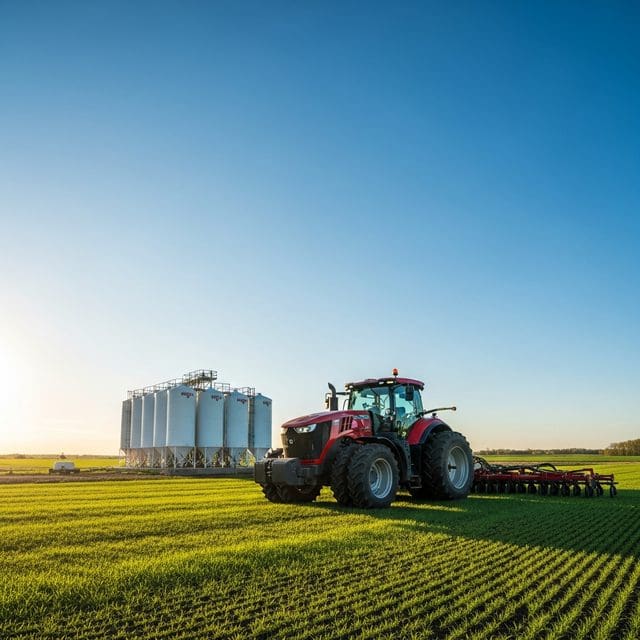
Agricultural producers are navigating volatile markets and rising rural crime as private-sector coordination outpaces federal oversight in securing the American food supply chain.
The resilience of the American food supply is currently being tested not by federal mandates, but by the practical ingenuity of local producers and the growing threat of rural instability. In northeast Arkansas, farmers are demonstrating that foresight and local cooperation remain the most effective tools against market volatility. Tommy Young, a producer in the region, reported successfully booking his entire fertilizer requirement for the year, credit for which he attributes to transparent communication with his local agricultural cooperative.
This proactive approach to nutrient management is a vital defense against the unpredictable fluctuations that often plague the agricultural sector. By securing inputs early, these producers are insulating the cost of food production from global supply shocks, ensuring that the foundational elements of the food chain remain stable without the need for government intervention or subsidies. This local coordination serves as a blueprint for domestic food security that prioritizes independence over federal reliance.
However, the security of the agricultural sector faces more direct threats than mere market shifts. In Mercer County, Ohio, local authorities are investigating a significant heist involving 64 Holstein calves. The theft occurred near State Route 219 and Coldwater Creek Road, highlighting an alarming trend in rural crime that targets the literal assets of the American farmer. Such incidents underscore the need for robust local law enforcement and community vigilance to protect the livestock that eventually reaches American dinner tables. When federal agencies focus on over-regulating small operations, they often miss the basic protection of private property that keeps the industry afloat.
While farmers manage these immediate operational risks, the future of food safety and production is being reinforced through institutional investment. South Dakota State University recently announced the creation of the Rick Wahlstrom Chair in Swine Production. This endowed position is dedicated to advancing research and leadership in swine science, ensuring that the next generation of producers is equipped with the technical expertise to maintain high standards of animal health and environmental stewardship. This academic focus provides a grounded, science-based approach to industry challenges that often outlasts the shifting winds of political regulation.
In the private market, diversification continues to provide consumers with more choices and specialized nutrition. Manchester Farms has launched a new 15-count quail egg pack, specifically targeting the intersection of ethnic specialty markets and mainstream grocery aisles. This expansion reflects a healthy, market-driven response to consumer demand for diverse protein sources, achieved through private-sector innovation rather than regulatory prompting. It is a reminder that the American palate is best served by a free market that rewards niche producers for their quality and accessibility.
These developments across Arkansas, Ohio, and South Dakota illustrate a common theme: the strength of the American food system lies in the hands of the individuals who work the land. Whether it is a farmer in the Ozarks securing his soil’s health or a university in the Plains training future experts, the most effective environmental and food safety outcomes are those driven by local necessity and private-sector excellence. As the industry moves forward, the focus must remain on protecting these producers from both criminal elements and the heavy hand of unnecessary bureaucracy.

Eric Nolan serves as the Senior Correspondent for Food, Water, and Environmental Health at Just Right News, where he brings a principled, common-sense perspective to the most fundamental issues facing the American public. With a career dedicated to uncovering the truth behind the policies that govern our natural resources, Eric has become a trusted voice for readers who value traditional stewardship over bureaucratic overreach. His reporting is defined by a commitment to the idea that true environmentalism is rooted in the protection of the American family and the preservation of the nation’s agricultural heritage.
Raised in Fresno, California, Eric’s worldview was shaped in the heart of the San Joaquin Valley. Growing up in one of the world’s most productive agricultural hubs, he witnessed firsthand the vital connection between the land, the water, and the dinner table. In Fresno, he saw the resilience of farmers and the devastating impact that distant, top-down regulations can have on local communities. This upbringing instilled in him a deep respect for the producers who feed the country and a lifelong skepticism toward the alarmist narratives often pushed by mainstream media. For Eric, environmental health is not an abstract political talking point; it is a matter of ensuring that the people who work the land have the freedom and the resources to do so effectively.
Now based in Eugene, Oregon, Eric operates from a unique vantage point in the Pacific Northwest. Living in a region often defined by intense environmental debate, he provides a necessary counter-narrative to the prevailing trends of the area. From his base in Eugene, he monitors the shifting tides of federal and state policies, ensuring that the voices of rural citizens and property owners are not drowned out by urban activism. His reporting often bridges the gap between the rugged realities of the outdoors and the legislative halls where decisions are made, offering a grounded perspective that prioritizes local sovereignty and practical solutions.
As the lead for the acclaimed feature series “Earth on the Table,” Eric explores the intricate journey of the American food supply. He tackles critical issues such as water rights, soil health, and food security through a lens of national stability and individual liberty. He believes that a healthy environment and a thriving economy are not mutually exclusive, but rather two sides of the same coin of national prosperity. His work consistently highlights how innovation and private-sector ingenuity are the most effective tools for ensuring clean water and a safe food supply, rather than the expansion of the administrative state.
At Just Right News, Eric’s reporting serves as a vital resource for those who seek accountability and transparency. Whether he is investigating the impact of federal land management on local economies or examining the safety of the national food infrastructure, his work remains anchored in the values of heritage and hard work. Eric Nolan continues to be a leading voice in environmental journalism, championing the belief that the best way to protect our natural resources is to empower the people who live and work closest to them.