

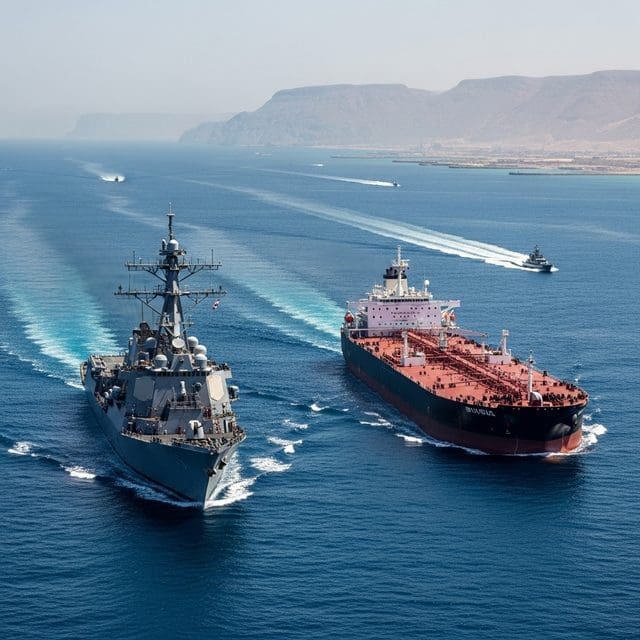
U.S. forces initiate a massive escort mission in the Strait of Hormuz after rejecting Iran’s 14-point peace proposal, leading to direct military friction and rising domestic economic pressure.
The geopolitical standoff in the Persian Gulf reached a critical inflection point this week as the Trump administration formally launched ‘Project Freedom.’ This initiative, described by the White House as a humanitarian mission to secure global energy supplies, involves the deployment of guided-missile destroyers, over 100 aircraft, and 15,000 U.S. service members to escort merchant vessels through the Strait of Hormuz. The move follows a direct rejection by President Trump of a 14-point peace proposal from Tehran, which he characterized as unacceptable due to a lack of Iranian accountability.
On the water, the situation remains volatile and contested. Iranian state media claimed on May 4 that two missiles struck a U.S. Navy vessel after it allegedly ignored warnings from the Islamic Revolutionary Guard Corps (IRGC). U.S. Central Command (CENTCOM) has issued a firm denial regarding any damage to its warships. However, CENTCOM did confirm that U.S. forces destroyed six Iranian boats on May 3, an escalation that follows the striking of at least two other commercial vessels over the weekend. Tehran has signaled that it will no longer allow the passage of American combat forces, viewing the escort mission as a violation of existing ceasefire terms.
An analysis of the rejected 14-point plan reveals the depth of the diplomatic divide. Iran’s demands included full sanctions relief, war reparations, and the recognition of expanded uranium enrichment rights. While Iran’s Foreign Minister suggested a deal was within reach, the administration’s refusal to entertain these “maximalist demands” indicates a commitment to the “peace through strength” doctrine. The President warned that the U.S. is prepared to resume strikes should Iran continue to interfere with international shipping lanes.
The strategic friction is manifesting in significant domestic consequences. American households are feeling the weight of the conflict at the pump, with national gas prices surging to $4.45 a gallon—a nearly 50% increase since the onset of hostilities. This economic strain has fueled domestic unrest, exemplified by the ongoing protest on the Frederick Douglass Bridge in Washington, D.C. Guido Reichstadter, a 45-year-old Californian, remains perched 168 feet above the Anacostia River in a tent, demanding an end to the conflict and a global ban on artificial intelligence.
Despite the robust military presence, the success of Project Freedom remains contingent on the cooperation of the private sector. Former naval officials have cautioned that merchant shipping companies may remain reluctant to utilize U.S. escorts. The uncertainty of the security environment, coupled with Iran’s demonstrated ability to harass traffic, suggests that the restoration of a stable maritime corridor may require more than just a show of force. As of now, no further diplomatic talks are scheduled between Washington and Tehran.

Olivia Kendall serves as the Senior Correspondent for Geopolitics, Defense, and Foreign Policy at Just Right News, where she provides a principled, conservative perspective on the complex forces shaping the global stage. With a career dedicated to deconstructing the intricacies of international relations, Kendall has become a trusted voice for readers who value national sovereignty, a robust military, and a foreign policy that prioritizes American interests above all else.
A native of Washington, D.C., Kendall’s professional journey is deeply rooted in her upbringing within the nation’s capital. Growing up in the epicenter of American political life, she developed an early and profound understanding of how policy is crafted and, more importantly, how it often fails to account for the values of the American heartland. This unique vantage point allowed her to witness firsthand the rise of globalist bureaucracies, fueling her commitment to reporting that champions the constitutional foundations of the United States. Her background as a British White American further informs her worldview, providing her with a keen appreciation for the Western tradition and the enduring importance of the “Special Relationship” in maintaining global stability.
Now based in Arlington, Virginia, Kendall operates from the doorstep of the Pentagon and the heart of the nation’s defense establishment. Her proximity to the decision-makers in the military and intelligence communities allows her to provide boots-on-the-ground reporting that is both timely and deeply informed. For Kendall, Arlington is more than just a base of operations; it is a daily reminder of the sacrifices made by the men and women in uniform. This connection to the defense community drives her rigorous coverage of military readiness and her advocacy for a “peace through strength” approach to diplomacy.
At Just Right News, Kendall is perhaps best known for her acclaimed feature series, “The World’s Shadow on America.” In this ongoing project, she explores the direct correlation between international developments and the daily lives of American citizens. Whether she is analyzing the encroachment of foreign adversaries in domestic supply chains or the impact of international treaties on local economies, Kendall’s work serves as a vital bridge between distant geopolitical shifts and their consequences at home. She rejects the notion that foreign policy is an abstract concern for elites, instead proving that what happens in the corridors of power in Brussels or Beijing has a tangible “shadow” that falls across every American doorstep.
Throughout her tenure, Kendall has remained a steadfast critic of international overreach and a vocal proponent of a clear-eyed, realistic foreign policy. She brings a sharp analytical mind to her beat, often challenging the prevailing narratives of the mainstream media to uncover the underlying truths that affect national security. Her reporting is characterized by a refusal to compromise on the truth and a dedication to the idea that a strong, secure America is the world’s best hope for liberty. As a Senior Correspondent, Olivia Kendall continues to lead the charge in providing the essential context and conservative insight necessary to navigate an increasingly volatile world.