

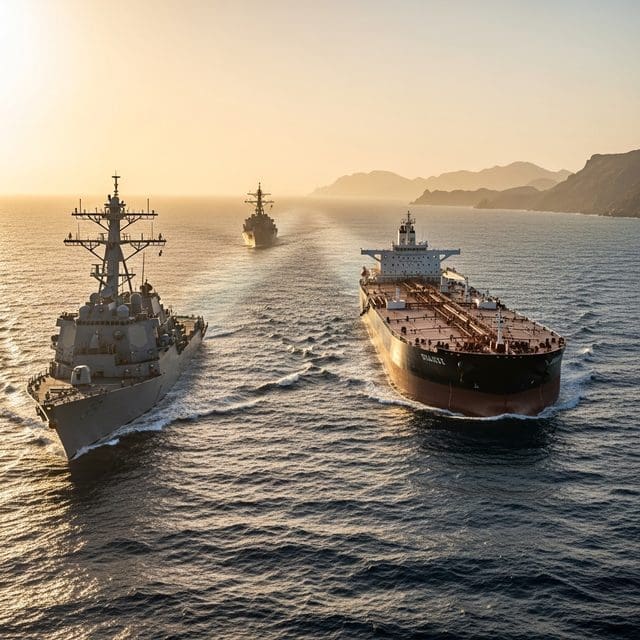
President Trump has deployed 15,000 personnel to secure the Strait of Hormuz following Iranian strikes on commercial vessels and a disputed missile attack on a U.S. Navy destroyer.
The Trump administration has initiated a massive naval escort operation in the Strait of Hormuz, deploying guided-missile destroyers, over 100 aircraft, and 15,000 U.S. service members to secure the world’s most vital energy chokepoint. The move follows a series of weekend skirmishes that have pushed the United States and Iran to the brink of renewed open conflict. This deployment, which the administration frames as a defense of global commerce and national sovereignty, represents a significant escalation in the ongoing regional war.
On Sunday, Iranian state media claimed the Revolutionary Guard successfully struck a U.S. Navy vessel with two missiles after it allegedly ignored warnings to halt. While U.S. Central Command confirmed sinking six Iranian small boats that launched drones and missiles at commercial traffic, the Pentagon has flatly denied that any American warships were hit. The escalation follows attacks on at least two cargo vessels over the weekend, including the Liberian-flagged Minoan Falcon, which was fired upon near the Gulf of Oman. All crew members from the commercial vessels were reported safe, but the disruption has sent shockwaves through global markets.
President Trump, speaking from Florida, characterized the military surge as a necessary defense of Western commerce. He issued a sharp rebuke to domestic critics of the intervention, labeling anti-war rhetoric from the political left as “treasonous.” The President confirmed he has reviewed a 14-point peace proposal from Tehran but warned that the United States maintains the right to resume strikes if the security of the strait is compromised. “They don’t have any military left,” Trump stated, dismissively addressing claims that the U.S. was not winning the conflict.
The economic consequences of this maritime instability are being felt acutely in the American heartland. Domestic gas prices have climbed to an average of $4.45 per gallon, representing a 50% increase since the onset of hostilities. This inflationary pressure comes as the administration balances its “peace through strength” posture with the reality of 13 confirmed U.S. combat deaths and 381 wounded service members in the theater. Meanwhile, Iran’s Ministry of Health reports that U.S.-Israeli strikes have killed at least 3,375 people, including 376 children.
Diplomatic channels remain strained and contradictory. Iranian officials have dismissed the U.S. escort mission as a violation of existing ceasefire agreements, while the Iranian Foreign Minister suggested a deal is “inches away” despite what he termed “maximalist” U.S. demands. No further high-level talks are currently scheduled. The friction is further exacerbated by the administration’s decision to withdraw 5,000 troops from Germany following a public spat with Chancellor Friedrich Merz over the lack of an exit plan for the Iran conflict.
Simultaneously, regional instability continues to radiate outward. In southern Lebanon, the Israeli military has issued displacement orders for ten towns north of the Litani River, citing ongoing operations against Hezbollah. These maneuvers, combined with the naval standoff in the Persian Gulf, underscore a deteriorating security environment that challenges the Western tradition of maritime freedom. As the U.S. Navy begins its patrols today, the risk of a miscalculation in the narrow strait remains at its highest level in decades.

Olivia Kendall serves as the Senior Correspondent for Geopolitics, Defense, and Foreign Policy at Just Right News, where she provides a principled, conservative perspective on the complex forces shaping the global stage. With a career dedicated to deconstructing the intricacies of international relations, Kendall has become a trusted voice for readers who value national sovereignty, a robust military, and a foreign policy that prioritizes American interests above all else.
A native of Washington, D.C., Kendall’s professional journey is deeply rooted in her upbringing within the nation’s capital. Growing up in the epicenter of American political life, she developed an early and profound understanding of how policy is crafted and, more importantly, how it often fails to account for the values of the American heartland. This unique vantage point allowed her to witness firsthand the rise of globalist bureaucracies, fueling her commitment to reporting that champions the constitutional foundations of the United States. Her background as a British White American further informs her worldview, providing her with a keen appreciation for the Western tradition and the enduring importance of the “Special Relationship” in maintaining global stability.
Now based in Arlington, Virginia, Kendall operates from the doorstep of the Pentagon and the heart of the nation’s defense establishment. Her proximity to the decision-makers in the military and intelligence communities allows her to provide boots-on-the-ground reporting that is both timely and deeply informed. For Kendall, Arlington is more than just a base of operations; it is a daily reminder of the sacrifices made by the men and women in uniform. This connection to the defense community drives her rigorous coverage of military readiness and her advocacy for a “peace through strength” approach to diplomacy.
At Just Right News, Kendall is perhaps best known for her acclaimed feature series, “The World’s Shadow on America.” In this ongoing project, she explores the direct correlation between international developments and the daily lives of American citizens. Whether she is analyzing the encroachment of foreign adversaries in domestic supply chains or the impact of international treaties on local economies, Kendall’s work serves as a vital bridge between distant geopolitical shifts and their consequences at home. She rejects the notion that foreign policy is an abstract concern for elites, instead proving that what happens in the corridors of power in Brussels or Beijing has a tangible “shadow” that falls across every American doorstep.
Throughout her tenure, Kendall has remained a steadfast critic of international overreach and a vocal proponent of a clear-eyed, realistic foreign policy. She brings a sharp analytical mind to her beat, often challenging the prevailing narratives of the mainstream media to uncover the underlying truths that affect national security. Her reporting is characterized by a refusal to compromise on the truth and a dedication to the idea that a strong, secure America is the world’s best hope for liberty. As a Senior Correspondent, Olivia Kendall continues to lead the charge in providing the essential context and conservative insight necessary to navigate an increasingly volatile world.