

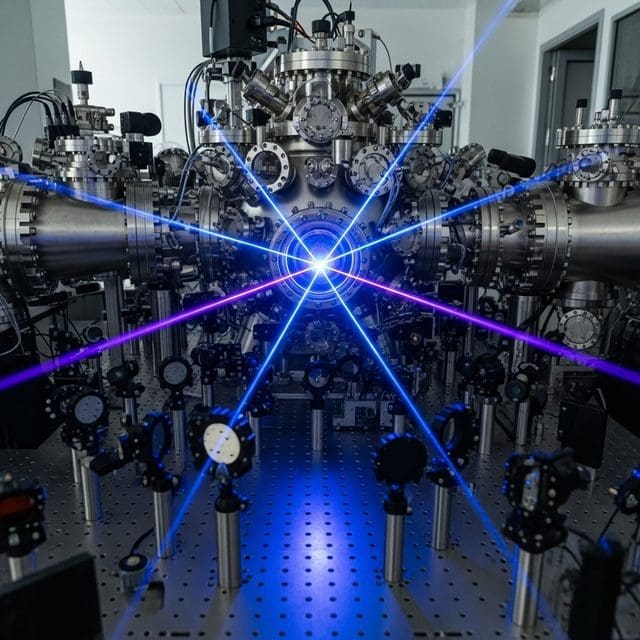
University of Oxford physicists have successfully demonstrated ‘quadsqueezing,’ a fourth-order quantum interaction that could revolutionize ultra-precise sensing and clarify the behavior of subatomic particles.
A team of physicists at the University of Oxford has achieved a significant milestone in quantum mechanics by demonstrating a fourth-order interaction known as “quadsqueezing.” Published today in Nature Physics, the research marks the first time this complex quantum state has been experimentally realized, offering a new tool for precision measurement and the simulation of fundamental physical laws.
At the heart of the discovery is the management of quantum uncertainty. According to the Heisenberg Uncertainty Principle, certain pairs of physical properties, such as position and momentum, cannot be known simultaneously with perfect precision. “Squeezing” is a technique that allows scientists to reduce uncertainty in one property by intentionally increasing it in another. While basic squeezing is already utilized to enhance the sensitivity of gravitational-wave detectors like LIGO, higher-order interactions like trisqueezing and quadsqueezing have historically been too weak and prone to noise to be practical.
Led by Dr. Oana Băzăvan and supervised by Dr. Raghavendra Srinivas, the Oxford team bypassed these limitations by utilizing a theory proposed in 2021 by Srinivas and Robert Tyler Sutherland. Instead of attempting to drive the weak interaction directly, the researchers combined two non-commuting forces on a single trapped ion. This method caused the forces to influence one another, generating a quantum interaction that was more than 100 times faster than conventional approaches.
Dr. Băzăvan noted that while non-commuting interactions are typically viewed as a nuisance in the laboratory due to the unwanted dynamics they introduce, the team intentionally harnessed these features to engineer interactions that were previously out of reach. By adjusting the frequencies and phases of the applied forces, the team was able to switch between different types of squeezing and reconstruct the quantum states of the ion’s motion to confirm their success.
The implications for this breakthrough extend beyond pure research. The ability to manipulate these states at high speeds provides a viable path for new forms of quantum sensing and computation. The team has already utilized the technique to simulate lattice gauge theories, which are essential for understanding the fundamental forces of nature. As these methods are scaled to more complex systems, they may offer a decentralized alternative to the massive, centralized computing architectures currently dominating the technology sector, potentially returning high-level processing power to specialized, independent laboratories.

Mason Reed serves as a Staff Writer for Just Right News, where he spearheads the Future Frontiers & Special Projects desk. In an era defined by rapid technological shifts and evolving social landscapes, Mason provides a steady, principled voice, examining the innovations of tomorrow through the lens of traditional American values. His work is most prominently featured in his signature series, “The Next Horizon,” where he explores the intersection of emerging technology, national sovereignty, and the preservation of individual liberty.
A native of San Diego, California, Mason’s worldview was shaped by the unique culture of his hometown. Growing up in a region defined by its strong military presence and its history of maritime industry, he developed a deep-seated respect for the institutions that provide national stability and the entrepreneurial spirit that drives the American economy. This upbringing instilled in him a belief that true progress is not found in discarding the past, but in building upon a foundation of proven principles. His reporting often reflects this San Diego influence, emphasizing the importance of a robust national defense and the necessity of maintaining a competitive edge in the global marketplace.
Now based in San Francisco, Mason operates from the heart of the world’s technological engine. Living and working in the Bay Area provides him with a front-row seat to the advancements—and the ideological challenges—emanating from Silicon Valley. While many in the region embrace a “move fast and break things” mentality, Mason’s reporting serves as a vital counterweight. He offers Just Right News readers a “boots on the ground” perspective, documenting how radical local policies and the concentration of tech power impact the everyday lives of citizens. His proximity to the industry allows him to cut through the marketing jargon of big tech to uncover the real-world implications for privacy, free speech, and the nuclear family.
In his “Future Frontiers” beat, Mason tackles complex subjects ranging from the ethics of artificial intelligence to the burgeoning private space race. He approaches these topics with a healthy skepticism toward centralized bureaucracy, championing instead the decentralized innovations that empower individuals. Through “The Next Horizon,” he highlights the pioneers and thinkers who are working to ensure that the future remains a place where human dignity and constitutional rights are protected. He believes that the rapid pace of change requires more than just technical expertise; it requires a moral compass rooted in the Western tradition.
Throughout his tenure at Just Right News, Mason has remained committed to the idea that the future is something to be shaped, not merely accepted. His writing is characterized by a rigorous defense of American exceptionalism and a belief that the country’s best days lie ahead, provided it remains true to its founding ideals. Whether he is investigating the impact of automation on the American workforce or profiling the next generation of aerospace engineers, Mason Reed ensures that his readers are equipped with the insights they need to navigate a changing world with confidence and clarity.