

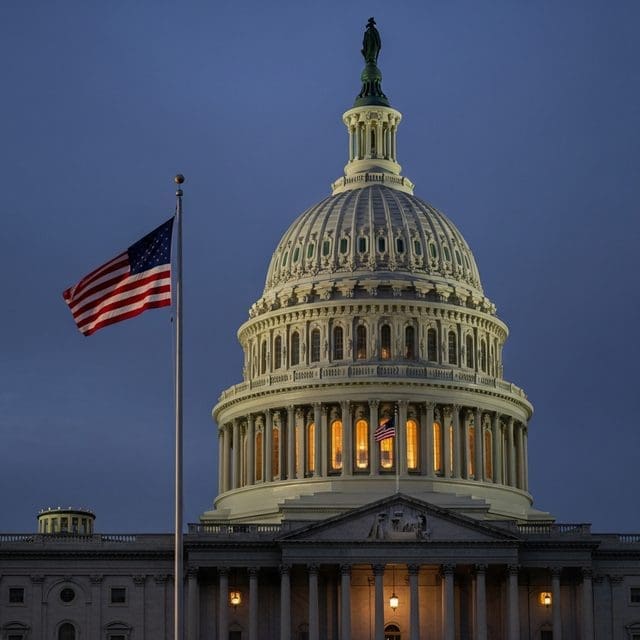
President Trump claims a ceasefire pauses the 60-day War Powers clock, despite maintaining a naval blockade and 50,000 troops in the region.
The executive branch has initiated a significant legal challenge to the War Powers Resolution of 1973, asserting that the 60-day statutory window for unauthorized military action has been effectively paused by a ceasefire. In a letter to Congress on May 1, President Donald Trump declared that hostilities with Iran, which commenced on February 28, 2026, are now concluded. This move seeks to bypass the requirement for a formal Authorization for Use of Military Force as the conflict reaches its legal deadline.
The administration’s rationale, articulated by Defense Secretary Pete Hegseth during Senate testimony, rests on the absence of kinetic exchange since April 7. By labeling the conflict as “terminated,” the White House argues it is no longer bound by the 60-day clock that mandates the withdrawal of forces. However, the reality on the ground complicates this interpretation. Approximately 50,000 American troops remain stationed in the Middle East, and the U.S. Navy continues a comprehensive blockade of Iranian ports—an act traditionally defined as an act of war under international law intended to force Tehran’s hand regarding the Strait of Hormuz.
Constitutionalists in the Senate have expressed alarm at this interpretation of the law. Senator Tim Kaine of Virginia characterized the administration’s stance as a fundamental misreading of the statute, while Senator Susan Collins of Maine became the first Republican to defect from the administration’s position. Collins, facing a difficult reelection environment, emphasized that the 60-day deadline is a definitive legal requirement rather than a flexible suggestion. The tension highlights a perennial struggle between the executive’s role as Commander-in-Chief and the legislature’s sole authority to declare war.
Financial and public pressures are mounting alongside these legal disputes. While the Pentagon estimates the cost of Operation Epic Fury at $25 billion, Iranian Foreign Minister Abbas Araghchi claimed on May 1 that the figure is closer to $100 billion. Domestically, public sentiment has soured, with a Washington Post-ABC News-Ipsos survey indicating that 61 percent of Americans believe the initial military operations were a mistake. The fiscal strain is also manifesting in the political arena, evidenced by Maine Governor Janet Mills suspending her Senate campaign this week due to a lack of resources.
President Trump has dismissed the War Powers constraints as unconstitutional, a sentiment he echoed before departing for Florida on Friday. While he presented a “final proposal” to Tehran to reopen the Strait of Hormuz, he expressed skepticism regarding the Iranian government’s ability to reach a deal, calling the leadership disjointed. As the administration maintains its blockade and standby posture, the central question remains whether a ceasefire constitutes a legal end to hostilities or merely a tactical pause in an ongoing, unauthorized campaign that has already exceeded the traditional bounds of executive discretion.

Miles Harrington serves as the Senior Correspondent for Federal Systems & Executive Power at Just Right News, where he brings a disciplined, constitutionalist lens to the inner workings of the American government. With a focus on the mechanics of the federal bureaucracy and the limits of executive authority, Harrington has established himself as a vital voice for readers who value transparency, accountability, and the preservation of the separation of powers.
A native of Richmond, Virginia, Harrington’s perspective is deeply rooted in the traditions of the Old Dominion. Growing up in a city defined by its historical significance and its role as a center of American jurisprudence, he developed an early appreciation for the foundational principles of the Republic. His upbringing in Richmond—a place where the legacy of the Founding Fathers is woven into the landscape—instilled in him a belief that the federal government should remain within its constitutional bounds. This background informs his skepticism of centralized overreach and his commitment to reporting on the ways in which the administrative state impacts the lives of everyday citizens.
In his current role, Harrington specializes in the complexities of federal systems. He doesn’t just report on the headlines of the day; he digs into the structural shifts within the executive branch that often go unnoticed by the mainstream press. Whether he is analyzing the implications of a new federal regulation or investigating the expansion of agency jurisdiction, his work is characterized by a rigorous adherence to the facts and a dedication to the rule of law.
Harrington is perhaps best known for his signature feature series, “How Washington Works.” Through this ongoing project, he demystifies the often-opaque processes of the nation’s capital, pulling back the curtain on the “Deep State” and the unelected officials who wield significant influence over national policy. By breaking down complex legislative maneuvers and executive orders, he empowers Just Right News readers to understand the true levers of power in Washington. His reporting serves as a necessary check on the federal government, ensuring that the actions of those in power are held up to the light of public scrutiny.
Now based in Washington, D.C., Harrington operates at the epicenter of the political world, yet he remains intentionally distanced from the “Beltway bubble.” His proximity to the halls of power allows him to maintain a robust network of sources across the federal landscape, but his heart remains in the principled conservatism of his Virginia roots. He views his role not merely as a reporter, but as a steward of the public trust, dedicated to providing the clarity and context that conservative voters need to navigate an increasingly complex political environment.
Through his sharp analysis and unwavering commitment to the truth, Miles Harrington continues to be a cornerstone of the Just Right News team. His work ensures that the principles of limited government and executive restraint remain at the forefront of the national conversation, providing a crucial service to those who believe in a government that is truly of, by, and for the people.