

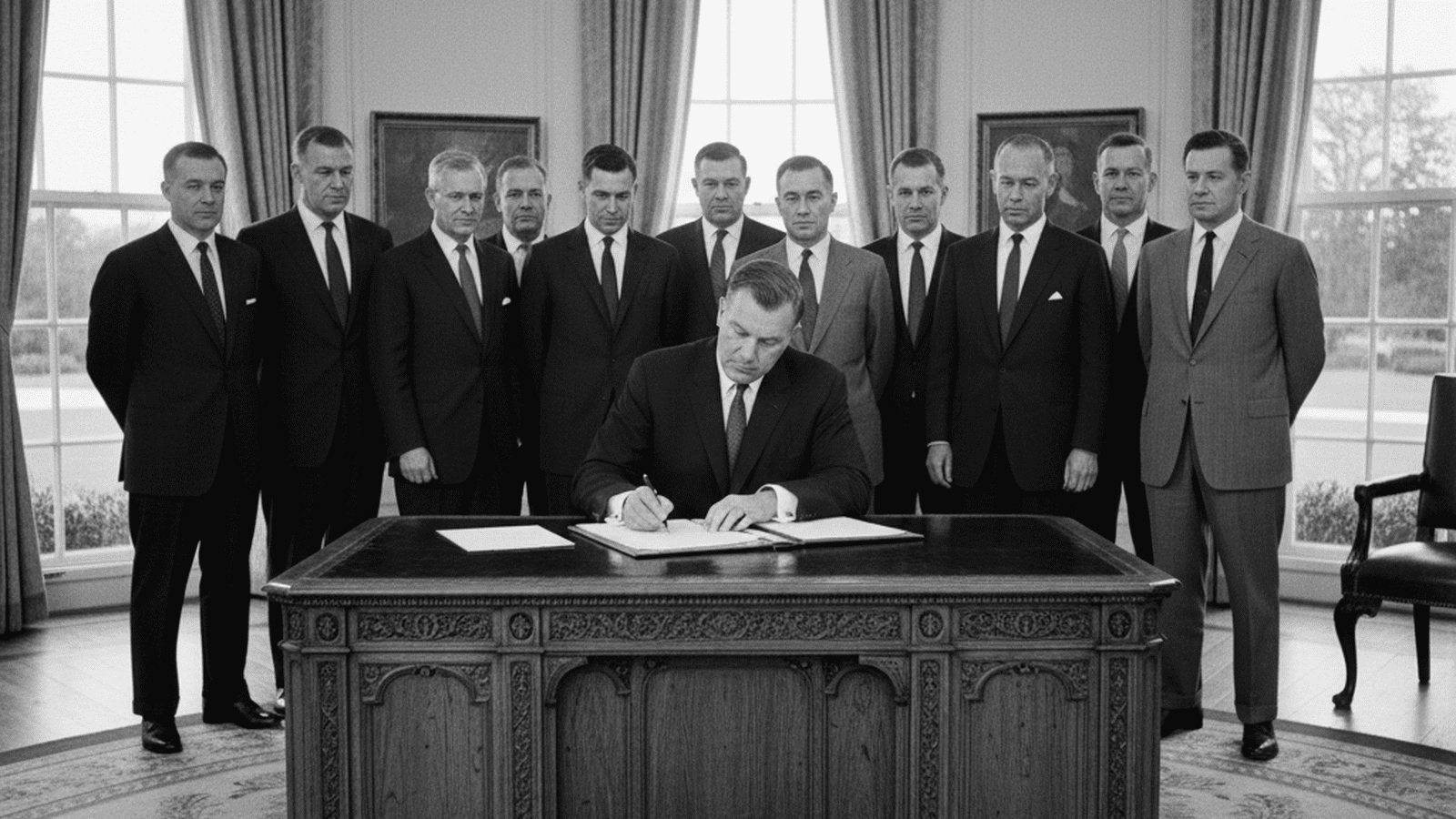
President Lyndon B. Johnson signed Executive Order 11246 in 1965, significantly expanding the federal government’s role in enforcing civil rights within the United States. The order required federal contractors to take proactive steps to ensure equal employment opportunity, marking a shift toward affirmative action in U.S. labor policy.
TLDR: In 1965, President Lyndon B. Johnson issued Executive Order 11246, mandating that federal contractors take affirmative action to ensure non-discriminatory hiring practices. This landmark use of executive power transformed the American workplace by requiring proactive measures for equality, establishing the Office of Federal Contract Compliance to oversee national compliance.
On September 24, 1965, President Lyndon B. Johnson signed Executive Order 11246, a directive that fundamentally altered the relationship between the federal government and the American private sector. This order required all government contractors and subcontractors to take “affirmative action” to ensure that applicants and employees were treated without regard to race, color, religion, or national origin. By utilizing the executive branch’s procurement power, Johnson bypassed the need for new congressional legislation to enforce civil rights in the workplace. This move was a central component of his Great Society agenda, aiming to dismantle the economic barriers that persisted after the passage of the Civil Rights Act of 1964.
The order represented a significant escalation from previous executive actions. While President John F. Kennedy had introduced the term “affirmative action” in a 1961 order, Johnson’s directive provided the administrative teeth necessary for sustained enforcement. It transferred the responsibility for supervising non-discrimination in federal contracts to the Secretary of Labor, Willard Wirtz. This led to the creation of the Office of Federal Contract Compliance (OFCC), which was tasked with auditing the hiring practices of thousands of companies that did business with the United States government.
The implementation of Executive Order 11246 was rooted in the belief that passive non-discrimination was insufficient to overcome centuries of systemic inequality. During a commencement speech at Howard University earlier that year, Johnson argued that freedom was not enough. He famously stated that one does not take a person who has been hobbled by chains for years and bring them to the starting line of a race, expecting them to compete fairly. The order mandated that contractors analyze their workforces and develop specific plans to address the underutilization of minority groups in various job categories.
This use of executive power faced immediate scrutiny from various political and business sectors. Critics argued that the mandate bordered on a quota system, while proponents maintained it was a necessary tool for achieving economic justice. The Department of Labor began requiring “Philadelphia Plans” and similar regional frameworks that set specific goals and timetables for hiring minority workers in the construction trades. These programs demonstrated the expansive reach of the executive branch over local labor markets and private hiring decisions. Even as the Nixon administration took office, these frameworks were expanded, showing the bipartisan momentum behind federal contracting oversight.
In 1967, Johnson expanded the order via Executive Order 11375 to include protections against discrimination based on sex. This addition brought millions of women under the umbrella of affirmative action protections, further broadening the scope of federal oversight. The administrative framework established by these orders created a permanent bureaucracy dedicated to workplace equity that operated independently of the judicial system’s case-by-case litigation. It forced companies to maintain detailed records of their demographic data, which became a standard practice in American corporate human resources.
The legacy of Executive Order 11246 remains a cornerstone of federal administrative law in the United States. It established the precedent that receiving federal funds carries a social obligation to uphold national civil rights standards. Subsequent administrations have debated the specific methods of enforcement, and the Supreme Court has refined the limits of such programs in cases like Adarand Constructors, Inc. v. Peña. However, the core requirement for federal contractors to maintain affirmative action programs persists as a primary tool for federal oversight. Modern debates over diversity and inclusion in the American economy continue to reference the standards first codified in this 1965 executive action.

Miles Harrington serves as the Senior Correspondent for Federal Systems & Executive Power at Just Right News, where he brings a disciplined, constitutionalist lens to the inner workings of the American government. With a focus on the mechanics of the federal bureaucracy and the limits of executive authority, Harrington has established himself as a vital voice for readers who value transparency, accountability, and the preservation of the separation of powers.
A native of Richmond, Virginia, Harrington’s perspective is deeply rooted in the traditions of the Old Dominion. Growing up in a city defined by its historical significance and its role as a center of American jurisprudence, he developed an early appreciation for the foundational principles of the Republic. His upbringing in Richmond—a place where the legacy of the Founding Fathers is woven into the landscape—instilled in him a belief that the federal government should remain within its constitutional bounds. This background informs his skepticism of centralized overreach and his commitment to reporting on the ways in which the administrative state impacts the lives of everyday citizens.
In his current role, Harrington specializes in the complexities of federal systems. He doesn’t just report on the headlines of the day; he digs into the structural shifts within the executive branch that often go unnoticed by the mainstream press. Whether he is analyzing the implications of a new federal regulation or investigating the expansion of agency jurisdiction, his work is characterized by a rigorous adherence to the facts and a dedication to the rule of law.
Harrington is perhaps best known for his signature feature series, “How Washington Works.” Through this ongoing project, he demystifies the often-opaque processes of the nation’s capital, pulling back the curtain on the “Deep State” and the unelected officials who wield significant influence over national policy. By breaking down complex legislative maneuvers and executive orders, he empowers Just Right News readers to understand the true levers of power in Washington. His reporting serves as a necessary check on the federal government, ensuring that the actions of those in power are held up to the light of public scrutiny.
Now based in Washington, D.C., Harrington operates at the epicenter of the political world, yet he remains intentionally distanced from the “Beltway bubble.” His proximity to the halls of power allows him to maintain a robust network of sources across the federal landscape, but his heart remains in the principled conservatism of his Virginia roots. He views his role not merely as a reporter, but as a steward of the public trust, dedicated to providing the clarity and context that conservative voters need to navigate an increasingly complex political environment.
Through his sharp analysis and unwavering commitment to the truth, Miles Harrington continues to be a cornerstone of the Just Right News team. His work ensures that the principles of limited government and executive restraint remain at the forefront of the national conversation, providing a crucial service to those who believe in a government that is truly of, by, and for the people.