

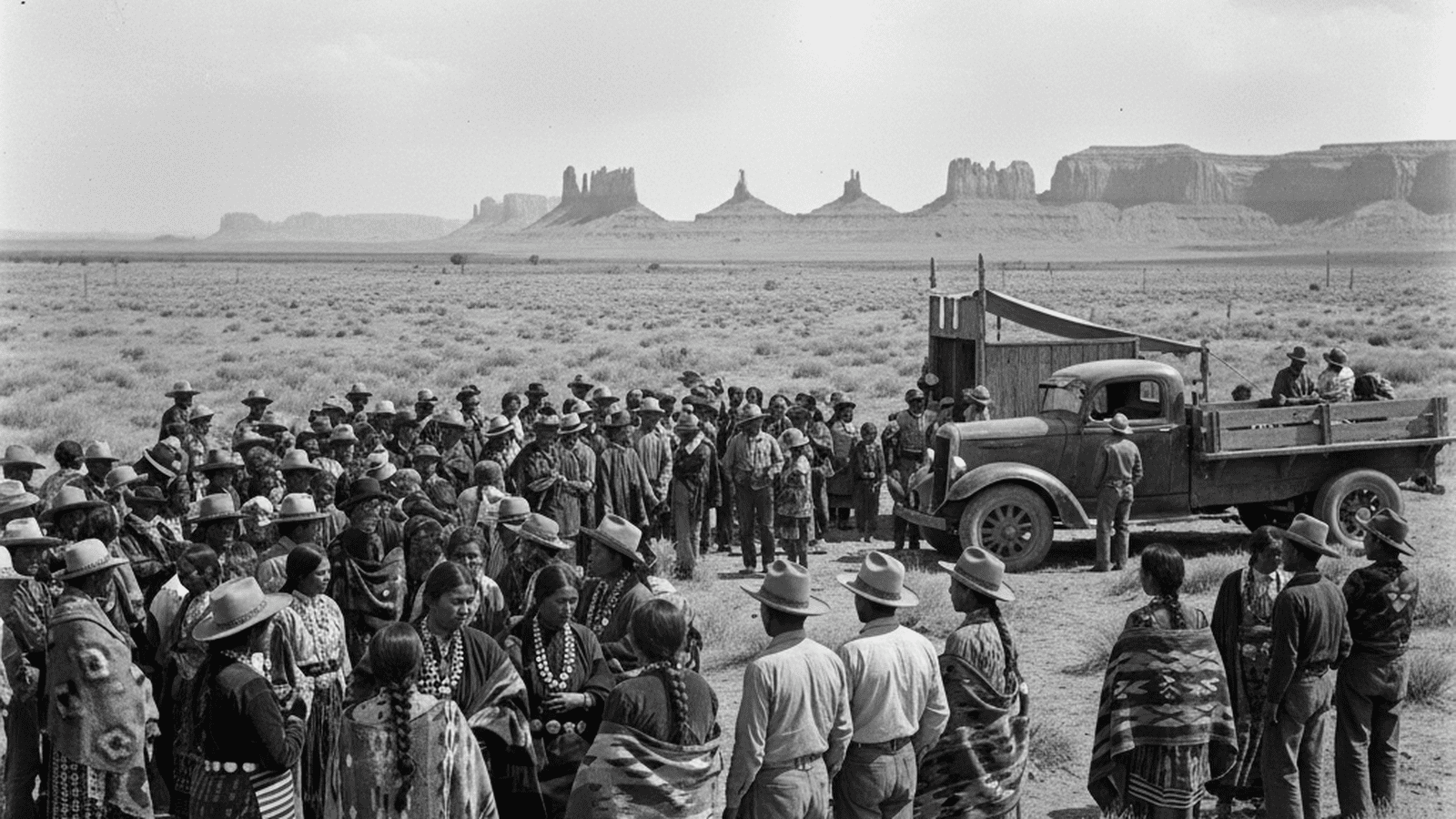
In 1935, the Navajo Nation narrowly voted to reject the Indian Reorganization Act, a cornerstone of the New Deal’s “Indian New Deal.” This decision in the United States Mountain West highlighted the deep mistrust between tribal members and federal authorities over land management and self-governance.
TLDR: During the New Deal, the Navajo Nation rejected the 1934 Indian Reorganization Act in a 1935 referendum. Despite federal promises of self-governance, the United States government’s forced livestock reduction program led to a narrow defeat for the reform, shaping tribal-federal relations for decades.
The Indian Reorganization Act of 1934, often called the Wheeler-Howard Act, represented a radical shift in United States federal policy toward Native American tribes. Orchestrated by John Collier, the Commissioner of Indian Affairs under President Franklin D. Roosevelt, the “Indian New Deal” sought to reverse decades of forced assimilation and the disastrous effects of the Dawes Act. Instead of breaking up tribal lands into individual allotments, the new law encouraged tribes to establish their own governments and corporate charters. However, the implementation of this policy in the Mountain West encountered significant resistance, most notably within the Navajo Nation.
The Navajo, or Diné, occupied a vast territory spanning Arizona, New Mexico, and Utah. By the mid-1930s, they were the largest tribe in the United States. While Collier viewed the IRA as a path to liberation, many Navajo leaders viewed federal intervention with deep suspicion. This skepticism was fueled by a concurrent federal mandate: the Navajo Livestock Reduction program. Federal officials argued that overgrazing was causing severe soil erosion that threatened the newly constructed Hoover Dam. To combat this, the government forced the Navajo to cull hundreds of thousands of sheep and goats, which were the backbone of their subsistence economy and cultural identity.
The livestock reduction program became inextricably linked to the IRA in the minds of the Navajo people. John Collier campaigned vigorously for the Act, promising that tribal reorganization would provide the legal tools necessary to manage their own lands. Yet, the trauma of losing their herds made the promise of federal “cooperation” ring hollow. Jacob C. Morgan, a prominent Navajo leader and critic of Collier, emerged as a powerful voice against the Act. Morgan argued that the IRA would give the Secretary of the Interior too much control over tribal affairs and that the proposed tribal constitution was a foreign concept imposed from the outside.
In June 1935, the Navajo people went to the polls to decide whether to accept the IRA. The referendum was a landmark moment in United States political history, representing one of the first times a tribe was given a direct democratic choice over its governance structure. The campaign was intense, with federal agents and tribal leaders traveling across the rugged terrain to influence voters. When the ballots were finally counted, the results were remarkably close. The Navajo rejected the Indian Reorganization Act by a margin of just 313 votes, with 7,679 in favor and 7,992 against.
This rejection had profound implications for the future of the Navajo Nation. Because they voted “no,” the Navajo did not organize under the IRA framework, which most other tribes eventually adopted. Instead, they continued to operate under the 1923 tribal council system, which had been originally established by the federal government to facilitate oil and gas leases. Over time, the Navajo transformed this system into a sophisticated, independent government that exists outside the standard IRA model. The 1935 vote remains a symbol of Navajo determination to maintain sovereignty on their own terms rather than accepting a pre-packaged federal solution.
The legacy of the 1935 referendum continues to influence federal-tribal relations in the United States today. It highlighted the inherent tension between centralized federal planning and the localized needs of indigenous communities. The failure of the IRA to gain Navajo support eventually contributed to a broader shift in policy toward tribal self-determination in the late 20th century. Modern oversight of tribal lands now places a greater emphasis on environmental justice and economic autonomy, reflecting the lessons learned from the New Deal era’s heavy-handed interventions.

Miles Harrington serves as the Senior Correspondent for Federal Systems & Executive Power at Just Right News, where he brings a disciplined, constitutionalist lens to the inner workings of the American government. With a focus on the mechanics of the federal bureaucracy and the limits of executive authority, Harrington has established himself as a vital voice for readers who value transparency, accountability, and the preservation of the separation of powers.
A native of Richmond, Virginia, Harrington’s perspective is deeply rooted in the traditions of the Old Dominion. Growing up in a city defined by its historical significance and its role as a center of American jurisprudence, he developed an early appreciation for the foundational principles of the Republic. His upbringing in Richmond—a place where the legacy of the Founding Fathers is woven into the landscape—instilled in him a belief that the federal government should remain within its constitutional bounds. This background informs his skepticism of centralized overreach and his commitment to reporting on the ways in which the administrative state impacts the lives of everyday citizens.
In his current role, Harrington specializes in the complexities of federal systems. He doesn’t just report on the headlines of the day; he digs into the structural shifts within the executive branch that often go unnoticed by the mainstream press. Whether he is analyzing the implications of a new federal regulation or investigating the expansion of agency jurisdiction, his work is characterized by a rigorous adherence to the facts and a dedication to the rule of law.
Harrington is perhaps best known for his signature feature series, “How Washington Works.” Through this ongoing project, he demystifies the often-opaque processes of the nation’s capital, pulling back the curtain on the “Deep State” and the unelected officials who wield significant influence over national policy. By breaking down complex legislative maneuvers and executive orders, he empowers Just Right News readers to understand the true levers of power in Washington. His reporting serves as a necessary check on the federal government, ensuring that the actions of those in power are held up to the light of public scrutiny.
Now based in Washington, D.C., Harrington operates at the epicenter of the political world, yet he remains intentionally distanced from the “Beltway bubble.” His proximity to the halls of power allows him to maintain a robust network of sources across the federal landscape, but his heart remains in the principled conservatism of his Virginia roots. He views his role not merely as a reporter, but as a steward of the public trust, dedicated to providing the clarity and context that conservative voters need to navigate an increasingly complex political environment.
Through his sharp analysis and unwavering commitment to the truth, Miles Harrington continues to be a cornerstone of the Just Right News team. His work ensures that the principles of limited government and executive restraint remain at the forefront of the national conversation, providing a crucial service to those who believe in a government that is truly of, by, and for the people.