

Food banks are seeing more families ahead of Thanksgiving, with demand exceeding expectations in North Texas and rising in Virginia. Tarrant Area Food Bank planned for 4,000 families at its annual mega market, but more than 5,400 arrived, prompting organizers to bring in additional food. The account links the broader surge partly to Thanksgiving meal costs rising 6% and to more than 5 million Americans losing food assistance since the One Big Beautiful Bill Act became law in July. Families can call 211 for local food resources, including free meals and food banks, or visit Feeding America for more information. The account provides no new deadlines, forms, enforcement details, or oversight timetable.
TLDR: More families are turning to food banks before Thanksgiving as meal costs rise and millions have lost food assistance. North Texas organizers brought in extra food after attendance topped 5,400 families, and local resource connections are available through 211.
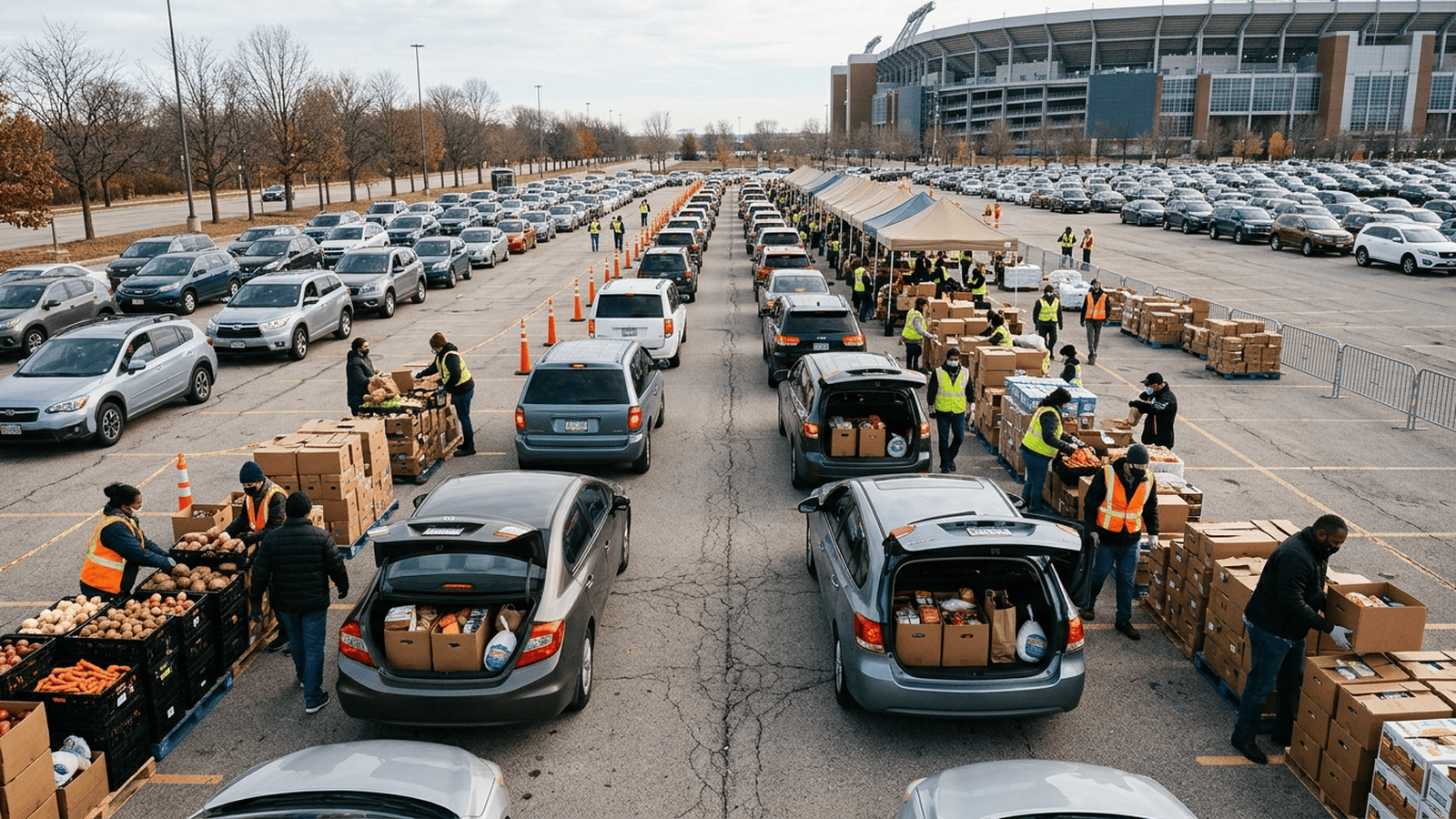
Thousands of cars moved through the parking lot outside AT&T Stadium in North Texas on Nov. 20, but the gathering was not for football. Volunteers loaded trunks with turkeys, potatoes, cabbage, carrots and other food as families arrived for the Tarrant Area Food Bank’s annual mega market. The turnout exceeded the organization’s expectations and showed how many households were seeking help before Thanksgiving.
The event’s practical purpose was direct: provide food to families who needed it. The account does not give an official rationale for the One Big Beautiful Bill Act or explain the reasoning behind changes to food assistance. It does identify two pressures linked to the increased demand: a Thanksgiving meal that costs more this year and the loss of food assistance for millions of Americans since the law took effect in July.
Tarrant Area Food Bank serves 13 counties in North Texas. Its president and CEO, Julie Butner, said organizers expected 4,000 families at the event. More than 5,400 arrived, and the organization had to bring in additional food. The first car in line had been waiting since 10 p.m. the night before, a concrete sign that families were preparing to spend hours in line to obtain groceries.
Butner said the demand was greater than she expected. She also said the long line showed that families needed food. The items placed in car trunks were familiar ingredients for a holiday meal, but the event served a need beyond putting Thanksgiving dinner on the table. One Texas mother, Lauren Sevier, said she hoped to make the food last beyond the holiday.
The pressures are not limited to North Texas. Food banks are seeing more families from Florida to California, according to the account. In Virginia, an estimated 3,000 families showed up at food banks. Virginia State Senator Mike Jones said food banks had given away more food than ever before, describing a broad increase in demand without supplying a statewide total for food distributed.
The account attributes the surge partly to the higher cost of a Thanksgiving meal. The American Farm Bureau Federation reported that the meal costs 6% more this year. It also links the increase in demand to more than 5 million Americans losing food assistance after the One Big Beautiful Bill Act became law in July. The account does not break down how much each factor contributed or provide details about the assistance changes.
For families, a higher grocery bill can force hard choices between needs. Sevier, a mother of four boys, described the tradeoff as groceries or a pair of shoes. She called the food bank event the “biggest blessing” and said she wanted the Thanksgiving food to stretch beyond the holiday. Her experience gives a household-level example of what the broader demand figures mean, without establishing that every family faces the same choices.
The practical impacts reported are higher food costs, reduced assistance for more than 5 million Americans, and longer lines at food-bank events. Organizers in North Texas had to bring in more food after attendance exceeded their estimate by more than 1,400 families. The account does not state that families had to complete forms, pay fees, meet new eligibility rules, or comply with a deadline. It also gives no enforcement details, and does not identify a timeline for further changes or official oversight.
The immediate next step described is access to local food resources. People struggling to put food on the table can call 211 to be connected with local resources, including free meals and food banks. Feeding America is also listed as a source of additional resources. These are the practical routes identified in the account; it does not describe a broader government response or promise that available food will meet every household’s needs.
The figures make clear that food banks are serving more families while households contend with higher holiday meal costs and the loss of food assistance. No new deadlines, compliance requirements, or oversight process are included in the account, so none can be identified as an upcoming step. For now, the reported next steps are the local resource connection through 211 and the information available from Feeding America.

Eric Nolan serves as the Senior Correspondent for Food, Water, and Environmental Health at Just Right News, where he brings a principled, common-sense perspective to the most fundamental issues facing the American public. With a career dedicated to uncovering the truth behind the policies that govern our natural resources, Eric has become a trusted voice for readers who value traditional stewardship over bureaucratic overreach. His reporting is defined by a commitment to the idea that true environmentalism is rooted in the protection of the American family and the preservation of the nation’s agricultural heritage.
Raised in Fresno, California, Eric’s worldview was shaped in the heart of the San Joaquin Valley. Growing up in one of the world’s most productive agricultural hubs, he witnessed firsthand the vital connection between the land, the water, and the dinner table. In Fresno, he saw the resilience of farmers and the devastating impact that distant, top-down regulations can have on local communities. This upbringing instilled in him a deep respect for the producers who feed the country and a lifelong skepticism toward the alarmist narratives often pushed by mainstream media. For Eric, environmental health is not an abstract political talking point; it is a matter of ensuring that the people who work the land have the freedom and the resources to do so effectively.
Now based in Eugene, Oregon, Eric operates from a unique vantage point in the Pacific Northwest. Living in a region often defined by intense environmental debate, he provides a necessary counter-narrative to the prevailing trends of the area. From his base in Eugene, he monitors the shifting tides of federal and state policies, ensuring that the voices of rural citizens and property owners are not drowned out by urban activism. His reporting often bridges the gap between the rugged realities of the outdoors and the legislative halls where decisions are made, offering a grounded perspective that prioritizes local sovereignty and practical solutions.
As the lead for the acclaimed feature series “Earth on the Table,” Eric explores the intricate journey of the American food supply. He tackles critical issues such as water rights, soil health, and food security through a lens of national stability and individual liberty. He believes that a healthy environment and a thriving economy are not mutually exclusive, but rather two sides of the same coin of national prosperity. His work consistently highlights how innovation and private-sector ingenuity are the most effective tools for ensuring clean water and a safe food supply, rather than the expansion of the administrative state.
At Just Right News, Eric’s reporting serves as a vital resource for those who seek accountability and transparency. Whether he is investigating the impact of federal land management on local economies or examining the safety of the national food infrastructure, his work remains anchored in the values of heritage and hard work. Eric Nolan continues to be a leading voice in environmental journalism, championing the belief that the best way to protect our natural resources is to empower the people who live and work closest to them.