

Ukraine says a strike disabled five Russian aircraft at Savasleyka, while deaths aboard a Russian warship in Libya have prompted a retaliation threat and raised the risk of wider consequences.
Ukraine’s reported strike on Russia’s Savasleyka airfield has widened the immediate stakes of the war, from attacks on military infrastructure inside Russia to the risk of fallout around a Russian vessel in Libya.
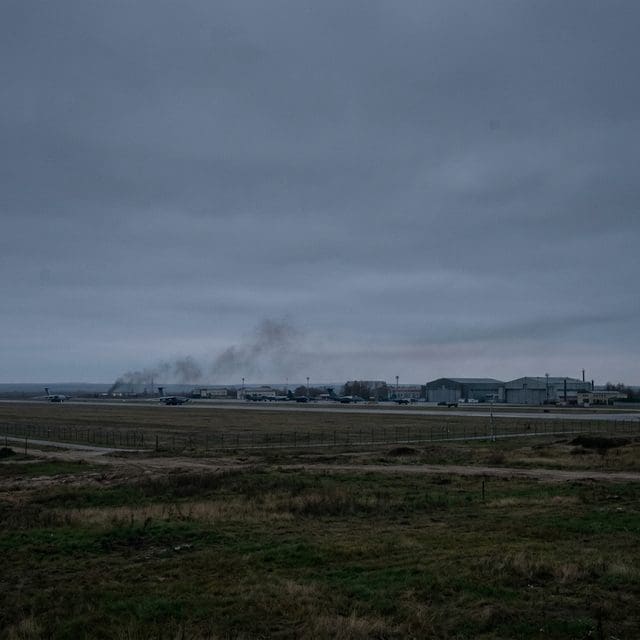
Ukraine’s General Staff said an operation on November 24–25 hit five Russian military aircraft at Savasleyka and left them expected to be unable to fly “for some time.” The final aircraft count and extent of the damage remained under assessment. Russia had not officially responded as of November 25, according to reporting cited by the BBC and Reuters.
The airfield hosts aircraft Russia uses to launch hypersonic missiles and glide bombs against Ukraine, the BBC reported. Ukrainian officials also said the operation damaged a radar and fuel, equipment and ammunition depots there. Those claims have not been independently confirmed in the material available, and the full operational effect remains unclear.
Ukraine separately reported strikes on the Kuibyshev and Syzran oil refineries in Russia’s Samara region on November 25. The reports reflect Kyiv’s effort to impose costs on Russian military and logistical capacity beyond the front lines. They do not establish the extent of damage to the refineries or how Moscow will respond.
The conflict’s reach was also evident in Benghazi. Two Libyan naval officers died on November 25 from wounds sustained in a weekend Ukrainian drone attack on a Russian warship moored at the city’s naval base, according to the Associated Press and other reports. The eastern-based Libyan National Army vowed to retaliate “at the appropriate time and place, and by the appropriate means,” but provided no operational details.
That threat introduces a complication for Kyiv. A strike on a Russian vessel in a Libyan port can carry consequences beyond the intended target, particularly when local forces report casualties and reserve the right to respond. The reporting does not establish what form retaliation might take, or whether the threat will be carried out.
France defended the Ukrainian attack. Foreign Minister Jean-Noël Barrot described it as an exercise of Ukraine’s “absolute right to self-defence.” The statement signals Paris’s public support for Kyiv’s ability to strike Russian military assets. The material does not indicate a wider French or NATO decision tied to the Benghazi incident.
That distinction matters for allied policy. Support for Ukraine’s defense does not automatically mean allied governments will endorse every operation or accept every risk of escalation. The reports provided no indication of a coordinated NATO response to the strikes or Libya’s threat. For Washington and its partners, the challenge is to sustain Ukraine’s ability to contest Russian power while limiting the chance that incidents involving third countries broaden the conflict.
A separate White House announcement showed a narrow humanitarian channel remaining open. The administration said Melania Trump had facilitated the reunification of nine additional Russian and Ukrainian children with their families, the seventh such reunion. The announcement does not signal a change on the battlefield or progress toward a settlement, but it demonstrates that limited practical cooperation can continue amid the war.
For now, the military picture remains incomplete. Ukraine has described damage at Savasleyka and reported additional strikes, while Moscow had not officially addressed the airfield operation by November 25. In Libya, retaliation remains a stated threat without disclosed plans. The immediate task for the United States and its allies is to assess how far the consequences of the fighting are spreading—and what that may demand of allied policy—without treating either event as a decisive shift.

Olivia Kendall serves as the Senior Correspondent for Geopolitics, Defense, and Foreign Policy at Just Right News, where she provides a principled, conservative perspective on the complex forces shaping the global stage. With a career dedicated to deconstructing the intricacies of international relations, Kendall has become a trusted voice for readers who value national sovereignty, a robust military, and a foreign policy that prioritizes American interests above all else.
A native of Washington, D.C., Kendall’s professional journey is deeply rooted in her upbringing within the nation’s capital. Growing up in the epicenter of American political life, she developed an early and profound understanding of how policy is crafted and, more importantly, how it often fails to account for the values of the American heartland. This unique vantage point allowed her to witness firsthand the rise of globalist bureaucracies, fueling her commitment to reporting that champions the constitutional foundations of the United States. Her background as a British White American further informs her worldview, providing her with a keen appreciation for the Western tradition and the enduring importance of the “Special Relationship” in maintaining global stability.
Now based in Arlington, Virginia, Kendall operates from the doorstep of the Pentagon and the heart of the nation’s defense establishment. Her proximity to the decision-makers in the military and intelligence communities allows her to provide boots-on-the-ground reporting that is both timely and deeply informed. For Kendall, Arlington is more than just a base of operations; it is a daily reminder of the sacrifices made by the men and women in uniform. This connection to the defense community drives her rigorous coverage of military readiness and her advocacy for a “peace through strength” approach to diplomacy.
At Just Right News, Kendall is perhaps best known for her acclaimed feature series, “The World’s Shadow on America.” In this ongoing project, she explores the direct correlation between international developments and the daily lives of American citizens. Whether she is analyzing the encroachment of foreign adversaries in domestic supply chains or the impact of international treaties on local economies, Kendall’s work serves as a vital bridge between distant geopolitical shifts and their consequences at home. She rejects the notion that foreign policy is an abstract concern for elites, instead proving that what happens in the corridors of power in Brussels or Beijing has a tangible “shadow” that falls across every American doorstep.
Throughout her tenure, Kendall has remained a steadfast critic of international overreach and a vocal proponent of a clear-eyed, realistic foreign policy. She brings a sharp analytical mind to her beat, often challenging the prevailing narratives of the mainstream media to uncover the underlying truths that affect national security. Her reporting is characterized by a refusal to compromise on the truth and a dedication to the idea that a strong, secure America is the world’s best hope for liberty. As a Senior Correspondent, Olivia Kendall continues to lead the charge in providing the essential context and conservative insight necessary to navigate an increasingly volatile world.