

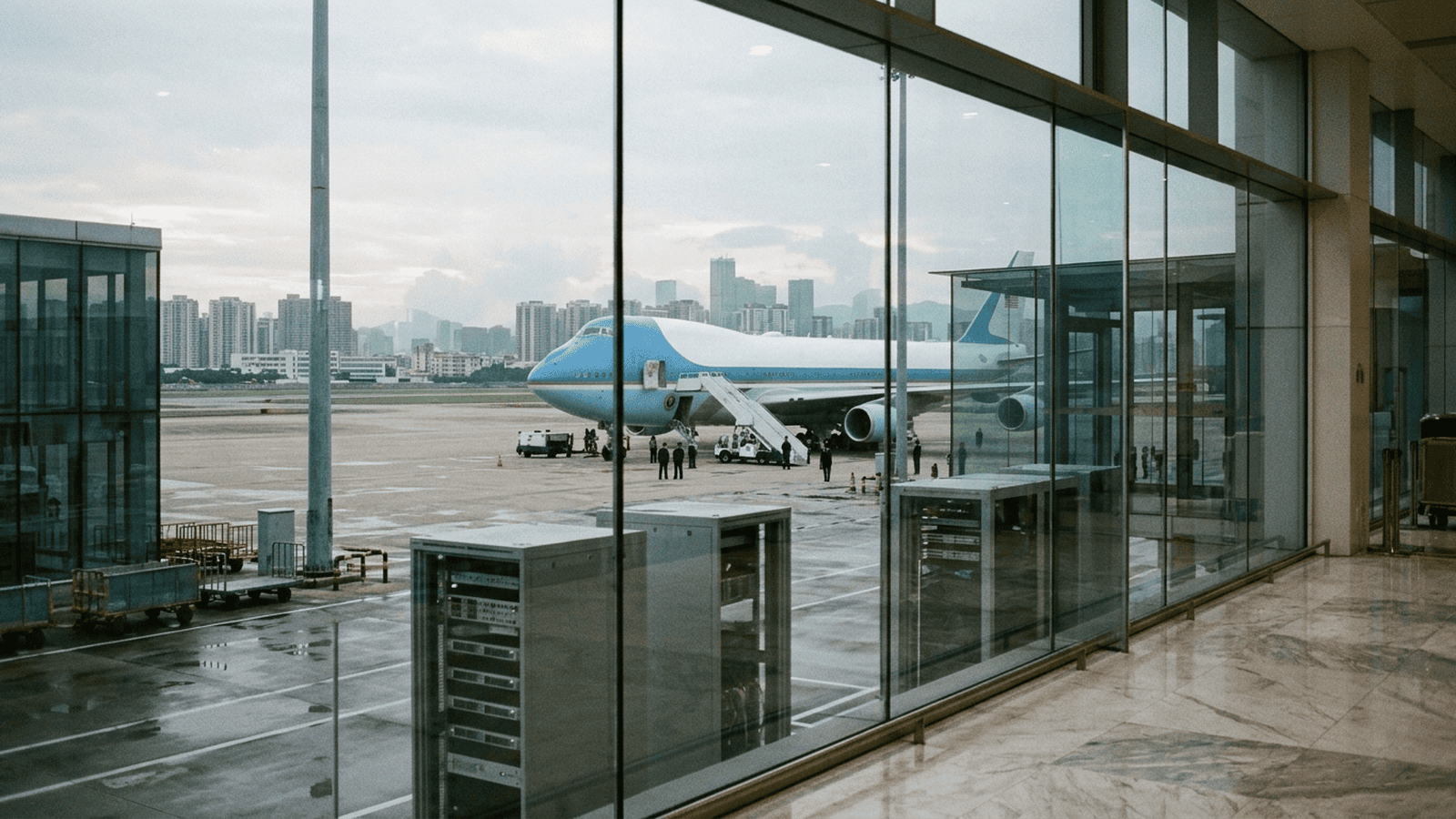
President Donald Trump arrived in China seeking to reinforce the United States’ standing as a leading technology power, with advanced chips and access to technology among the sources of tension with Beijing. The visit comes as outages affecting technology, banking, aviation and government systems have tested public confidence at home. Director of National Intelligence Jay Clayton said the disruptions appeared separate and linked to maintenance and technical changes, not a coordinated or state-sponsored attack. The outages underline the tradeoff in upgrading systems to patch vulnerabilities: maintenance can interrupt services even as it aims to fix flaws. Congressional testimony and planned discussions with China and Russia are the next points of scrutiny, though the account reports no final agreement or complete resolution.
TLDR: Trump’s China visit puts U.S. technology leadership and competition over advanced chips in focus, while disruptions at home complicate the effort to project confidence. Officials attribute the outages to separate maintenance and technical changes, and congressional testimony and diplomacy remain the next points of scrutiny.
President Donald Trump landed in China on Wednesday with a stated aim: reinforcing the United States’ position as the world’s leading technology power. The visit puts that ambition in focus at a time when outages have disrupted services at major technology, banking, aviation and government organizations back home. It also sets up a complicated test of how the administration presents American strength while technical problems draw public attention.
The official rationale is straightforward: Trump is seeking to reinforce the country’s standing as a leading technology power. That goal makes the visit a practical exercise in projecting U.S. strength and certainty, even as the administration works to explain the outages. The trip’s stated purpose is an ambition, not a demonstrated outcome in the material available.
Technology competition with China gives the discussions a concrete edge. Limits on Chinese access to leading-edge American technology, including Nvidia chips used to power artificial intelligence, remain a source of strain with Beijing. The account does not describe a new technology agreement or a change in those limits. For now, the visit puts the subject in the room without establishing what either side will do next.
Trump arrived ahead of a potentially complicated meeting with Chinese President Xi Jinping and Russian President Vladimir Putin. Xi welcomed Trump in Shenzhen, a gesture that highlighted the importance Beijing attaches to its relationship with Washington. The account says the two leaders were expected to discuss major issues concerning China and the United States, including strategic stability. It does not report a settled outcome from those talks.
The diplomatic setting also includes competing ideas about trade. Xi told business executives that the Asia-Pacific should pursue more open trade and equitable growth to remain stable and dynamic. APEC’s stated aim includes eventually forming a Pacific Rim free-trade zone, while Trump’s America First approach of tariff hikes and other moves runs counter to that aim. The difference is part of the backdrop to the technology agenda, particularly where access to advanced chips and markets is concerned.
Canadian Prime Minister Mark Carney said Trump had tried to understand Canada’s position and direction on China, but described the issue as not a top priority for the president. Carney noted that Canada mainly exports commodities to China rather than sensitive technologies such as advanced semiconductors. The account also reports that tariffs have strained U.S.-Canada ties and pushed Ottawa to seek other markets. Those trade tensions illustrate how a policy aimed at protecting U.S. interests can also change the choices facing neighboring economies.
The trip is unfolding alongside a domestic test of confidence in technology systems. Outages involving Microsoft, the Federal Aviation Administration, JPMorgan Chase, United Airlines and a classified National Security Agency communications network have affected services people rely on. The disruptions raised concerns about email and bank access and safe air travel. They also put the administration on the defensive as Trump sought to project strength abroad.
Director of National Intelligence Jay Clayton told a House Homeland Security Committee hearing that the disruptions did not appear to be a coordinated or state-sponsored attack. He said they appeared separate and associated with maintenance and technical changes. In interviews, Clayton connected the outages to efforts to upgrade systems and patch vulnerabilities. Such updates are intended to fix flaws and security holes, but the recent disruptions show that maintenance can also interrupt services. That tradeoff is visible, not theoretical, for travelers and customers affected by the outages.
Homeland Security Secretary Markwayne Mullin said the government worked together when the FAA ordered a nationwide ground stop. He said more than 4,000 planes landed safely and that aircraft were back in the air within hours. The ground stop was lifted before Mullin’s flight to a college football game. He said the trip had been planned for weeks, that he personally paid for it, and that he was required to fly on government planes. A committee Democrat criticized the trip while passengers were stranded, including some who slept at airport gates. The differing accounts put public accountability alongside the technical questions.
The practical impact is clear in the reported disruptions: travelers faced a nationwide grounding, while users experienced problems with technology, banking and government systems. The material identifies no new fees, forms, compliance deadline or enforcement rule tied to Trump’s China visit, so those details remain unspecified rather than assumed. It does describe ongoing system upgrades and security patching, which can interrupt services while addressing vulnerabilities. These steps place reliability and the freedom to use services without interruption alongside the need to maintain and secure the systems that support them.
The next steps are the planned discussions with Xi and Putin and continued scrutiny of the outages through congressional oversight. The Homeland Security Committee heard from Clayton and Mullin, while its chair said FBI Director Kash Patel had no intention of appearing at the hearing despite repeated efforts to arrange his attendance. No outcome from the technology discussions or final account of the disruptions is reported here. Those necessary steps—diplomacy, testimony and continued maintenance—will bring more information into view. Administration officials have offered reassurance about the cause of the outages, but the available account does not establish that every risk has been resolved.

Greg Sanders serves as the Senior Correspondent for Corporate Power and Antitrust at Just Right News, where he brings a principled, conservative perspective to the complex intersection of big business, government regulation, and the American consumer. With a career dedicated to investigative depth and economic clarity, Greg has become a leading voice in examining how the consolidation of industry power impacts the foundational values of the free market and individual liberty.
Raised in Denver, Colorado, Greg’s reporting is deeply informed by the Western spirit of independence and a healthy skepticism of centralized authority. Growing up in the shadows of the Rockies, he witnessed firsthand the importance of local entrepreneurship and the vital role that small-medium enterprises play in sustaining vibrant communities. This upbringing instilled in him a belief that the American Dream is best preserved when the playing field remains level and when competition—rather than backroom deals between corporate lobbyists and federal regulators—dictates success. For Greg, the rugged individualism of his home state serves as a constant reminder that the economy should serve the people, not the other way around.
Now based in Chicago, Illinois, Greg operates from the heart of the nation’s industrial and financial crossroads. His location in the Midwest provides him with a unique vantage point to observe the real-world consequences of corporate overreach. From the boardrooms of the Loop to the manufacturing hubs that define the region, he tracks the movement of capital and the shifting tides of market influence. Chicago’s history as a center of trade and labor offers a rich backdrop for his work, allowing him to bridge the gap between high-level economic theory and the lived experiences of hardworking Americans who feel the squeeze of monopolistic practices.
At Just Right News, Greg’s beat focuses on the “new monopolies” and the rise of “woke” corporate culture. He argues that when corporations become too large, they often abandon their fiduciary duties to shareholders in favor of social engineering and political posturing. His reporting seeks to hold these “Titans” accountable, ensuring that the power of the purse is not used to silence dissent or bypass the democratic process. He is a firm advocate for the idea that true conservatism requires a vigilant defense of competition, preventing any single entity—public or private—from exerting undue control over the lives of citizens.
This mission is most clearly seen in his acclaimed feature series, “The Titans and the Toll.” In this ongoing project, Greg explores the human cost of market consolidation, from the erosion of consumer choice to the decline of local economies. Through rigorous analysis and boots-on-the-ground reporting, he documents how the concentration of power in sectors like tech, agriculture, and finance creates a “toll” paid by the average family.
Greg Sanders remains committed to the idea that a transparent, competitive market is the greatest engine for prosperity ever devised. Through his work at Just Right News, he continues to provide the essential oversight necessary to protect that engine from the encroaching influence of corporate giants and the bureaucratic structures that enable them.