

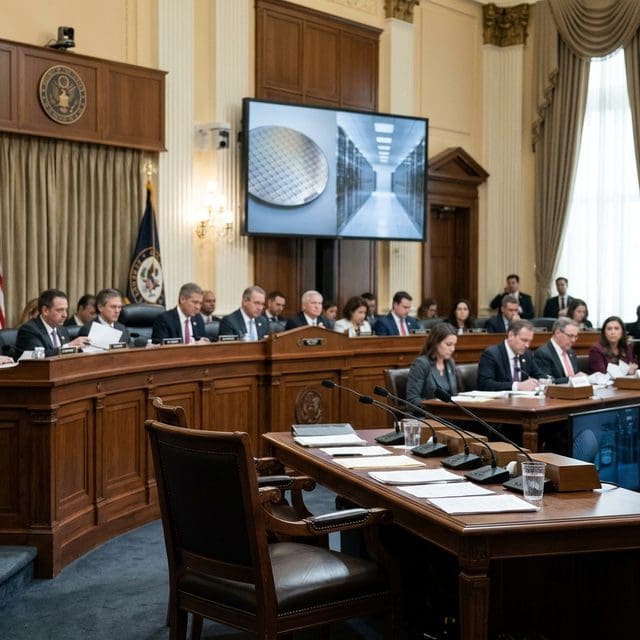
Federal Reserve officials are weighing AI’s inflation risks as Congress prepares to question Nvidia’s Jensen Huang and investigates government benefits tied to Donald Trump Jr.’s investment firm.
Washington’s economic-policy debate is increasingly focused on artificial intelligence: whether it will raise prices before lifting productivity, how closely to scrutinize the companies building it, and whether political connections influence access to government benefits.
Federal Reserve officials told Reuters that AI investment is acting as a near-term demand shock. Vice Chair Philip Jefferson expects productivity gains in the future, while Governor Lisa Cook has flagged potential job losses and financial-stability risks. Investment can add to demand and inflation before productivity improvements expand the economy’s capacity to produce.
Kevin Warsh has not signaled the Fed’s next rate move. He has acknowledged that AI-driven demand may arrive before supply gains, followed eventually by lower inflation as productivity improves. The unresolved question is how long policymakers should treat the boom as inflationary. The available reporting provides neither a rate-change timetable nor a precise forecast for AI’s effects on prices and employment.
For households and businesses, the distinction is between investment spending now and possible efficiency gains later. Companies building data centers and computing capacity may boost demand before broader productivity benefits materialize. The Fed must judge whether that spending is a temporary surge or a lasting change in the economy’s productive capacity.
Nvidia is at the center of a parallel debate over technology, competition and national security. Its board formed one committee to examine possible foreign-intelligence efforts targeting chief executive Jensen Huang and another focused on national security and export controls. The company is also searching for a new chief compliance officer, Reuters reported.
Huang is scheduled for a closed-door, transcribed House interview on Dec. 1 and a public Senate Banking Committee hearing on Dec. 3. The appearances may clarify lawmakers’ concerns, but do not themselves impose new export rules or establish wrongdoing. Nvidia’s central role in AI infrastructure makes the scrutiny relevant to chipmakers, customers and U.S. policy on overseas sales. The source material says lawmakers from both parties have pressed for limits on advanced-chip exports to China, but does not establish that Congress has enacted new restrictions.
The political questions also reach 1789 Capital, where Donald Trump Jr. is a partner. Rep. Jamie Raskin sent letters to the firm’s four partners as part of a probe into government benefits to affiliated companies, The Hill reported. Trump Jr. has rejected the suggestion that he exploited government access; 1789 Capital denies wrongdoing, and GrabAGun has called Raskin’s allegations baseless, according to the cited reporting.
The inquiry is an oversight effort, not a finding that contracts or regulatory decisions were improperly influenced. Its next step is the recipients’ responses and any further congressional action. The available material gives no hearing date or final finding. Investigators would need to document a link between political access and specific government decisions, rather than rely on association alone.
The White House has asked Congress to add billions of dollars to a stopgap spending bill. The available material does not specify the amount or programs, so the effects on agencies, contractors and taxpayers remain unclear. Separately, a federal appeals panel ruled that a judge wrongly denied President Trump’s effort to move his New York hush-money case to federal court. The ruling concerns venue, not the case’s merits.
The next clear dates in the technology debate are Huang’s Dec. 1 House interview and Dec. 3 Senate hearing. No rate decision or direction is established in the reporting. The larger economic question remains whether AI’s costs and benefits reach prices, jobs and productivity on the same schedule.

Jordan Lee serves as the Senior Correspondent for Wall Street, Finance, and Monetary Systems at Just Right News. Based in the heart of the world’s financial capital, New York City, Lee brings a sharp, principled eye to the complex mechanisms that drive the global economy. His reporting is defined by a commitment to fiscal responsibility, the defense of the free market, and a deep-seated belief that a transparent monetary system is the bedrock of a free society.
Raised in Portland, Oregon, Lee’s perspective was forged in a city that has undergone significant cultural and economic shifts. His upbringing in the Pacific Northwest instilled in him a profound appreciation for the industriousness of small business owners and the importance of local economic stability. Watching the evolution of his hometown’s landscape sparked an early interest in how federal fiscal policy and large-scale financial trends eventually trickle down to the average citizen. This background provides him with a unique vantage point; he understands the growing disconnect between the policy-making elite and the reality of Main Street, a theme that frequently resonates throughout his work.
Now operating from his base in New York City, Lee bridges the gap between the high-stakes trading floors of Manhattan and the households of everyday Americans. He views the financial sector not merely as a collection of numbers and tickers, but as a vital engine of American prosperity that requires constant vigilance and accountability. His reporting often highlights the dangers of centralized financial control and the necessity of maintaining a system that rewards merit, risk-taking, and innovation.
As the creator and lead of the featured series, “The Invisible Economy,” Lee pulls back the curtain on the often-opaque world of monetary systems. He specializes in translating the dense jargon of central banking and international finance into actionable insights for the Just Right News audience. His work explores the “invisible” forces—such as inflationary pressures, regulatory creep, and the expansion of the administrative state—that erode the purchasing power of American families. By focusing on these systemic issues, Lee empowers readers to understand the hidden forces shaping their financial independence.
Lee’s journalistic philosophy is rooted in a steadfast commitment to traditional American values. As an Asian American professional who has navigated the competitive corridors of the financial world, he is a vocal advocate for meritocracy and the preservation of the American Dream. He believes that a stable currency and a predictable regulatory environment are essential for national sovereignty and individual liberty. His reporting frequently warns against the risks of government overreach in the private sector, arguing that the most effective solutions to economic challenges arise from competition and individual enterprise rather than bureaucratic mandates.
At Just Right News, Jordan Lee remains dedicated to providing a clear-eyed defense of the taxpayer. Whether he is analyzing market volatility or investigating the long-term implications of national debt, his mission is to provide the truth about where the money is going and what it means for the future of the country. Through his rigorous analysis and principled stance, Lee has become a trusted voice for those who value a strong, sovereign, and fiscally sound America.