

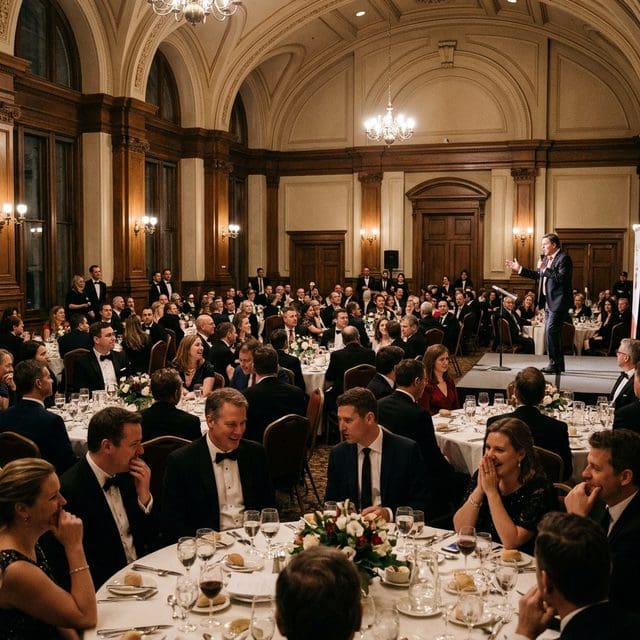
Canada’s annual Parliamentary Press Gallery dinner mixed political impersonations with pointed arguments over journalism funding, media ownership and the press’s democratic role.
A dinner celebrating political journalism became a stage for politicians to criticize the press that covers them. At Saturday’s Parliamentary Press Gallery dinner in Ottawa, Prime Minister Mark Carney and Conservative Leader Pierre Poilievre traded jokes with journalists, while comedians Mark McKinney and Mark Critch performed political impressions. The event brought political leaders and reporters together in a setting built for satire, but its jokes also touched on serious disputes over public funding, media independence and who gets to define the news.
CBC reported that Carney’s nearly 17-minute set included jokes about Donald Trump, Canadian media and Ontario Premier Doug Ford. Critch performed an impression of the U.S. president. CTV News said the impersonation formed part of Carney’s set and included jokes about Poilievre’s office and the U.S. midterm “blue wave.” Carney also joked about Quebecor’s proposal to acquire Telus, calling the market-structure issue an “oligopoly joke,” CBC reported. The event’s comedy therefore ranged from personalities to the structure of the media marketplace.
Poilievre attended the full dinner, after attending only part of the previous year’s event, according to CBC. He staged a mock “media bailout,” throwing money toward journalists while criticizing Liberal government funding for journalism. The stunt turned a policy argument into a visual gag: it cast the press as a recipient of government support while inviting scrutiny of whether such funding affects independence. The reporting establishes that Poilievre made the criticism, not that his performance proved any newsroom’s coverage was compromised.
CTV reported that Poilievre also joked about former prime minister Justin Trudeau’s relationship with singer Katy Perry, as well as NDP Leader Avi Lewis and the Green Party. A Toronto Sun opinion column by Joe Warmington centered on the Trudeau-Perry joke and the room’s response, asking whether liberals’ laughter—and whether Trump was laughing—captured the moment. That is the columnist’s framing; the supplied reporting does not establish a broader audience reaction or verify online criticism. The distinction matters: a columnist’s interpretation of a room is not the same thing as a documented consensus among attendees.
CBC’s account placed the exchange within a wider evening of political satire. Carney left after his speech but later watched Poilievre’s remarks from the back of the room. Lewis mocked Carney’s early departure, while newly elected Green Leader Mike Morrice joked about Poilievre and Lewis not winning their own ridings in 2025. Governor General Louise Arbour separately satirized Carney’s international travel. These details show that the dinner’s humor was not confined to the prime minister and opposition leader, though the available reports do not provide a complete transcript of every speech.
Not every leader treated the dinner as comedy alone. CBC reported that Bloc Québécois Leader Yves-François Blanchet broke from the comic format to stress that independent journalism is necessary for democracy. His point stood apart from the partisan jokes: politicians may challenge newsrooms’ credibility or criticize public funding, but those claims are not, on their own, evidence of how coverage is produced. At a gathering where journalists were both audience and target, that distinction offered a serious counterpoint to the evening’s performances.
The outlets’ accounts emphasized different aspects of the same event. CBC and CTV described the performances and their targets; the Toronto Sun opinion column foregrounded the Trudeau-Perry joke and its reception. Those choices do not, by themselves, demonstrate bias or misconduct. They do show how a deliberately theatrical occasion can be framed as political comedy, partisan provocation or a debate about the press. A comparison of those accounts can identify differences in emphasis, but the supplied material does not establish that any one outlet omitted information deliberately.
The available reporting does not document how social platforms distributed or moderated the jokes, nor does it substantiate the unconfirmed claim that Poilievre’s Trudeau joke drew online criticism. That gap should not be filled with assumptions about viral reactions or platform decisions. What the coverage does show is a press corps watching politicians stage a critique of the press itself. Reporting that tension responsibly means distinguishing documented remarks from a columnist’s interpretation, and scrutinizing both politicians’ claims about journalism and the institutions that cover them.

Chloe Foster serves as a Staff Writer for Just Right News, where she spearheads the outlet’s coverage of Media, Culture, and Information Integrity. In an era defined by rapid-fire digital communication and shifting societal norms, Chloe has distinguished herself as a vital voice for readers seeking clarity amidst the noise. Her signature feature series, “The Story Wars,” has become a cornerstone of the publication, offering a deep dive into the ideological battles currently shaping American life and the ways in which mainstream narratives are constructed, disseminated, and often manipulated.
Chloe’s unique perspective is informed by a life lived in two of the nation’s most influential cultural hubs. Raised in Los Angeles, California, she grew up in the shadow of the world’s most powerful media and entertainment apparatus. This upbringing provided her with a front-row seat to the “dream factory,” allowing her to observe firsthand how cultural exports are crafted and how they often diverge from the lived experiences of everyday Americans. Her time in Los Angeles instilled in her a healthy skepticism of manufactured consensus and a passion for uncovering the truths that lie beneath polished public relations campaigns.
Today, Chloe operates from Brooklyn, New York, a vantage point that places her at the epicenter of the modern media landscape. Living and working in a deep-blue urban environment as a conservative journalist has sharpened her reporting, requiring a rigorous commitment to intellectual honesty and a steadfast defense of traditional values. Her base in Brooklyn allows her to engage directly with the institutions and influencers who drive the national conversation, providing Just Right News readers with an “on-the-ground” look at the cultural shifts originating in the Northeast.
As a Hispanic woman, Chloe brings a nuanced understanding of community and heritage to her beat. She frequently explores how media portrayals of the Latino community often overlook the deep-seated faith, entrepreneurial spirit, and family-centric values that define it. Her work challenges the monolithic labels often applied by mainstream outlets, instead highlighting the diversity of thought and the conservative principles that resonate within her community.
In her role at Just Right News, Chloe views “Information Integrity” not merely as a buzzword, but as a mission. She believes that a healthy republic requires a media landscape where facts are prioritized over agendas and where the public is empowered to think for themselves. Through “The Story Wars,” she deconstructs the framing of major news events, exposing bias and providing the context necessary for readers to understand the broader cultural implications of the day’s headlines.
Chloe Foster’s reporting is more than just a collection of articles; it is a sustained effort to reclaim the narrative for those who feel sidelined by the prevailing media establishment. By bridging the gap between her West Coast roots and her East Coast base, she continues to provide essential commentary on the forces that define our shared American culture.